
Radio Flyer Pathfinder Stroller Wagon Review (2026): Is It Worth It?
As an Amazon Associate we earn from qualifying purchases. Prices and availability are accurate as of the date/time indicated and are subject to change.
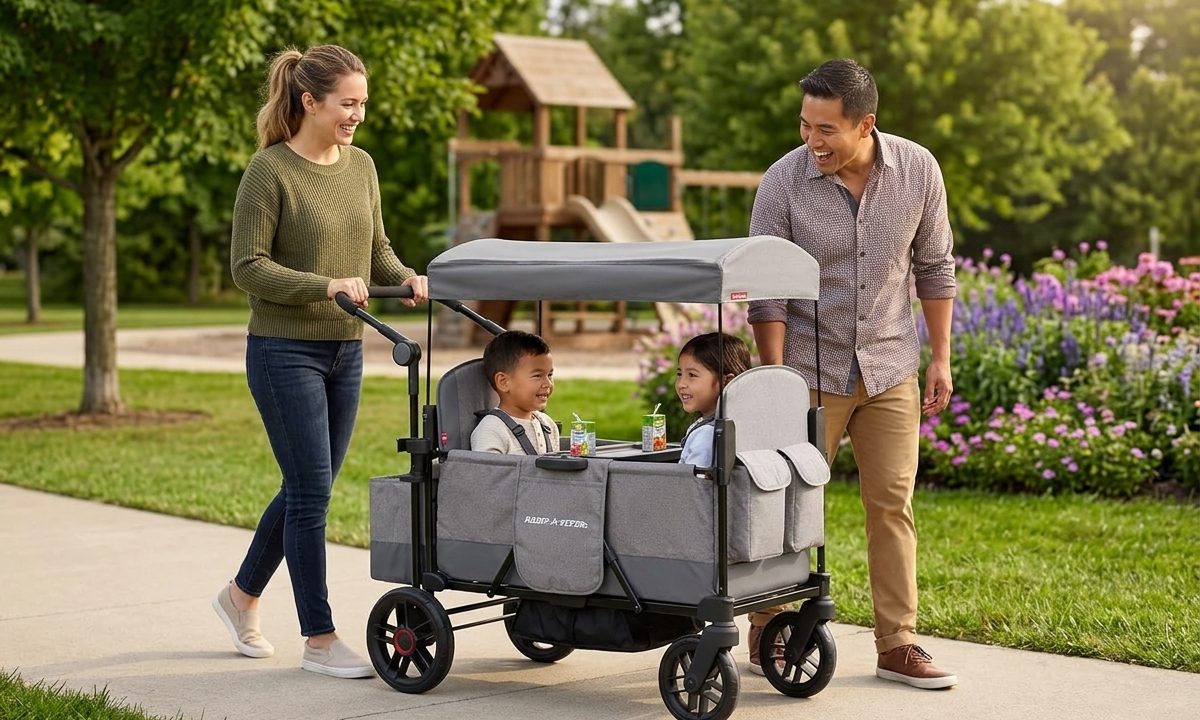
Radio Flyer just launched a second stroller wagon line, and if that sentence made you pause, you’re not the only one. The company already sells the Voya. Now there’s the Pathfinder too — a 2-seat version at $329 and a 4-seat version (called the Pathfinder+) running $369 to $399 depending on the retailer. Both are brand new, both are already getting compared to Wonderfold on TikTok, and both are worth a closer look before you decide which Radio Flyer wagon actually fits your family, because it isn’t obvious from the product pages alone.
The short version: the Pathfinder is Radio Flyer’s more rugged, more stripped-down wagon, built to take a beating rather than pamper anyone. The seats fold flat into a cargo bed, the whole thing folds without removing a single accessory first, and the price undercuts most of the premium end of this category by a wide margin. What you’re not getting is the plush, elevated-seat comfort of the Voya, and you’re buying into a product with barely a season’s worth of real owner feedback behind it.
Two seats or four — the first decision
| Category | Pathfinder 2-Seat | Pathfinder+ 4-Seat |
|---|---|---|
| Price | $329 | $369–$399 (varies by retailer) |
| Weight capacity | 180 lbs | 250 lbs |
| Wagon weight | 33.7 lbs | ~38–39.4 lbs (varies by listing) |
| Wagon + accessories weight | 36.4 lbs | ~42–42.7 lbs |
| Rear suspension | Not specified | Yes |
| Never Fall pull handle | Not specified | Yes |
| Canopy | Full-coverage UV canopy | Full-coverage UV canopy with drop-down mesh sides |
| Minimum age | 6 months (0+ with car seat adapter) | 6 months (0+ with car seat adapter) |
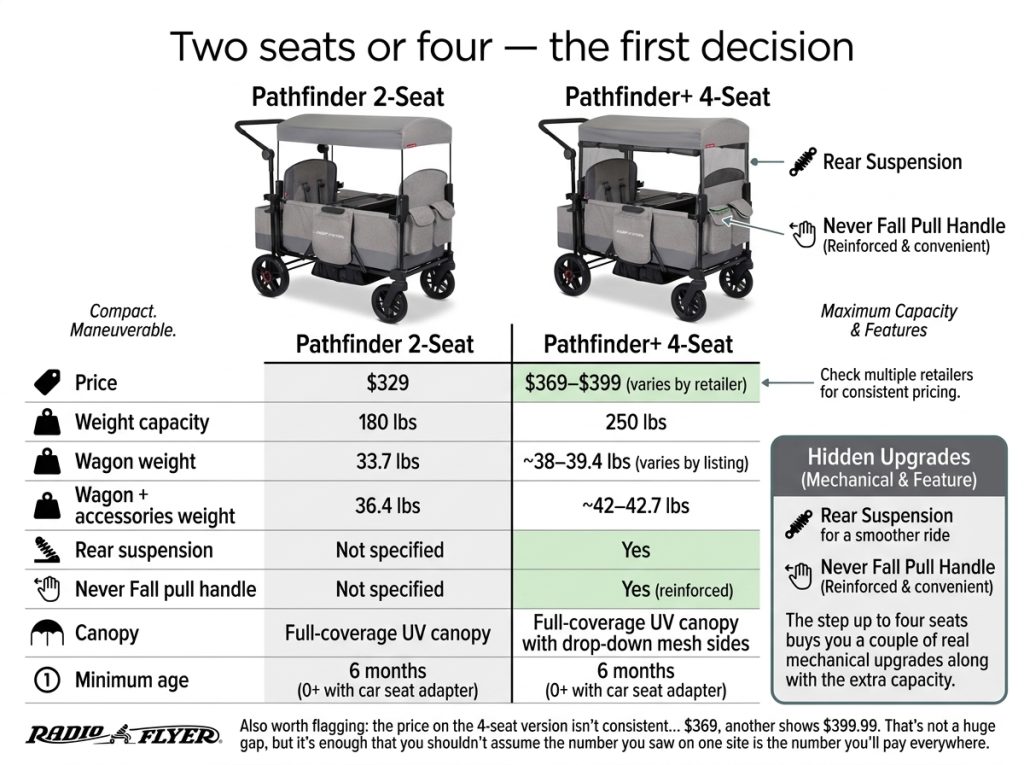
Notice the four-seat version isn’t just a bigger box with more seats — it picks up rear suspension and a reinforced pull handle that the two-seat version’s listing doesn’t mention. If you’re deciding purely on seat count, that’s worth knowing, since it means the step up to four seats buys you a couple of real mechanical upgrades along with the extra capacity.
Also worth flagging: the price on the 4-seat version isn’t consistent across retailers. One listing shows $369, another shows $399.99. That’s not a huge gap, but it’s enough that you shouldn’t assume the number you saw on one site is the number you’ll pay everywhere.
The fold is the actual selling point
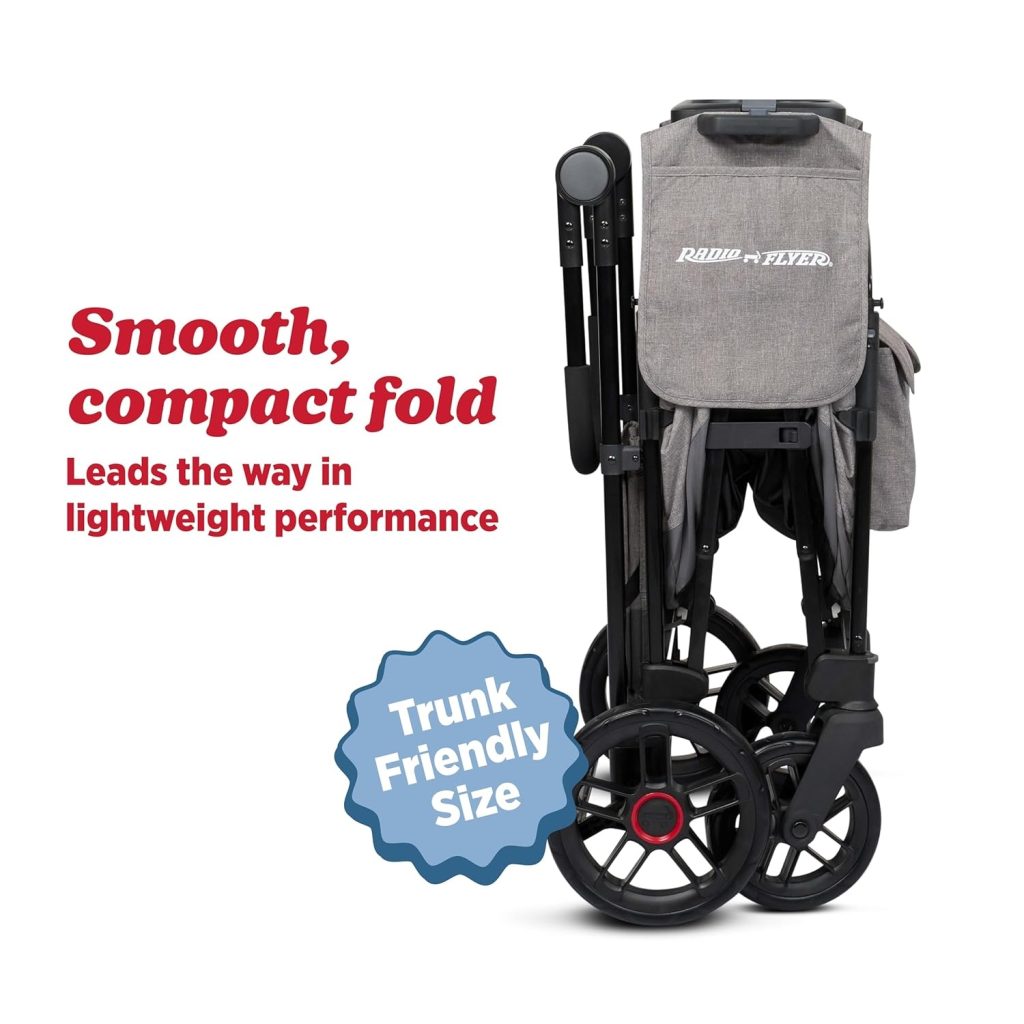
Most wagons in this price range make you choose between a compact fold and keeping your accessories attached. Pull the canopy off, unclip the snack tray, then fold — or don’t bother folding it small and just leave it bulky in the trunk.
Radio Flyer is explicit that the Pathfinder doesn’t require any of that. The canopy, the tray, the storage bag — all of it stays on while the wagon folds down. For even tighter trunk space, all four wheels pop off with a button push, which is a level of compactness a lot of competing wagons don’t offer without full disassembly.
That’s a genuine advantage if you’re folding and unfolding this thing daily rather than storing it in a garage between weekend outings. It’s the kind of detail that sounds minor on a spec sheet and turns out to matter a lot after the first month of actual use.
Seats that turn into a flatbed
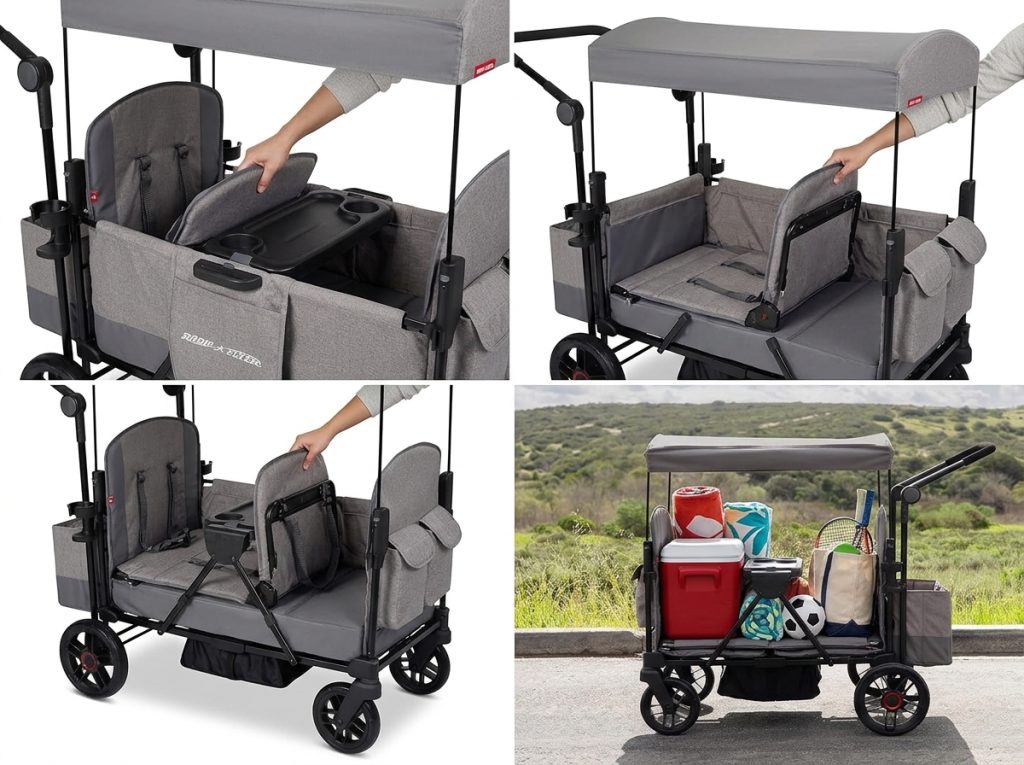
Both versions convert their seats into a flat cargo bed rather than requiring you to remove seats entirely to haul gear. Fold the seat backs down, and you’ve got open space for a cooler, beach bag, or sports equipment instead of two upright benches.
That’s a smarter design than wagons where converting to cargo mode means popping seats out and finding somewhere to store them. Here, the seats just fold into the floor. Less clever, but less hassle too.
Canopy and storage: what’s actually included
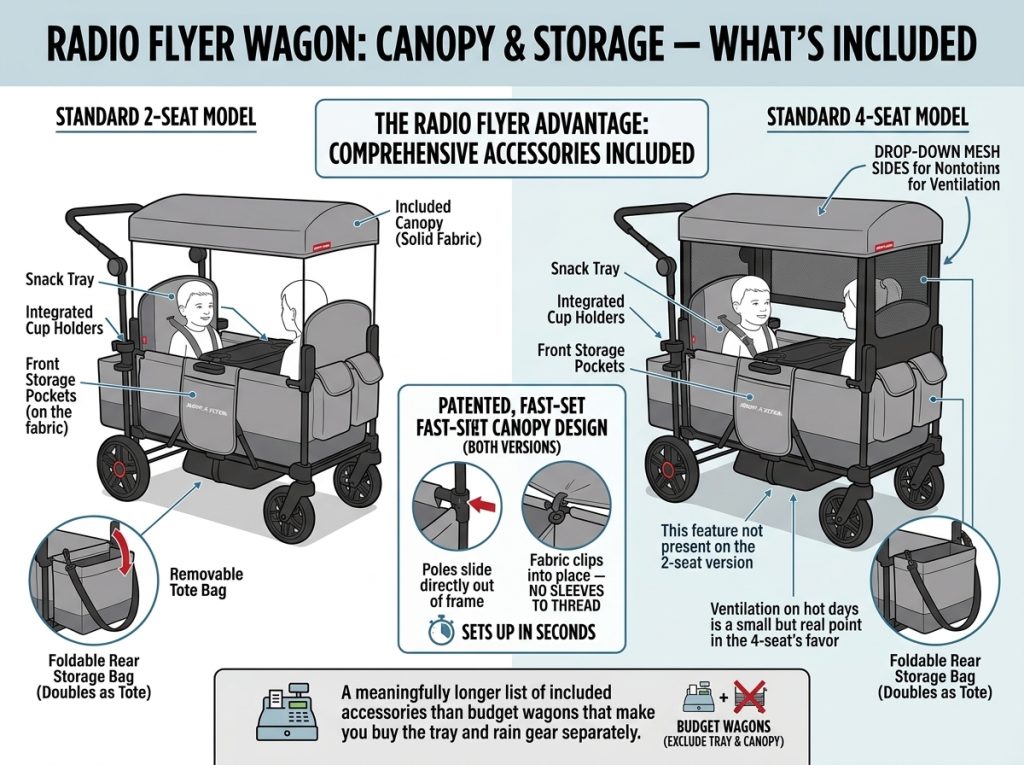
Snack tray, rear storage bag that doubles as a tote when removed, cup holders, front storage pockets — all standard on both versions. That’s a meaningfully longer included-accessory list than budget wagons that make you buy the tray and rain gear separately.
The canopy itself is where Radio Flyer leans on some real engineering rather than a plain fabric dome. The poles slide directly out of the wagon frame, and the fabric clips into place — a setup Radio Flyer describes as a patented design, built to go from folded to shading in seconds rather than requiring you to thread poles through fabric sleeves the way a lot of cheaper canopies work.
The 4-seat version adds drop-down mesh sides to its canopy, which the 2-seat listing doesn’t mention. If ventilation on hot days is a priority and you’re torn between the two sizes, that’s a small but real point in the 4-seat’s favor beyond just extra capacity.
Car seat compatibility
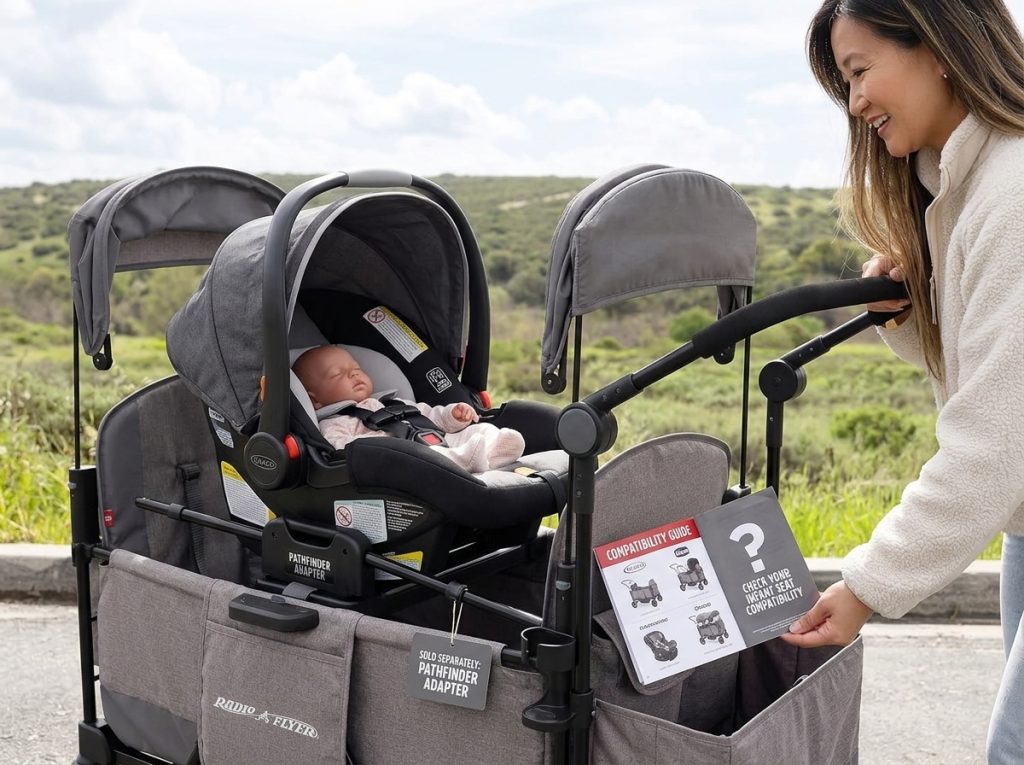
Neither wagon includes a car seat adapter standard — it’s sold separately as the Pathfinder Car Seat Adapter, and it’s what takes the minimum age down from 6 months to newborn. Radio Flyer doesn’t publish a detailed brand-compatibility list the way some competitors do, so if you’re planning to use this from birth, it’s worth confirming your specific infant seat works with the adapter before you buy rather than assuming universal compatibility.
Where this fits next to the Voya
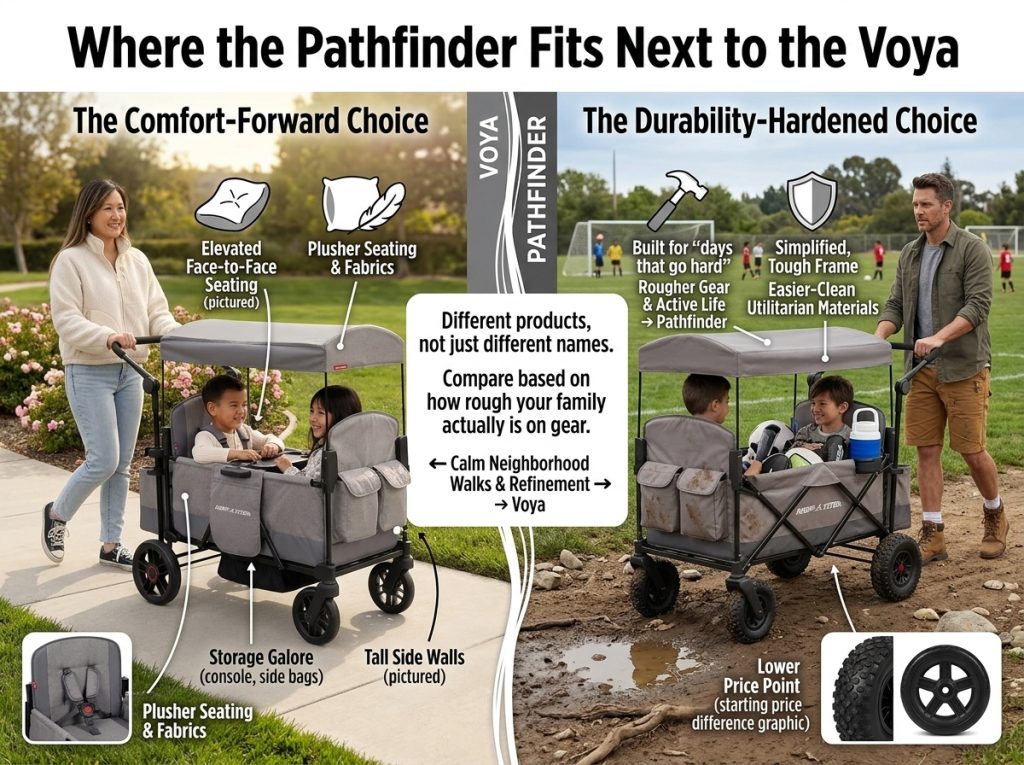
Here’s the part Radio Flyer’s own marketing doesn’t spell out clearly: Pathfinder and Voya aren’t the same wagon with a different name. They’re positioned as genuinely different products within the same brand.
The Voya leans into comfort — elevated, face-to-face seating options, dual canopies on some trims, extra-tall side walls on the XT version, and a starting price around $279 for the base 2-seat model. Our full Radio Flyer Voya review goes deep on that version specifically, including where it beats and loses to the Wonderfold and Veer Cruiser on comfort and price.
The Pathfinder leans into durability — Radio Flyer’s own language describes it as built for “days that go hard,” which reads as marketing until you notice the price gap and the accessory-included fold work in the same direction: less plush, more utilitarian, meant to take abuse rather than baby you through a park outing.
If you’re comparing the two, think of it less as “which is better” and more as “which matches how rough your family actually is on gear.” A family that mostly uses a wagon for calm neighborhood walks might prefer the Voya’s comfort features. A family hauling gear to soccer practice three times a week might get more mileage out of the Pathfinder’s tougher-oriented design and lower price.
The Wonderfold comparisons are already happening

Search for the Pathfinder on TikTok and you’ll find it getting held up against Wonderfold constantly — cheaper, no extra charge for basics like a cup holder, and one creator specifically framing it as the practical alternative to the pricier VW-styled wagon. That’s not a coincidence; Radio Flyer is clearly positioning this line to compete directly with premium wagons on price without matching their sticker.
Whether that comparison holds up over years of use is genuinely unknown right now. Wonderfold has a long track record and a dedicated car seat adapter ecosystem across multiple seat brands. The Pathfinder has a few months on the market and a single adapter option. If you’re weighing the two specifically, our Radio Flyer Voya vs. Wonderfold comparison covers a lot of the same tradeoffs, even though it’s written about Voya rather than Pathfinder — the brand-level differences it covers mostly still apply.
The honest caveat: this is a brand-new product
As of writing, the Pathfinder 2-seat has around 33 reviews on Amazon with a 4.9-star average, and over 100 units sold in the past month — solid early numbers, but a small sample next to wagons that have been on the market for years and have thousands of reviews to draw patterns from. At least one major gear-testing outlet has confirmed it’s still in the process of formally testing the 4-seat Pathfinder+, meaning independent, hands-on comparison data against the rest of the category isn’t fully available yet.
That’s not a reason to avoid it. Radio Flyer isn’t an unknown marketplace brand — it’s been making wagons for over a century, and the standard accessory list and fold design suggest real engineering went into this line rather than a quick rebrand. But it does mean you’re buying slightly ahead of the reviews rather than after them, and long-term durability claims are still unproven simply because the product hasn’t been out long enough to prove them.
Picking between two, four, and everything else
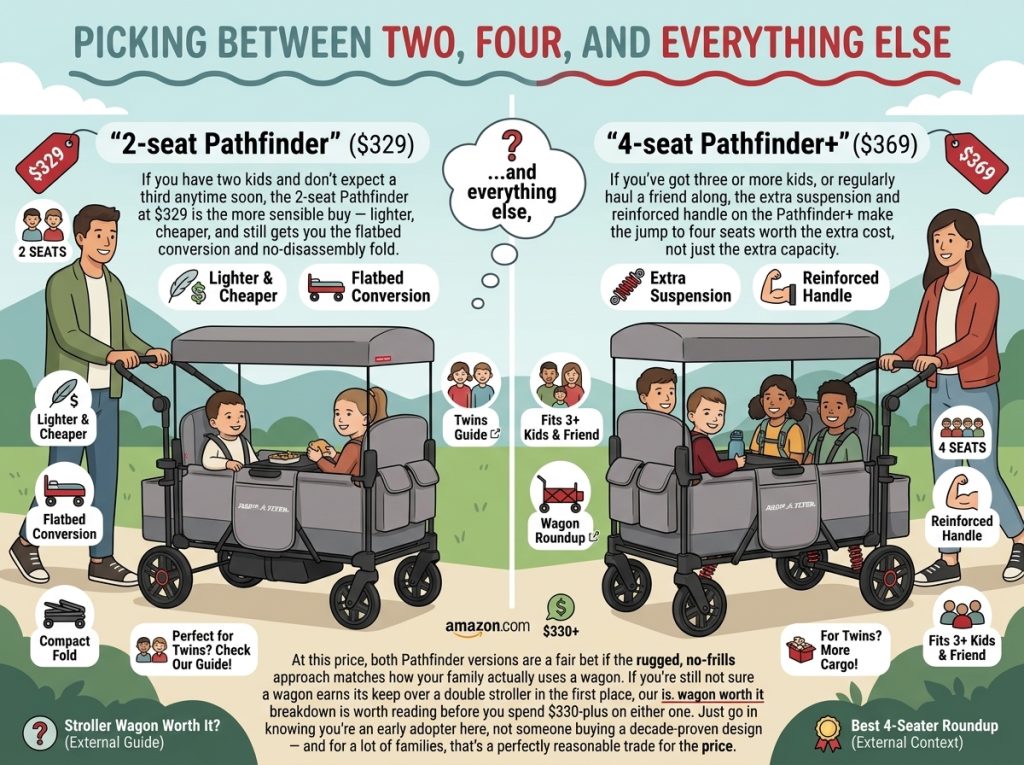
If you have two kids and don’t expect a third anytime soon, the 2-seat Pathfinder at $329 is the more sensible buy — lighter, cheaper, and still gets you the flatbed conversion and no-disassembly fold. If you’ve got three or more kids, or regularly haul a friend along, the extra suspension and reinforced handle on the Pathfinder+ make the jump to four seats worth the extra cost, not just the extra capacity. For twins specifically, either size works depending on how much cargo space you need alongside the kids — our best stroller wagon for twins guide is worth a look if you’re trying to decide between a 2-seat and 4-seat setup for that exact situation, and our best 4-seater wagon stroller roundup puts the Pathfinder+ in context against other big wagons if capacity is your main concern.
At this price, both Pathfinder versions are a fair bet if the rugged, no-frills approach matches how your family actually uses a wagon. If you’re still not sure a wagon earns its keep over a double stroller in the first place, our is a stroller wagon worth it breakdown is worth reading before you spend $330-plus on either one. Just go in knowing you’re an early adopter here, not someone buying a decade-proven design — and for a lot of families, that’s a perfectly reasonable trade for the price.

Related guides & reviews
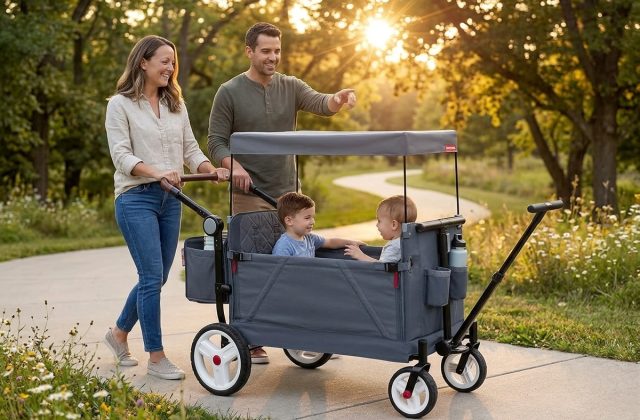
Radio Flyer Odyssey Stroll ‘N Wagon Review (2026)
The Odyssey is Radio Flyer’s push-pull wagon built for two kids sitting bench-style rather than in individual bucket…

Momcozy ChangeGo Review (2026): Can It Really Replace a Stroller & Wagon?
Quick clarification before anything else, because this trips people up when they land here from a wagon search:…

Evenflo Shyft Rideshare All-Terrain Performance Stroller Wagon Review (2026)
The Shyft Rideshare is a genuinely capable 2-kid, all-terrain wagon with real suspension and urethane wheels that hold…
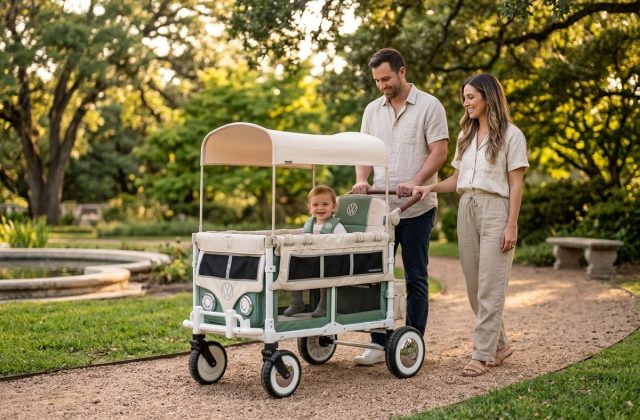
WonderFold VW4 Volkswagen Special Edition Review (2026)
If you just want the short answer: the VW4 is a genuine WonderFold W4 Luxe underneath a Volkswagen…