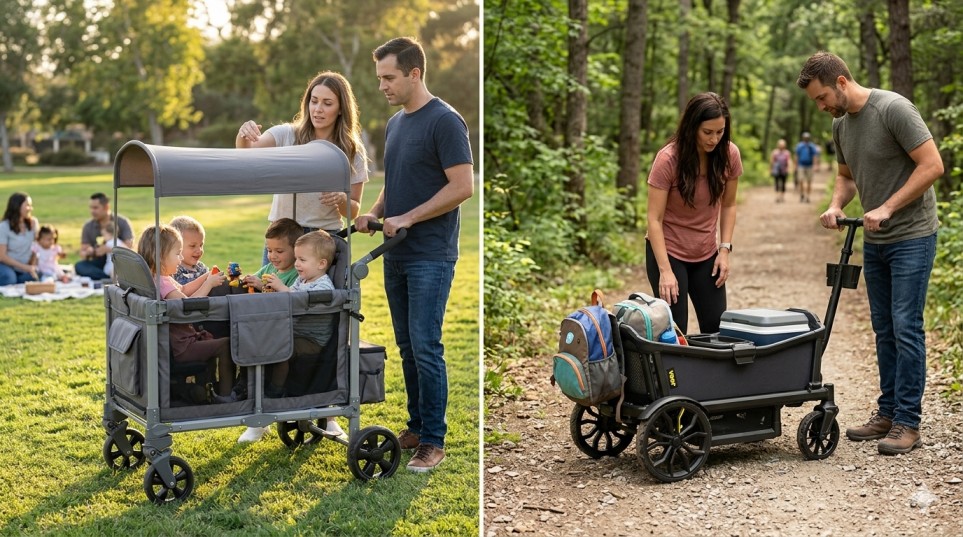
That’s the actual divide between these two, and once you see it, the whole decision gets a lot simpler.
Both the Wonderfold W series and the Veer Cruiser sit at the top of the stroller wagon market. Both cost real money. Both have loyal fans who swear by them. But they’re solving different problems — and most reviews dance around that instead of just saying it outright.
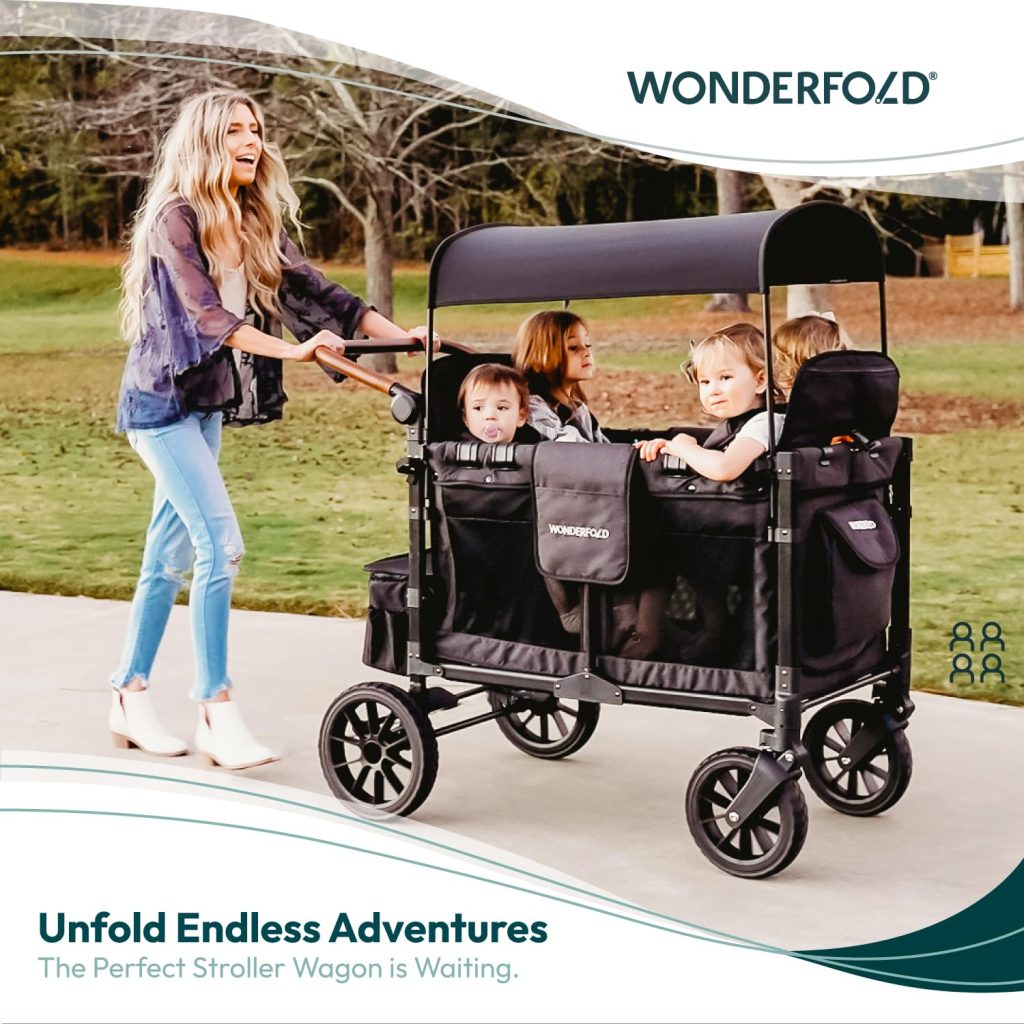
If you want a wagon your kids will love being in, get the Wonderfold. If you want a wagon you can actually go places with, get the Veer. That’s the headline. Everything below explains why.
The Steering Problem Nobody Warns You About
Let’s start with what the polished product listings don’t mention.
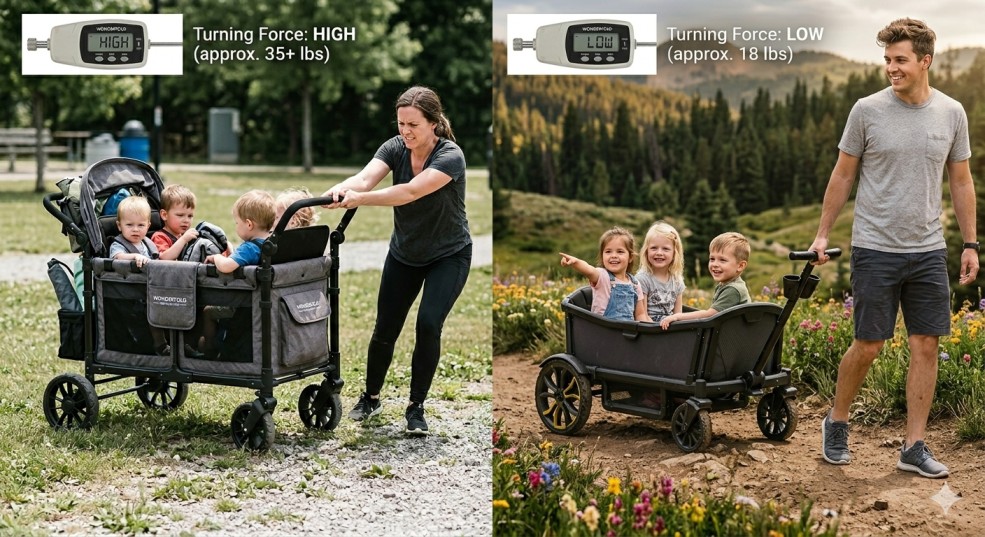
The Wonderfold W4 — the most popular 4-seater, currently priced around $659–$899 depending on the trim level — is notoriously hard to maneuver once it’s loaded. KidTravel.org, which ran 65 individual tests across 11 different stroller wagons, measured the turning force required for each wagon from a dead stop. The Wonderfold W4 required significantly more force than almost every other wagon tested. The best wagons in that test needed 13–22 lbs of force for a 90-degree turn. The Wonderfold needed considerably more.
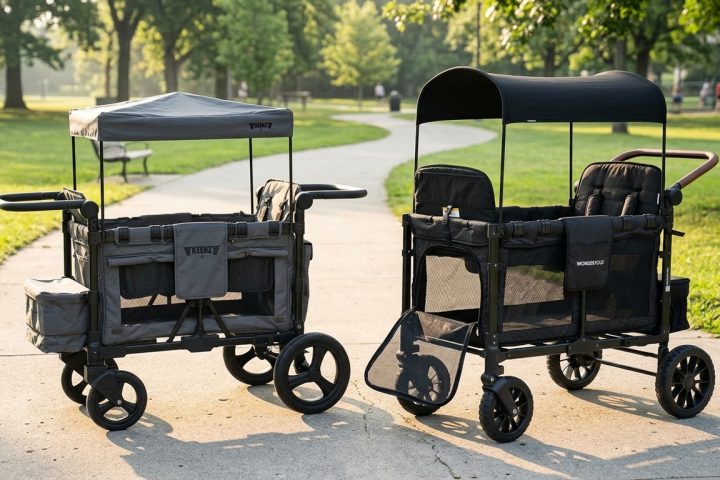
The wheels are a big part of why. The Wonderfold’s rear wheels measure 9.5 inches, while the Veer’s front wheels are 12 inches. On the Veer, the larger wheels sit up front, helping the wagon roll over obstacles instead of pushing into them.
That wheel placement creates a major difference between a wagon that handles bumps smoothly and one that struggles when the terrain gets rough.
The honest version: If your life involves grassy parks, gravel paths, hills,
uneven pavement, or crowded outdoor spaces, the Wonderfold will require more effort to push.
For mostly straight, smooth sidewalks and paved paths, it performs just fine.
The Veer’s steering has its own quirk worth knowing: the swivel wheels are in the rear, not the front. That’s counterintuitive compared to a traditional stroller or shopping cart, and it does have a learning curve. Most parents report getting comfortable with it within a few outings, but if you test-drive both wagons back to back in a store, the Wonderfold’s front-swivel setup will initially feel more familiar. Don’t let that fool you.
What the Wonderfold Does Better (And It’s Not Nothing)
Kids actually want to be in the Wonderfold. That matters more than people give it credit for.
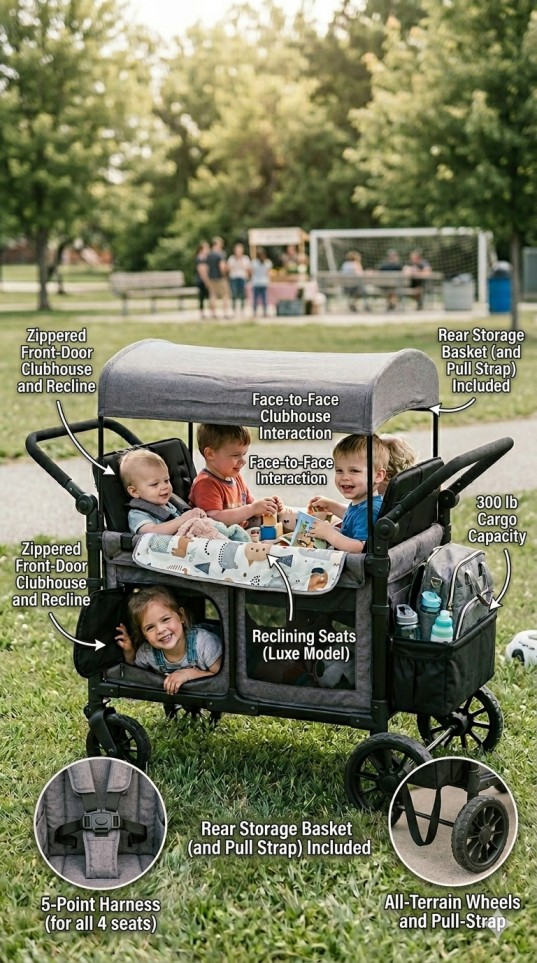
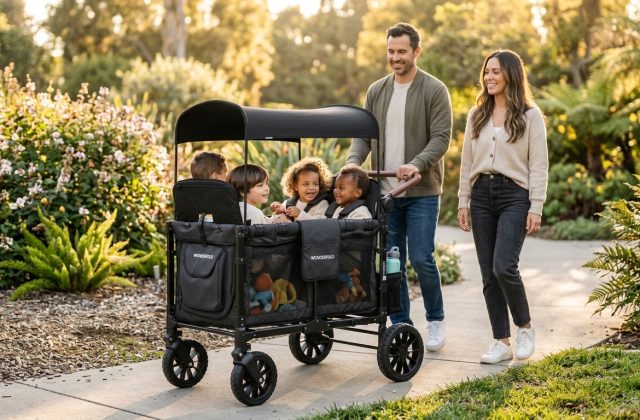
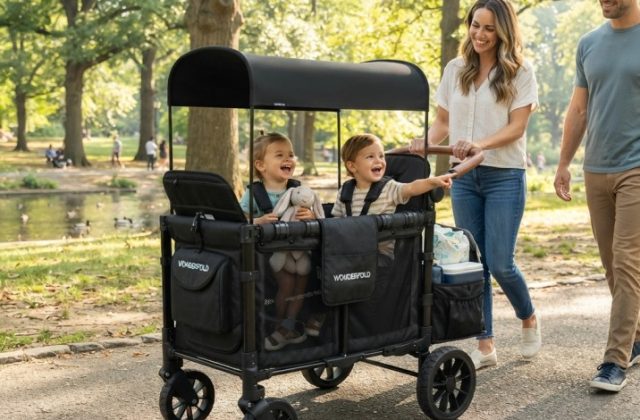
The W4’s high-backed seats, face-to-face configuration, and zippered front door make it feel like a little clubhouse. The rear zipper entry on most W-series models means kids can climb in and out independently, which is a genuine daily-life win. The interior is roomy enough that a toddler can nap, recline, and spread out. The W4 Luxe has reclining seatbacks, and even the base model has enough interior space that siblings aren’t constantly elbowing each other.
The Wonderfold also has a 300 lb cargo capacity, same as the Veer, and comes more complete out of the box. Where the Veer Cruiser XL ships without a canopy or storage basket (those are add-ons), the W4 Luxe includes a canopy, detachable rear basket, pull strap, and 5-point harness seats in the base price. That matters when you start running the real numbers on cost.
For families who need 4 seats and plan to use the wagon primarily at soccer games, farmers markets, zoo trips, and neighborhood walks — meaning mostly pavement or manicured grass — the Wonderfold W4 is hard to argue against. It seats more kids than the standard Veer Cruiser (which holds 2), it’s genuinely fun for kids to ride in, and the all-in price can be competitive once you tally up Veer’s add-on costs.
The Veer’s Real Advantage (It’s Not the All-Terrain Marketing)
Yes, the Veer handles terrain better. That’s real and documented. But the terrain story undersells what the Veer is actually good at.
The Veer Cruiser weighs roughly 26 lbs less than the W4 Luxe before you add accessories to either — and even accounting for the canopy and basket you’ll need to add separately, it’s still meaningfully lighter to push. It folds quickly. KidTravel clocked unboxing and assembly at 13 minutes, one of the fastest in their test group. And it loads into a car trunk without requiring a production.
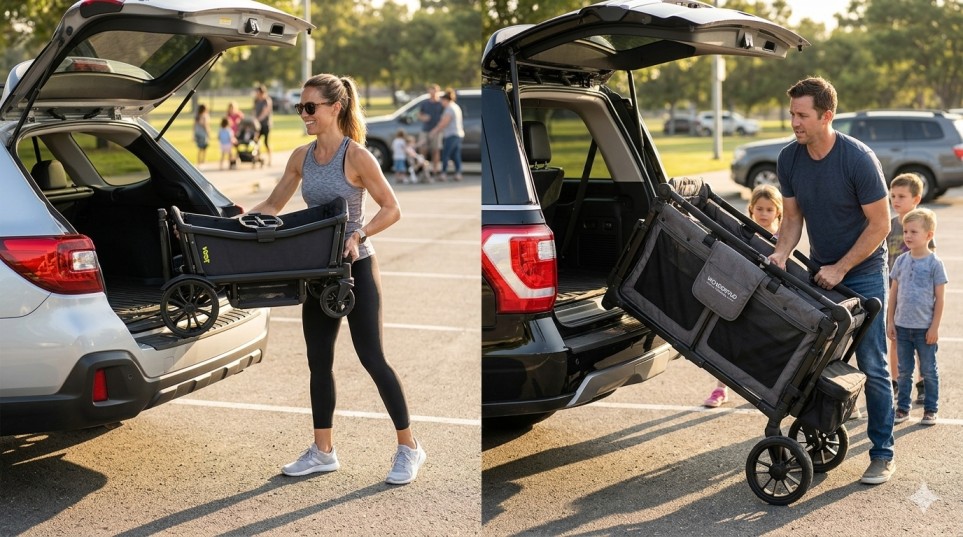
This is the part that doesn’t make headlines but will matter to you every single day: the Veer is easier to live with. Not just to push, but to fold, load, unload, store, and reassemble in a parking lot with two kids waiting. The Wonderfold W4’s fold is functional but bulky, and its fixed handlebar position (set higher, designed for pulling) makes navigating it while pushing through crowds noticeably more work.
At $699–$799 for the base Veer Cruiser before accessories, you’re paying a real premium. Add the canopy ($149), storage basket ($89), and maybe the nap system if you have an infant, and you’re approaching $950 for a 2-seater. That’s genuinely hard to defend if you have three or four kids who all want to ride.
The Veer Cruiser XL seats up to 4 children (at 55 lbs per seat), but the seating is lower and more open than the Wonderfold’s enclosed cabin-style setup. Kids in the Veer are more exposed to the elements unless you’ve bought the canopy. And the 3-point harness that comes standard on the XL is less secure than the Wonderfold’s 5-point harness — you’d need to buy comfort seats separately to get 5-point straps.
A Comparison Worth Actually Looking At
| Veer Cruiser XL | Wonderfold W4 Luxe | |
|---|---|---|
| Base price | ~$799 | ~$899 |
| Max passengers | 4 (55 lbs/seat) | 4 (99 lbs/bench) |
| Weight (wagon only) | ~37 lbs | ~63 lbs |
| Canopy included | No (add ~$149) | Yes |
| Storage basket | No (add ~$89) | Yes |
| Harness | 3-point (5-point sold separately) | 5-point standard |
| Terrain performance | Excellent | Flat surfaces only |
| Fold speed | Fast | Moderate |
| Interior feel for kids | Open, exposed | Enclosed, cozy |
| Fully-equipped cost | ~$1,000–1,100 | ~$899 |
Prices based on current retail listings as of 2025; always verify before purchase.

Veer Cruiser Generation Stroller Wagon
The Veer Cruiser Generation Stroller Wagon blends premium stroller comfort with rugged wagon-style performance. Designed for active families, it offers a durable build, smooth all-terrain handling, and a compact fold for easier everyday adventures.
- All-terrain wheels for parks, trails, and outdoor use
- Lightweight collapsible design for easy transport
- Strong frame built for daily family adventures
- Comfortable seating with flexible configurations
- Storage space for kids’ essentials and accessories
*As an Amazon Associate, we may earn from qualifying purchases.
The Accessories Trap
This is the thing most articles skip past: the Veer’s sticker price is misleading.
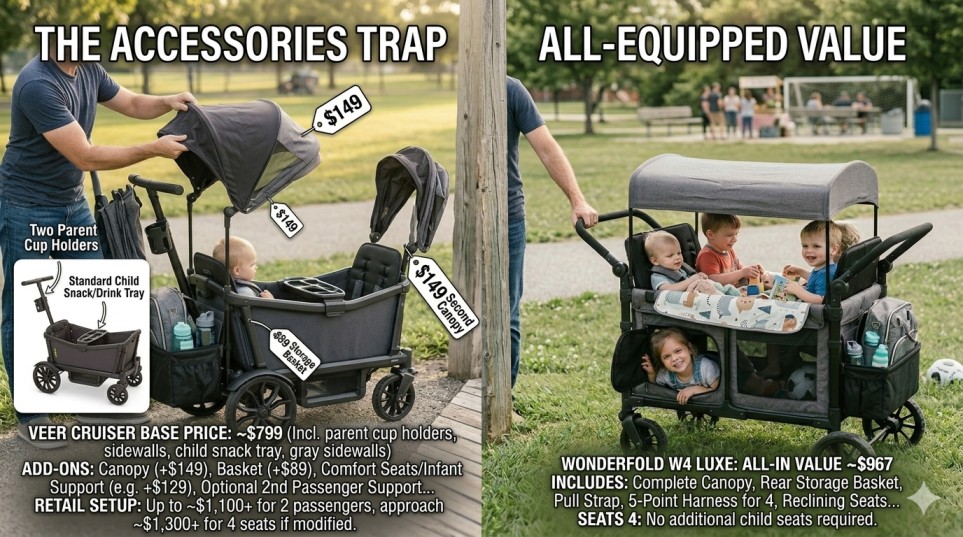
Veer’s base Cruiser comes with the wagon, two parent cup holders, gray sidewalls, and a child snack/drink tray. No canopy. No storage basket. Those are sold separately, and they’re not cheap — the canopy runs about $149, the basket around $89, and if you want a second canopy for a second passenger row, you’re buying another one. The “Essentials Bundle” that combines the Cruiser XL, basket, and canopy retails for about $967.
For that same ~$967, the Wonderfold W4 Luxe is already fully equipped and seats four. The math is uncomfortable.
That said: if you genuinely only need two seats and your family spends a lot of time on trails, beach boardwalks, or uneven terrain, the Veer is worth the premium. You’re paying for real engineering and a significantly better wheel-and-chassis setup. The quality difference is noticeable in-person. But be honest about whether you’ll actually use it that way.
What Most Articles Get Wrong About This Comparison
Most Veer vs. Wonderfold content frames this as “premium outdoor wagon vs. value family wagon.” That framing makes the Veer sound like the obviously correct choice for any serious family, which isn’t accurate.
The Veer is better on terrain. It’s also better for families with one or two younger children who need a wagon for varied environments. But the Wonderfold W4 isn’t a budget compromise — it’s a genuinely different product optimized for seating capacity, kid enjoyment, and all-in cost. For a family with three or four kids who mainly go to the zoo, parks, and school events, the Wonderfold may be the smarter buy, not the consolation prize.
Maybe I’m wrong about this, but I think the outdoor-adventure framing for the Veer is slightly aspirational for most buyers. The majority of stroller wagon usage is sidewalks, parks, and event venues — not trails. If that’s your reality, the Wonderfold’s limitations matter less and its advantages matter more.

WONDERFOLD Luxe Stroller Wagon
The WONDERFOLD Luxe Stroller Wagon combines premium comfort with wagon-style versatility. Designed for families who want extra space and a smoother ride, it offers a durable build, convenient storage, and a comfortable setup for everyday adventures.
- Spacious multi-seat wagon design for families
- Premium materials with durable construction
- All-terrain wheels for outdoor mobility
- Extra storage space for bags and accessories
- Foldable design for easier transport and storage
*As an Amazon Associate, we may earn from qualifying purchases.
One More Thing About Longevity
The Veer’s modularity extends its life in a way the Wonderfold can’t quite match. As kids get older and transition out of the harness-and-canopy stage, the Veer can adapt — different seat configurations, add-on accessories, and a chassis that holds up unusually well over years of use. Veer’s customer service is also notably responsive; KidTravel recorded a 7-minute email response time in their testing.
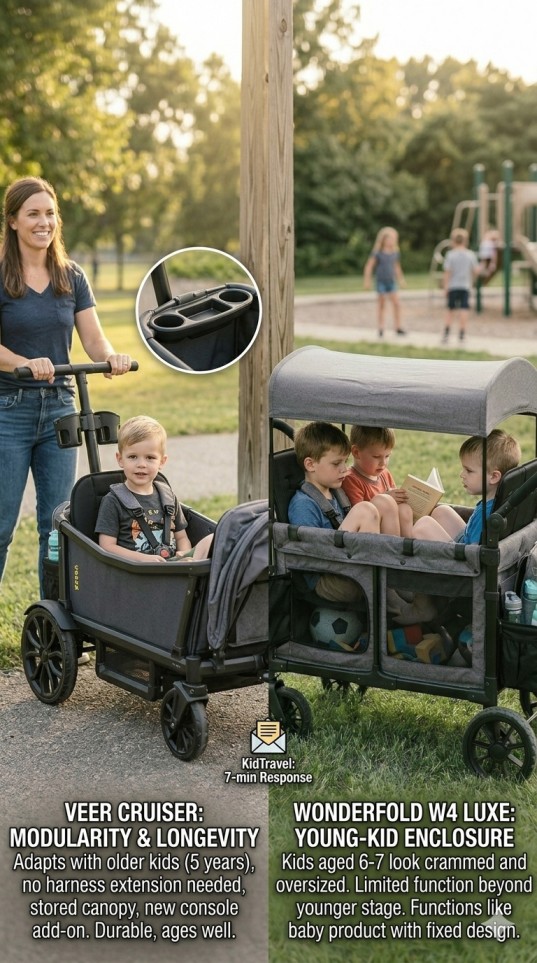
The Wonderfold’s fabric interior and enclosed design make it genuinely fun for younger kids, but that same design means it functions more like a traditional baby product with a limited window. Once kids are big enough to not want to sit in an enclosed box, the Wonderfold becomes less useful faster.
Neither of these things should be dealbreakers. But if you’re buying one of these and thinking about how long it’ll stay in rotation, the Veer tends to age better.
The decision really does come down to your terrain, your headcount, and your honest budget. If you’re pushing four kids on flat ground and need something that’s ready to go out of the box: Wonderfold W4. If you’re pushing one or two kids across varied environments and want something that will fold fast, handle hills, and last through multiple years of real use: Veer Cruiser. Neither one is wrong. They’re just different tools for families who live differently.