Most stroller wagon reviews start by telling you this is the era of the stroller wagon. They mention Wonderfold. They show you a price comparison table. Then they spend eight hundred words carefully not committing to anything.
I’m going to do something different. My verdict is this: the Radio Flyer Voya is the most underrated stroller wagon on the market right now. Not because it outperforms the Wonderfold W4 or the Veer Cruiser on raw specs. It doesn’t. But for families who just need something that works — pushes smoothly, folds without a physics degree, and doesn’t cost six hundred dollars before accessories — it hits a sweet spot that very few stroller wagons at this price point can match.
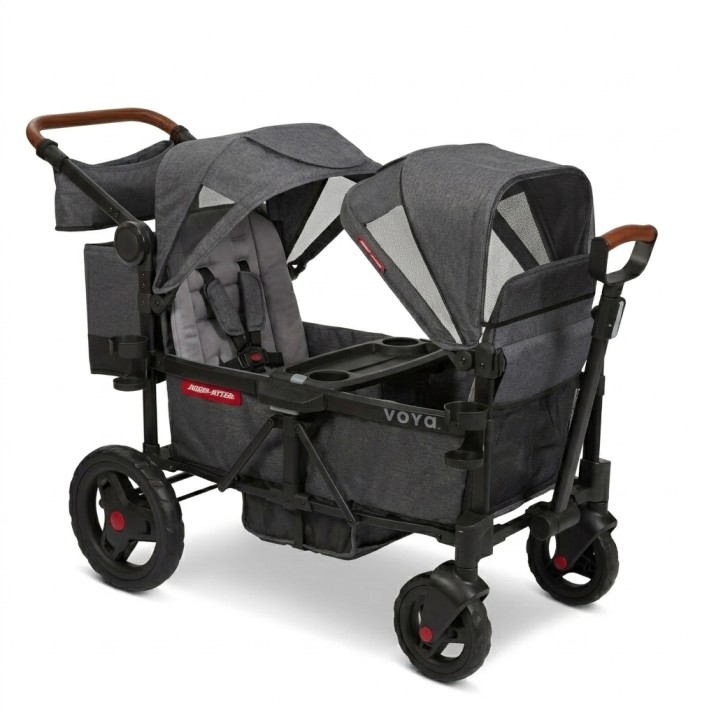
The base Voya 2-seater starts at $279. That’s the number I want you to hold onto as you read this.
How the Voya Line Actually Works — Before You Get Confused
Radio Flyer’s naming can trip you up at first. Let me break it down simply, because I’ve seen people buy the wrong model after getting confused on the product page.
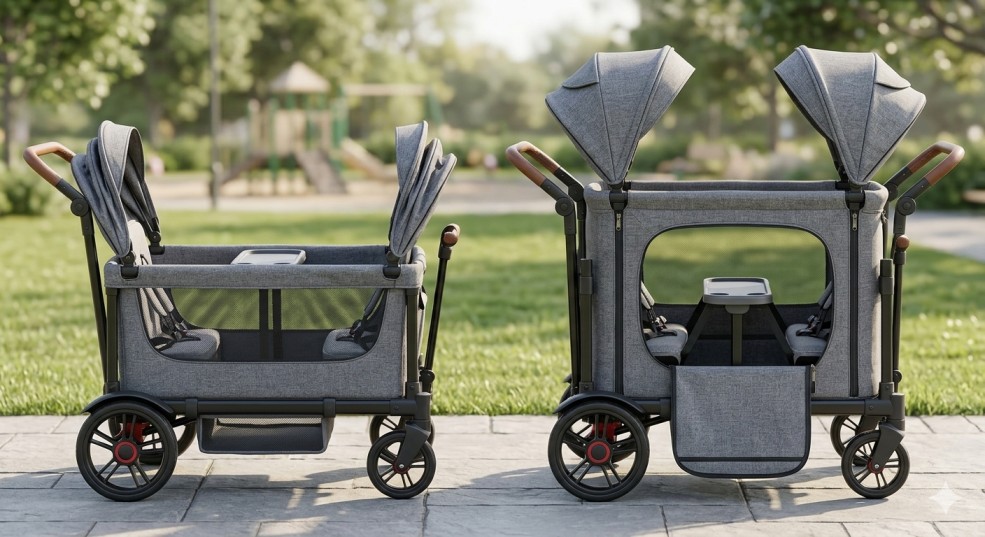
Voya (standard, 2-seat): Lower sidewalls, easier for kids to climb in and out independently, lower starting price ($279). The footwell has a recessed area where feet go, so the floor isn’t completely flat.
Voya XT (extra-tall, 2-seat): Taller sidewalls, flat floor, more interior storage space, zip-open side for entry, vegan leather handle grip. Starts around $499. The XT stands for Extra Tall — that’s the only meaningful difference.
Voya Quad (4-seat, standard): Same concept, four padded seats, weight capacity up to 250 lbs.
Voya XT Quad (4-seat, extra-tall): The top of the line, 300 lb weight capacity, zippered side doors, up to $599.99.
| Quick note on the Voya 2.0: Radio Flyer has been refreshing its lineup. Some listings reference ‘Voya 2.0’ — this reflects updated materials and refinements to the original Voya design, not a completely new product. Core specs and features remain consistent with what’s described here. |
For the purposes of this review, I’m focusing primarily on the standard 2-seat Voya (the most-purchased version) with notes on where the XT version meaningfully differs. If you’re a family of four kids looking at the Quad, most of this applies to you too — just with double the seats and a higher price.
The Thing That Makes the Voya Different from Cheaper Radio Flyer Wagons
Radio Flyer also makes a bunch of lower-priced folding wagons — the Convertible Stroll ‘N Wagon, the Adventure version — that run anywhere from $89 to $180. Those are a different category. Good products, but not what we’re talking about.
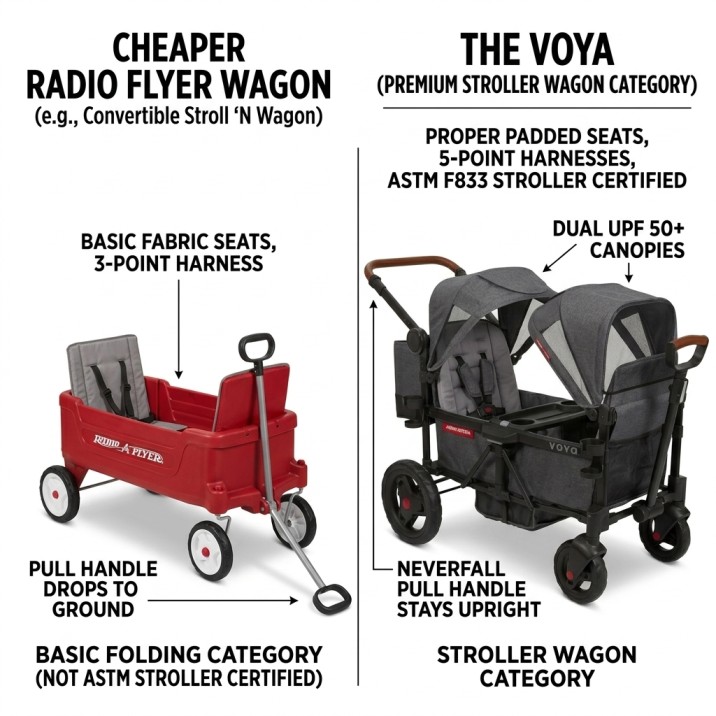
The Voya is Radio Flyer’s answer to the Wonderfold and Veer Cruiser category. It has proper padded seats with 5-point harnesses, ASTM F833 stroller certification, dual UPF 50+ canopies, and a fold that doesn’t require removing anything. That’s the line between a basic folding wagon and a stroller wagon replacement.
The NeverFall pull handle is one small detail that matters more than it sounds. On most pull wagons, the handle drops to the ground when you’re pushing. You either trip over it or have to stop and deal with it. Radio Flyer engineered the NeverFall to stay upright on its own. After a long day at the park, that’s less annoying than it sounds on paper.
Quick Specs Reference
| Spec | Details |
| Model Variants | Voya (2-seat, standard), Voya XT (2-seat, tall), Voya Quad (4-seat), Voya XT Quad (4-seat, tall) |
| Price Range | $279 – $599.99 (as of 2025) |
| Weight Capacity | 120 lbs (Voya 2-seat) / 200 lbs (Voya XT) / 250 lbs (Quad) / 300 lbs (XT Quad) |
| Frame Material | Lightweight aluminum |
| Safety Certification | ASTM F833 Stroller Standard |
| Seating | Padded seats with 5-point safety harnesses |
| Canopy | Dual UPF 50+ extendable canopies with mesh peek-a-boo windows |
| Handles | NeverFall pull handle + height-adjustable push handlebar (vegan leather grip) |
| Fold | Compact fold — no need to remove seats, canopies, or snack tray |
| Storage | XL rear storage bag, parent caddy, mesh interior pockets, snack tray with cupholders |
| Age Suitability | 6+ months (with car seat adapter accessory for younger infants) |
| Brake | Rear parking brake |
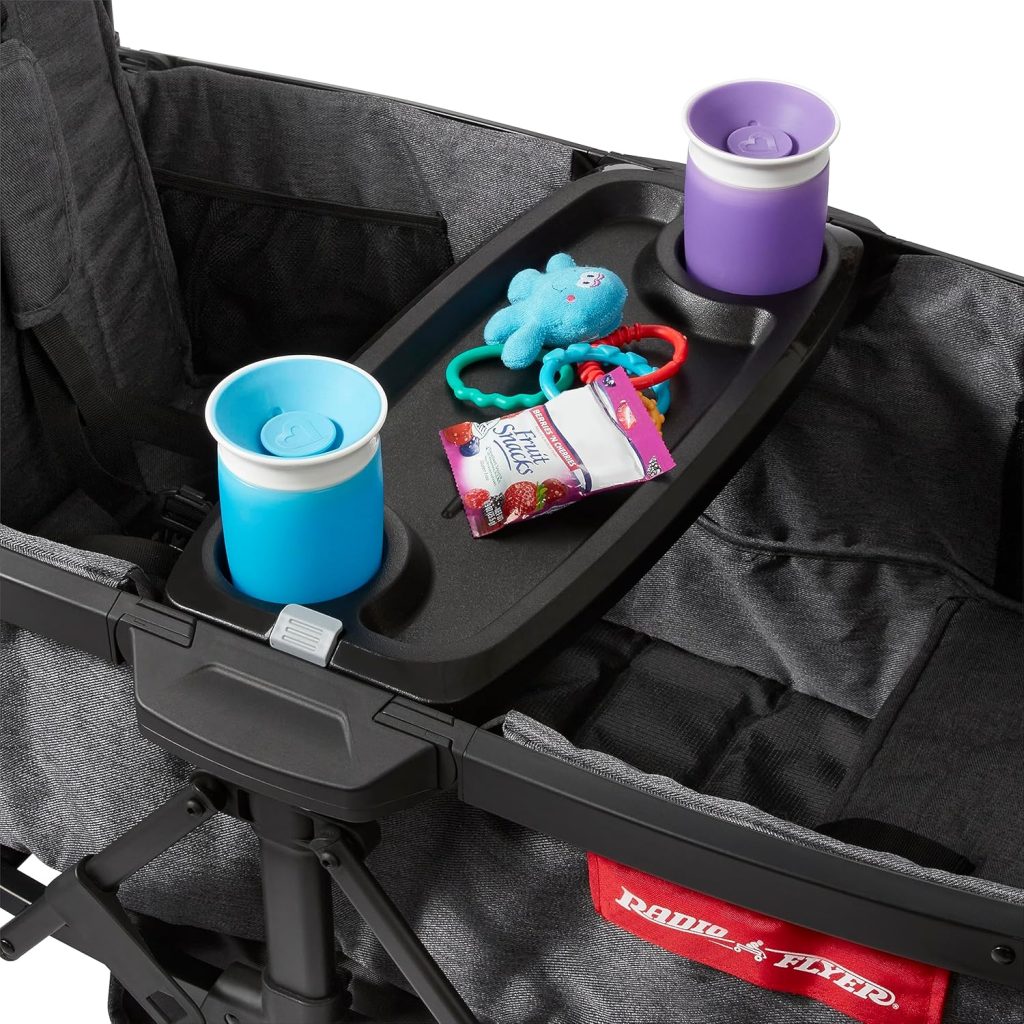
| Accessories Included | Snack tray, storage bag, cupholders (rain cover sold separately at $49.99) |
| Company | Radio Flyer (Certified B Corp) |
Pushing and Pulling: Where the Voya Actually Earns Its Keep
The push/pull dual capability is genuinely useful, and I want to explain why in concrete terms rather than just saying ‘versatility.’
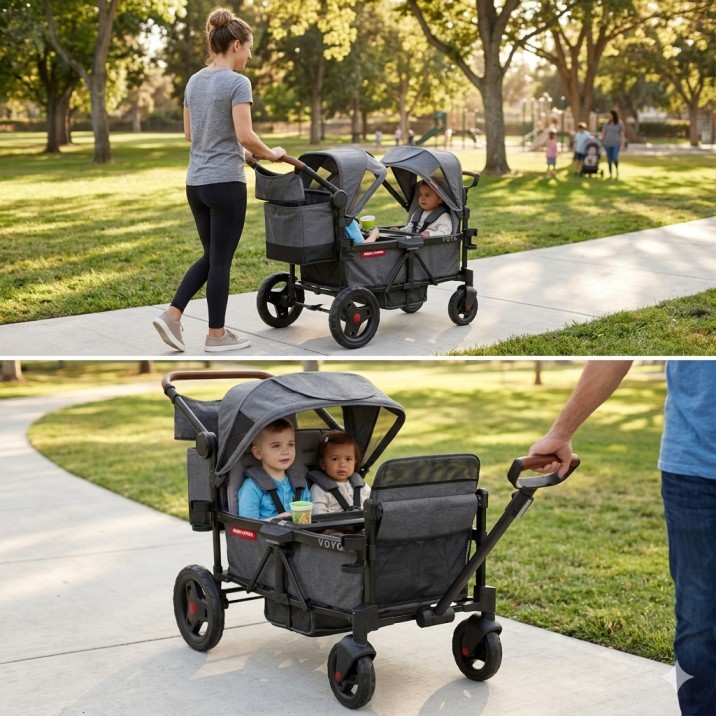
When you’re pushing on flat sidewalk, the push handlebar — which adjusts for height — makes this feel more like a stroller. It’s narrower than a wagon when viewed from the front, and you can navigate grocery store aisles and tighter park paths with it. One parent in a Reddit thread on r/Mommit described getting a Radio Flyer after a day at the zoo pulling a wagon: ‘getting the one with the push bar was an absolute necessity.’ That hits exactly right. Pull handles make sense when you’re strolling casually and want the kids facing outward. After an hour uphill, you want to push.
The height-adjustable push handlebar accommodates parents up to about 6’3″ without awkward hunching. That’s worth checking if you or your partner is tall — some stroller wagons in this category force taller parents into an uncomfortable forward lean.
The trade-off: the Voya’s maneuverability on uneven terrain is decent but not exceptional. The wheels roll fine on grass and light gravel. If you’re regularly doing serious off-road trails, sandy beaches, or terrain where you need real suspension, you’d want to look at a more purpose-built option. I’d call it parks-and-sidewalks capable, not trail-ready.
For true off-road outings, you might want to compare it against something like the Veer Cruiser, which handles rougher terrain better but at a significantly higher price point.
The Fold: Genuinely One of the Better Ones
I’ve used enough of these to know that ‘folds easily’ is meaningless marketing language 80% of the time. With the Voya, it actually means something.
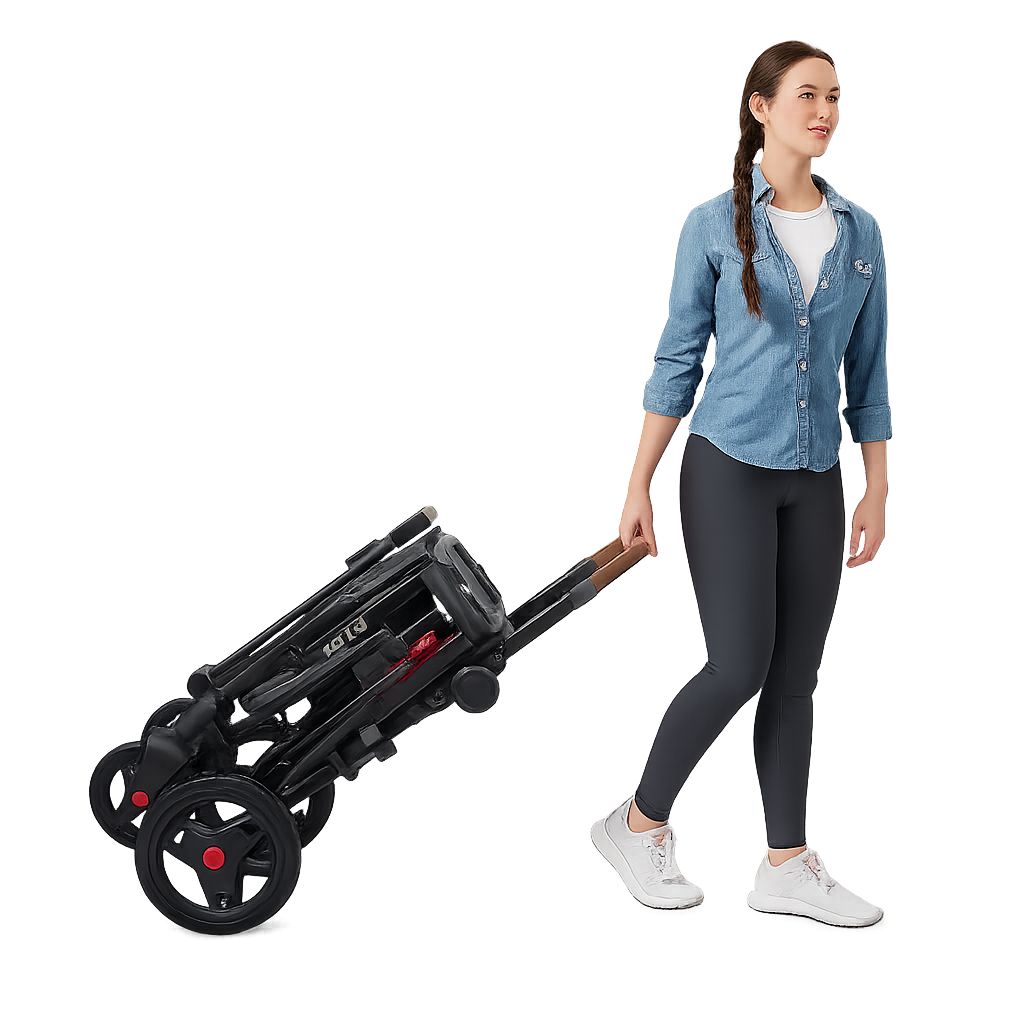
You don’t remove the seats. You don’t remove the canopies. You don’t remove the snack tray. You fold it. It fits in the trunk of a compact car — one family noted it fits fine in a Chrysler Pacifica — without a 10-step takedown ritual every time you leave the park. That distinction is more important than it seems when you’re doing this multiple times a day.
Compare that to some wagons where the fold requires pulling out inserts and stacking them separately — a common frustration with certain 4-seat models — and you understand why this matters.
The aluminum frame keeps the assembled wagon reasonably light compared to steel-frame alternatives, though ‘lightweight’ is relative. You’re still lifting a wagon, not a stroller. Worth keeping that in mind if trunk loading is a physical challenge for you.
Standard vs. XT: Which One to Actually Buy
This is where most reviews skip over the real decision. Let me save you the back-and-forth.
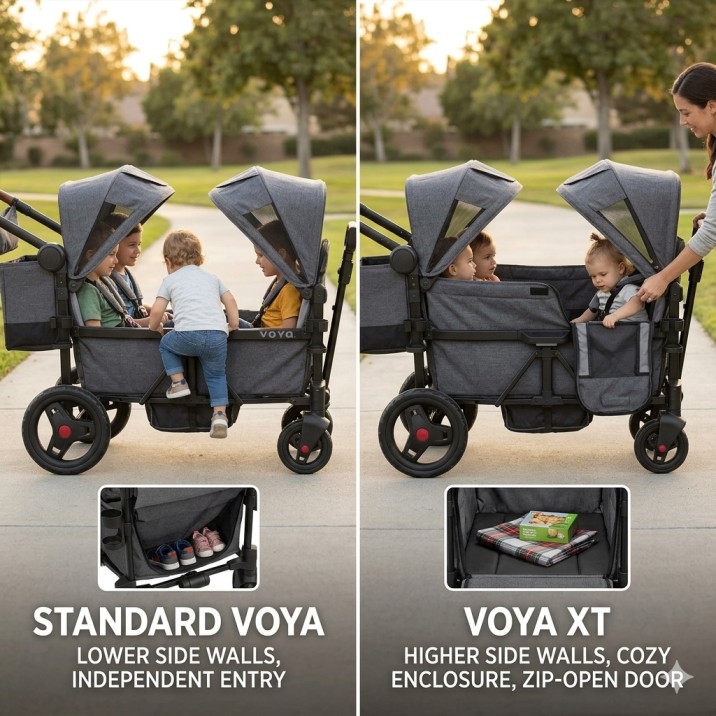
The standard Voya’s lower side walls are what allow kids to climb in and out independently. For a 3 or 4 year old who has opinions about everything, that matters. My kids wanted to climb in themselves by around 2.5 years old and the low sides made that possible without me lifting them every single time.
The XT’s higher walls offer more containment and slightly more of a cozy-enclosed feeling — some kids settle down more when they can’t see quite as much of the world around them, weirdly enough. The zip-open side door is the XT’s smart solution to the entry problem. It works well. The flat floor also means you can lay things flat in the footwell without them sliding into a recessed area.
| If your kids are still being lifted in and out (under 18 months, or just not climbers yet), the XT makes more sense. If your kids want independence and you want a lower price, the standard Voya. |
There’s also a storage difference that nobody emphasizes enough. The XT has more usable floor space precisely because the bottom is flat. If you’re loading gear under or around the kids, the XT wins. If it’s just two kids and a snack bag, the standard is fine.
What People on Reddit Actually Say — The Unfiltered Version
I spent time going through the Reddit thread compilations on the Voya (r/Preschoolers, r/Mommit, r/Parenting), and the picture that emerges is more nuanced than the product page would suggest.
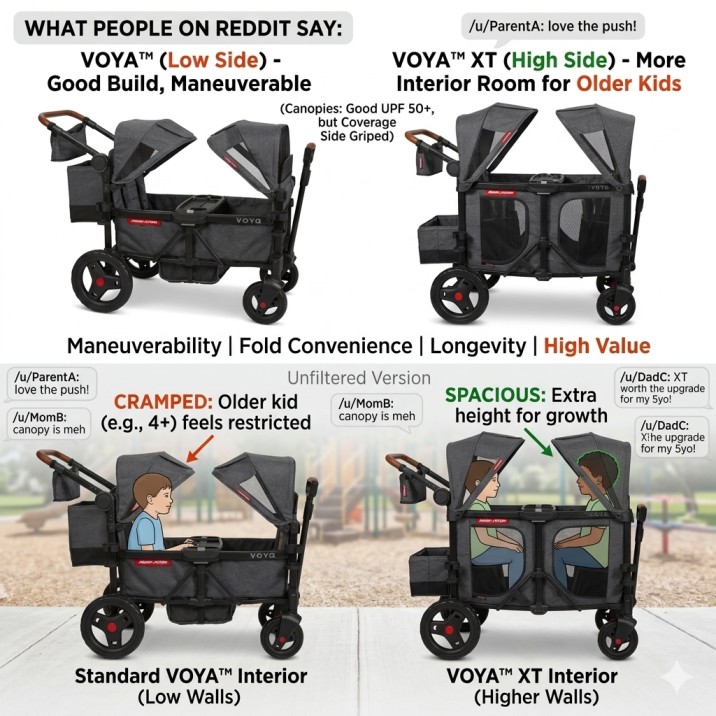
The consistent positives: maneuverability, the push/pull system, fold convenience, and durability over time. One parent mentioned their kids are 8 and 5 now and they still use it. That’s meaningful longevity for something that costs $279. People also mention picking them up on Facebook Marketplace because they hold value — a good sign for build quality.
The honest gripes: the canopy coverage gets called ‘meh’ by more than one person. One reviewer said it ‘really only shades at high noon.’ That’s a fair description. The canopies are dual and UPF 50+, which is accurate marketing, but the angle of coverage means late-afternoon sun from the side isn’t blocked particularly well. If sun protection is a priority — especially for fair-skinned kids — factor in the $49.99 rain/weather cover or plan around the sun angle.
A few people who used the standard Voya upgraded to the XT for the extra interior height. That decision usually came after realizing their older kid was getting cramped in the lower-walled version at around age 4 or 5. Something to think about if you’re buying for kids who’ll use this for multiple years.
Nobody was complaining about it breaking down or wheels failing early. That’s meaningful in a category where cheap construction is a genuine problem on the discount end of the market.
The Accessory Situation — Both Good and Frustrating
Everything you need for a regular outing comes in the box: snack tray, storage bag, cupholders, canopies. Radio Flyer doesn’t nickel-and-dime you the way some brands do with basic accessories.
Where they do require separate purchases: the rain cover ($49.99) and the infant car seat adapter (for kids under 6 months). Those are genuinely optional additions, not things most families need on day one — but it’s worth knowing upfront. If you live somewhere rainy or you’re starting from birth, add those to your budget.
There’s also the question of beach use. The Voya’s wheels handle light sand okay, but it’s not built for deep sand without resistance. If beach outings are a big part of your life, I’d point you toward our beach wagon guide — some options have better all-terrain wheel setups for that specific scenario.
The Price Question: Is the Voya Worth It Over a Basic Folding Wagon?
This comes up a lot when people are deciding between a stroller and a wagon stroller for the first time. The answer depends on what stage your kids are at.
For a family with kids between 18 months and 6 years, the Voya justifies its price over a basic wagon through two things: the stroller-certified harnesses and the push capability. Once kids reach a certain age, a basic pull wagon without a brake or harnesses becomes more of a liability than a convenience. The Voya handles city environments — crossing streets, stopping on slopes, managing two kids who may not always want to sit still — in a way that a $89 folding wagon just doesn’t.
Whether the Voya is worth it over a Wonderfold or Veer Cruiser is a harder question. My honest answer: probably yes for most families. The Wonderfold W4 Elite is an impressive product — I’ve reviewed it — but at nearly double the Voya Quad’s price, you have to really need the premium features to justify it. The Voya covers the fundamentals without the premium markup.

If you’re specifically weighing those higher-end options, our full stroller wagon comparison guide covers that ground in detail.
One Thing Most Reviews Don’t Say
The Voya qualifies as a stroller under airline regulations — not a wagon. Because it meets the ASTM F833 stroller standard and has dual harnesses, most airlines will gate-check it as a stroller rather than charge you for a wagon or sporting equipment. One parent in the Reddit threads specifically mentioned this happening with Delta after some initial pushback, and they were ultimately able to gate check it because of the harness system.
That is worth real money if you fly with kids. Gate-checking strollers is free. Checking a wagon as luggage is not. I don’t see any other Voya review actually mention this.
Who This Is and Isn’t For — Plainly
The Voya makes a lot of sense if you have two kids between roughly 1 and 6 years old, you do regular outings where you need to push and pull, you care about not disassembling everything before it fits in your trunk, and you don’t want to spend $500+ for features you probably won’t use.
It makes less sense if your kids are heavy sleepers who need recline (the Voya seats are upright, not reclining), if you’re regularly doing rough terrain, or if you need four seats. The Quad models solve the four-seat issue while keeping the same fold and push/pull system — just at a higher price and heavier weight.
Families with toddlers specifically will also want to check our dedicated stroller wagon guide for toddlers, which covers how different wagons handle that specific age group and the unique challenges that come with it.
The Voya is a Radio Flyer product, which matters more than it might seem. Radio Flyer is a Certified B Corp, still family-relevant after 100+ years, and their customer service (what they call ‘FUNomenal’) genuinely ships replacement parts. That’s not common in this category. You’re buying something with a support system behind it, not a brand that disappears after purchase.
At $279 for the standard 2-seater, it’s the honest choice. Not the flashiest. Not the most Instagram-ready. But one that, two years from now, you’ll probably still be using.