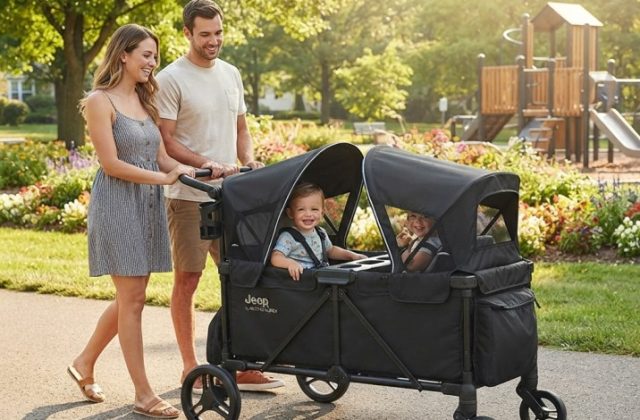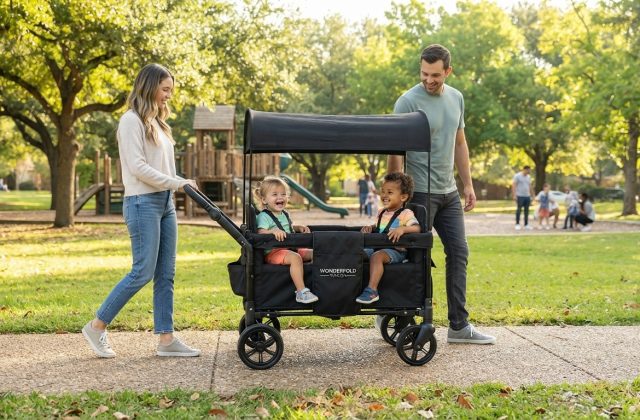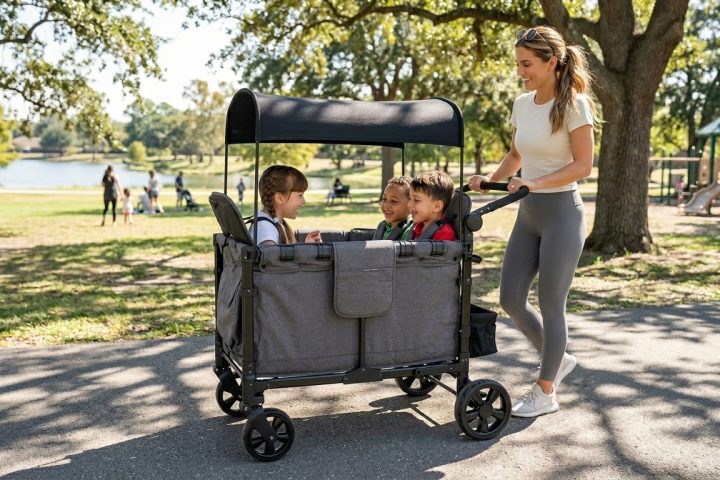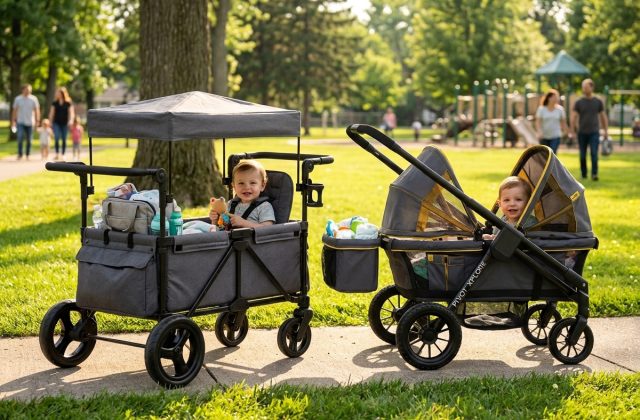
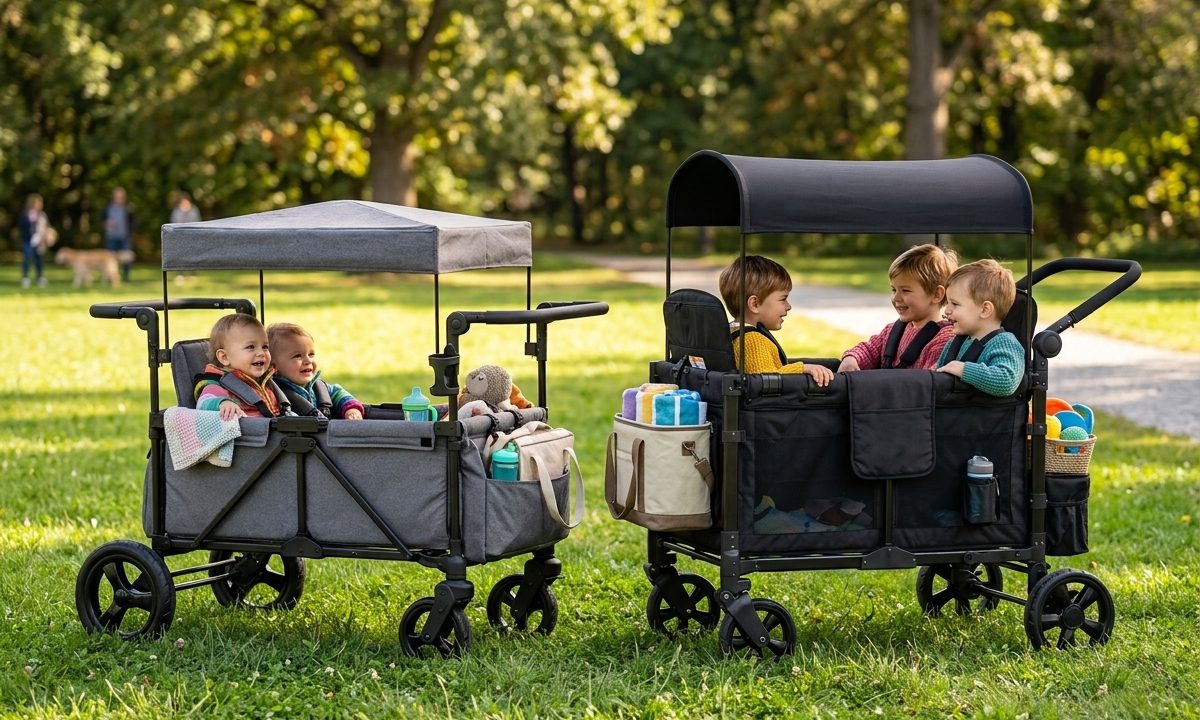
Neither wagon beats the other across the board, and anyone telling you one is simply “better” is skipping the parts where it isn’t. The Jeep Wrangler wins clearly on storage, on including a car seat adapter, and on brake feel. WonderFold’s W4 Elite wins clearly on kid comfort, thanks to real raised seats instead of a flat floor. WonderFold’s smaller W1 Original beats both of them on folding and fitting in a car, while giving up the most on storage and seat comfort to get there. Picking between these isn’t really a Jeep-vs-WonderFold question — it’s a question of which specific tradeoffs matter most for how your family actually uses a wagon.
This comparison leans on independent testing that measured all three wagons side by side — push force, turn force, fold times, terrain performance, the works — rather than going by spec sheets or marketing copy alone.
Quick specs, side by side
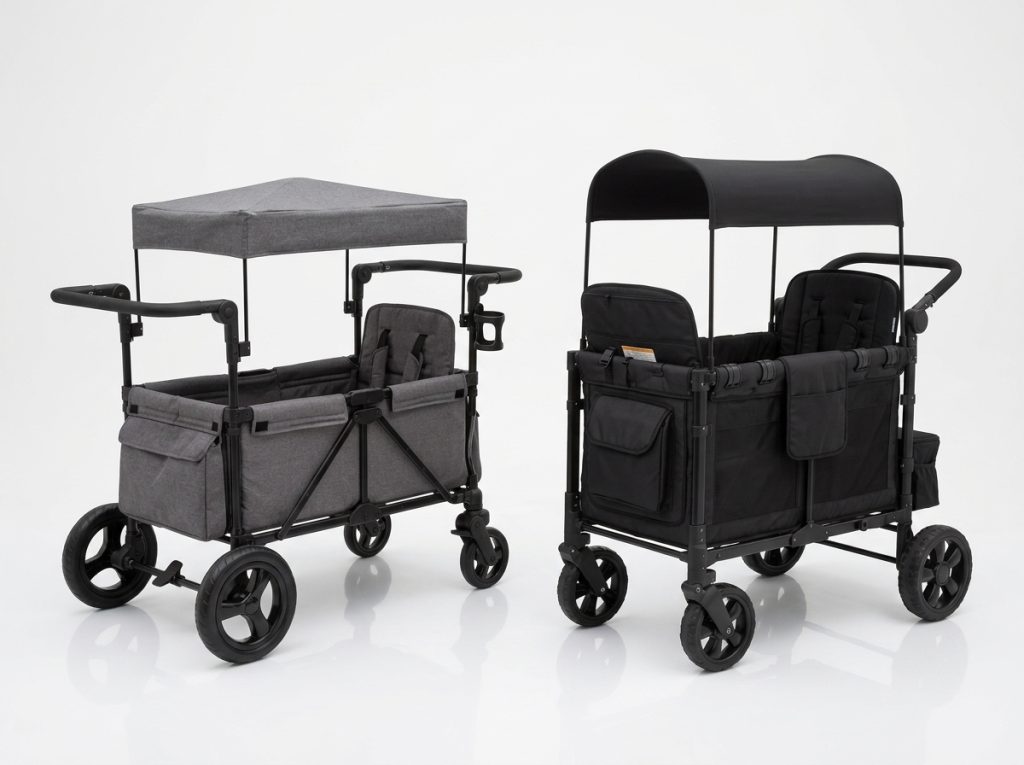
| Category | Jeep Wrangler | WonderFold W4 Elite | WonderFold W1 Original |
| Seats | 2 | 4 | 2 |
| Weight | 46.2 lbs | 53.0 lbs | 33.0 lbs |
| Capacity | 110 lbs | 300 lbs | 180 lbs |
| Minimum age | 6 months | 6 months | 6 months |
| Fits through a standard door | No | No | Yes |
| Car seat adapter included | Yes | No | No |
| Included accessories | Canopy, cooler bag | Canopy | Canopy |
Overall test scores
Independent lab testing scored all three wagons across five weighted categories. Here’s how they landed out of 100 in each.
| Category | Jeep Wrangler | WonderFold W4 Elite | WonderFold W1 Original |
| Overall Test Lab Score | 69 | 64 | 71 |
| Parent Comfort & Usability | 92 | 73 | 57 |
| Kid Comfort & Usability | 62 | 82 | 58 |
| Steering & Maneuverability | 39 | 53 | 73 |
| Folding & Transport | 60 | 22 | 85 |
| Part & Material Quality | 90 | 89 | 82 |
Read those scores carefully — the Jeep dominates parent-facing convenience (storage, car seat adapter, cupholder), the W4 Elite dominates kid comfort thanks to real seats, and the smaller W1 dominates everything related to folding and hauling it around, mostly because it’s dramatically lighter and simpler with only two flat floor spots instead of mounted seats.
The core structural difference: floor seating vs. mounted seats
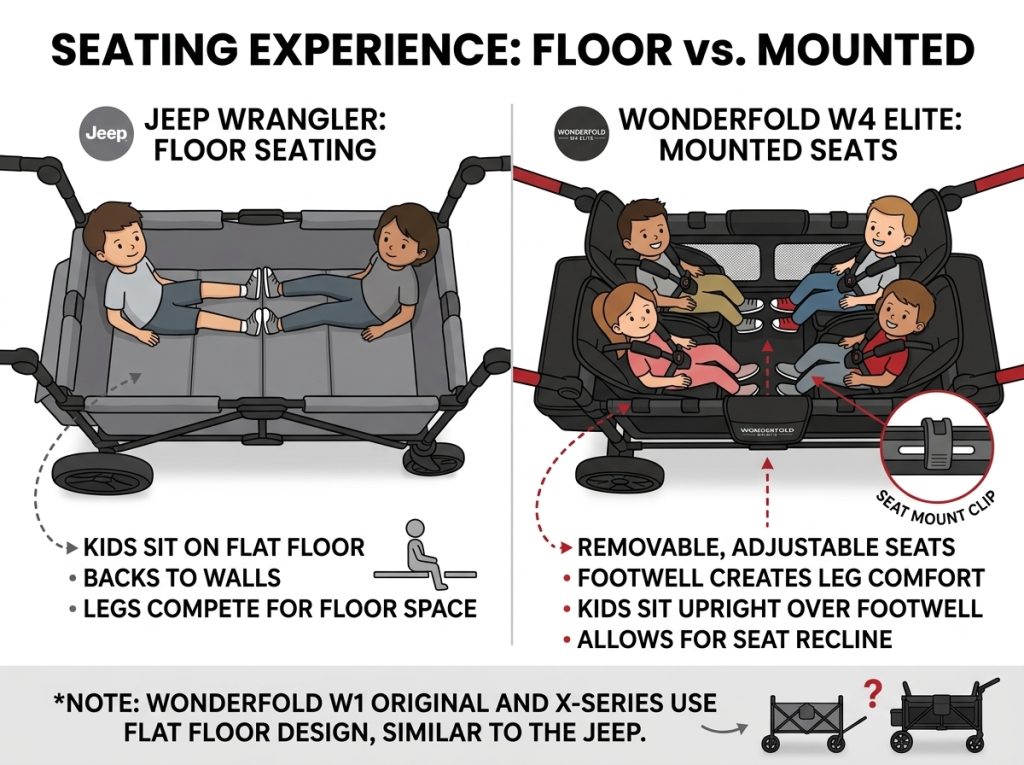
This is the single biggest thing separating these wagons, and it explains most of the score differences above. The Jeep Wrangler is a box — no separate seats, kids sit on the wagon floor with their backs against the front or rear walls. That gives you a flat, open surface that’s good for napping or letting an older kid sprawl out, but it also means legs compete for the same floor space, which mostly becomes a problem for older, taller kids.
The WonderFold W4 Elite goes the opposite direction: removable, adjustable seats mounted to the frame, creating a footwell between them. That’s a real comfort upgrade for sitting upright over a longer outing, and the seats recline by sliding the mount clips forward or back. WonderFold’s own smaller wagons — the W1 Original and the X series — actually use the same flat-floor setup as the Jeep, not the mounted-seat design of the W4. So “WonderFold” isn’t one seating experience across the whole brand; it depends which WonderFold you’re comparing.
Storage: the Jeep isn’t close
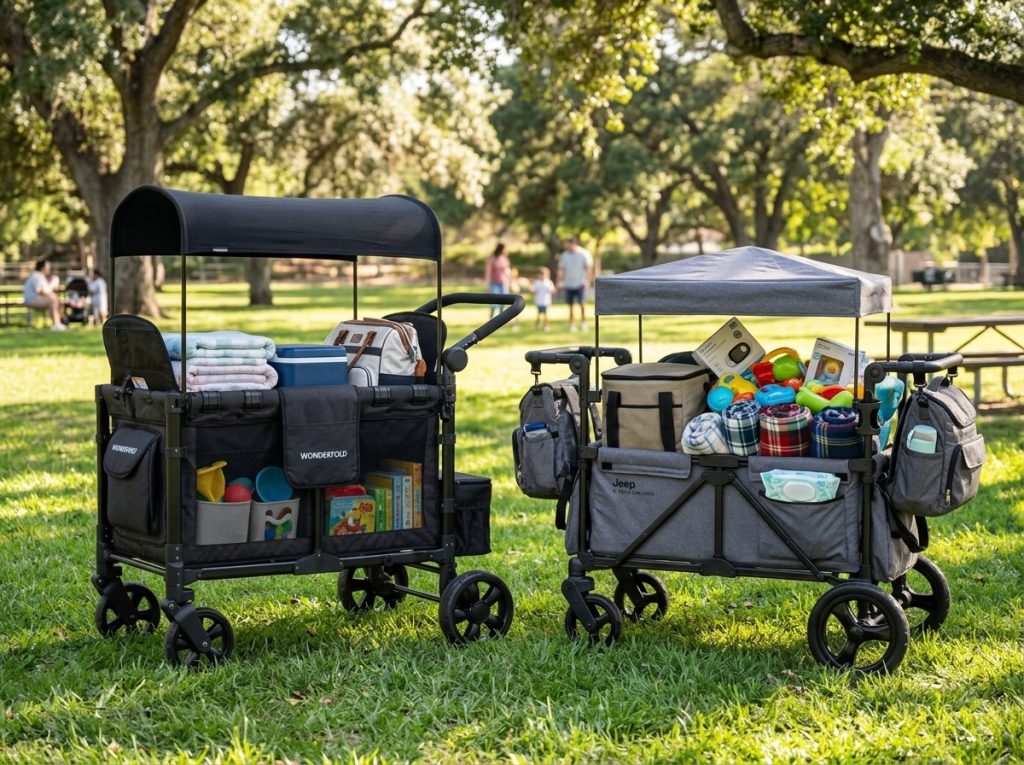
| Wagon | Storage rating (out of 10) |
| Jeep Wrangler | 10 |
| WonderFold W4 Elite | 9 |
| WonderFold W1 Original | 4 |
The Jeep’s rear has two large storage compartments plus a smaller cupholder-style pocket between them. Up front, a console splits into four separate storage areas, with a fabric bag hanging over the top that’s roomy enough to stash the canopy when it’s off. It also ships with an insulated cooler bag on a movable metal mount — big enough for about 16 cans if that’s genuinely what you’re hauling.
The W4 Elite holds its own with a large bin under the rear push handle, side pockets, front storage, and enough under-seat room for a diaper bag once the seats are installed. The W1 Original, by comparison, has close to nothing — a single zippered compartment that holds far less than either of the bigger wagons. If storage is a top priority, the W1’s compact size comes at a real cost here.
Car seat adapters: only the Jeep includes one
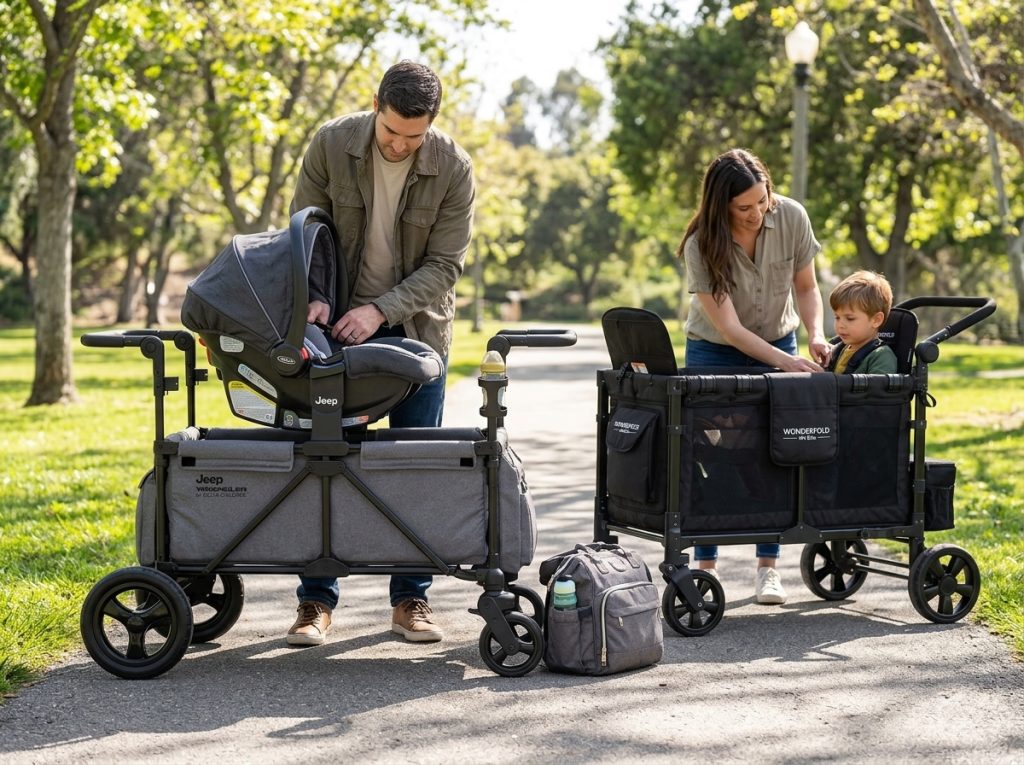
Of every wagon in this comparison, only the Jeep Wrangler ships with a car seat adapter in the box, compatible with Chicco, Graco, Britax, and Evenflo infant seats. Neither WonderFold wagon offers a car seat adapter at all — not included, not sold separately. If using an infant car seat with the wagon matters to you, this alone may settle the decision before you even get to storage or ride quality.
Handles and cupholders
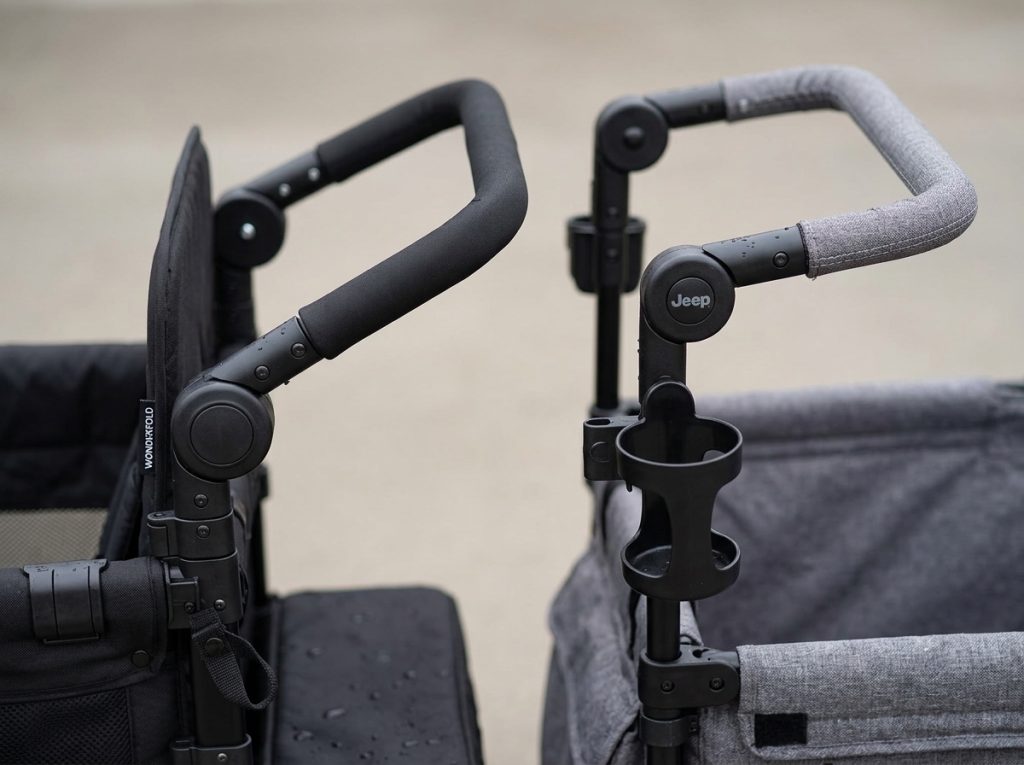
Handle height ranges: the Jeep adjusts from 29 to 41 inches, the W4 Elite from 34.5 to 45.5 inches (though at full extension it’s basically vertical, so the practical usable maximum is closer to 42 inches), and the W1 from 25 to 38 inches — the shortest range of the three, worth noting if you’re especially tall. All three use a similar handle design with a zip-off protective cover.
Cupholders are a weak spot across the board. The Jeep has one single, removable, frame-mounted cupholder. Neither WonderFold wagon includes a cupholder at all in these configurations — you’d need to step up to WonderFold’s Luxe tier, which adds a basic mesh pouch on the basket that can double as one.
Brakes: the Jeep stops more confidently
| Wagon | Brake effectiveness (out of 10) |
| Jeep Wrangler | 9 |
| WonderFold W1 Original | 7 |
| WonderFold W4 Elite | 7 |
Both brands use a single rear pedal that controls both back wheels, and both pedals are easy to reach with a foot. But in loaded stop testing, the Jeep’s brake brought the wagon to an immediate stop more reliably than either WonderFold. Releasing the brake barefoot or in sandals was uncomfortable on every wagon tested here — not just one brand’s problem. The Jeep also adds individual front-wheel brake locks, which neither WonderFold offers.
Steering and maneuverability: the WonderFolds win, especially the W1
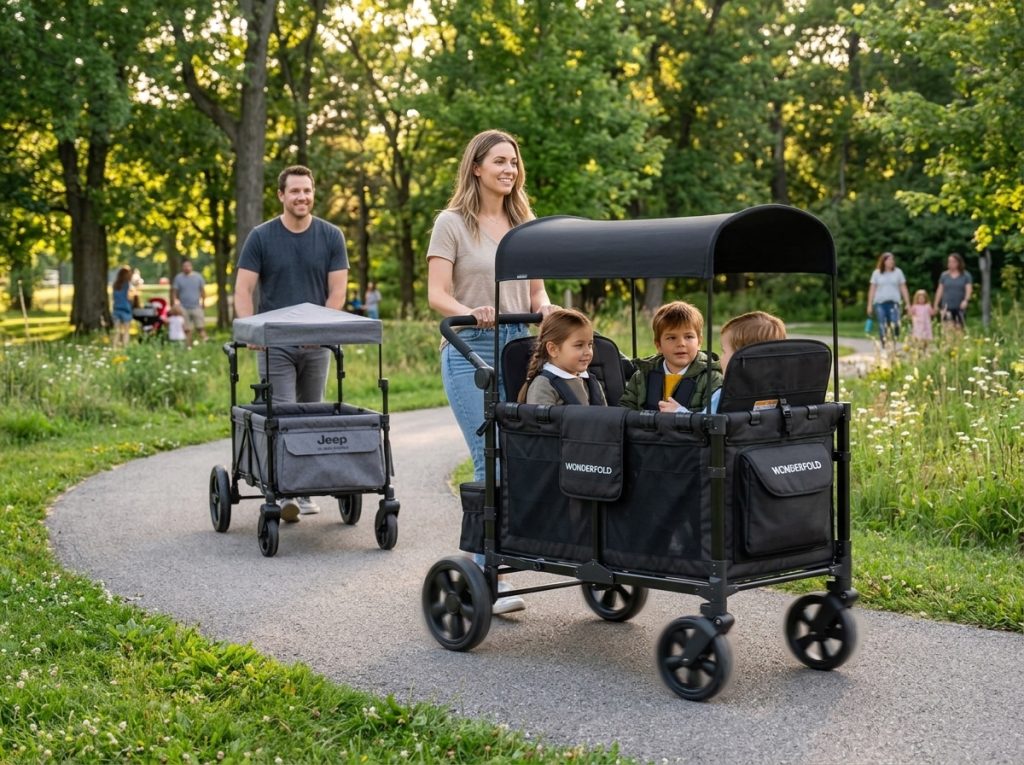
This is where the smaller WonderFold pulls ahead by a wide margin. Turning a fully loaded wagon 90 degrees from a dead stop took noticeably more effort on the Jeep than on either WonderFold — likely tied to the Jeep’s wider wheelbase.
| Wagon | Force to turn 90° from a stop |
| WonderFold W1 Original | 28.7 lbs |
| WonderFold W4 Elite | 33.5 lbs |
| Jeep Wrangler | 36.4 lbs |
Straight-line push force to get each wagon rolling was similar across all three, just over 15 lbs. It’s specifically the turning, not the rolling, where the Jeep struggles.
Tracking straight without veering told a similar story — bigger numbers below mean less veering, so the Jeep drifted noticeably more than either WonderFold during testing.
| Wagon | Veer / straight-tracking score |
| WonderFold W4 Elite | 26.0 |
| WonderFold W1 Original | 16.0 |
| Jeep Wrangler | 5.8 |
Wheels: width and diameter tell different stories
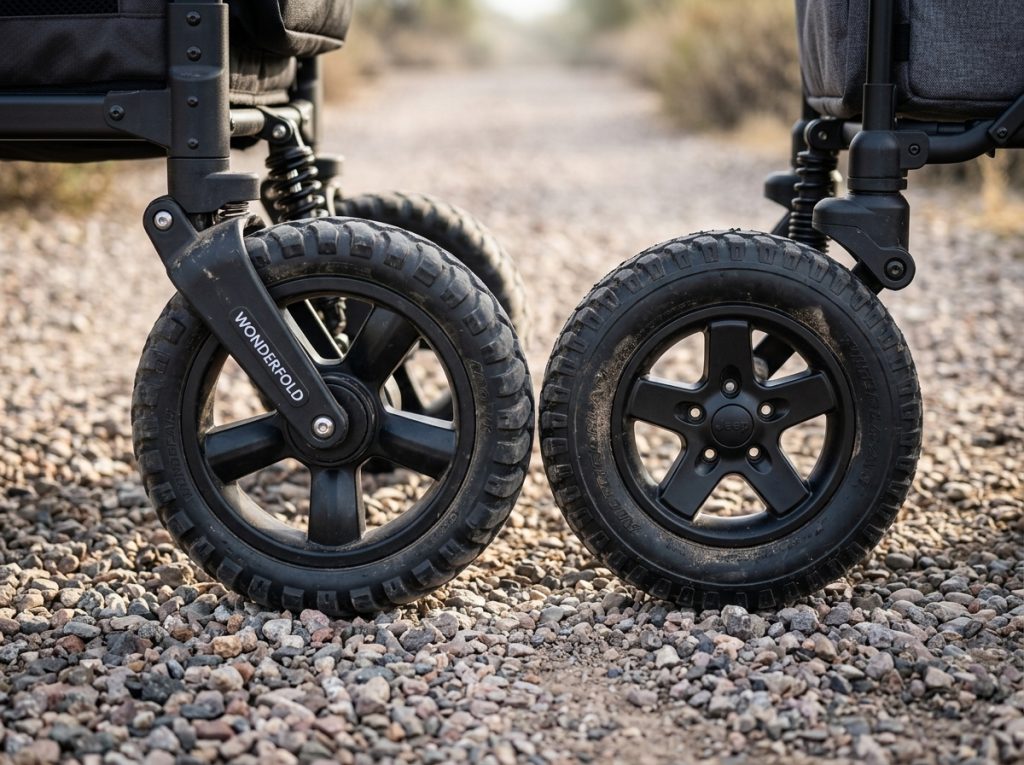
| Wagon | Front wheel width | Rear wheel diameter |
| Jeep Wrangler | 1.3 in (narrowest tested) | 12.0 in (largest tested) |
| WonderFold W1 Original | 1.5 in | 9.0 in |
| WonderFold W4 Elite | 1.9 in (near-widest tested) | 9.5 in |
Wider wheels generally help with terrain performance, and the Jeep has the narrowest front wheels of the group even though it has the largest rear wheels by far. The W4 Elite’s wider front wheels come with genuine front-wheel spring suspension, which the Jeep doesn’t have. The smaller rear wheels on both WonderFold wagons are also the likely reason feet tend to bump the axle and brake bar while pushing — a complaint that showed up specifically with the W4 Elite in testing. Jeep does sell dedicated all-terrain wheels separately, though like most add-on wheel upgrades in this category, they still aren’t built for soft sand.
Terrain: the WonderFolds handle bumps better, the Jeep handles hills about the same
| Wagon | Bump rating (out of 10) |
| WonderFold W1 Original | 7 |
| WonderFold W4 Elite | 6 |
| Jeep Wrangler | 3 |
Loaded with 80 lbs and run over rocks, roots, and boards of varying thickness, the Jeep performed noticeably worse than either WonderFold over bumps — none of the three were genuinely strong here, but the Jeep was clearly the weakest. On grass, all three pushed straight without much trouble, though turning on grass was harder across the board. Going straight up a grassy hill took similar effort for the Jeep and W4 Elite; the W1 needed less effort, likely due to its lighter weight. Going sideways across a hill was a real struggle for both the Jeep and the W4 Elite.
Folding and getting it into your car: no contest, the W1 wins
| Wagon | Fold time | Folded size | Folded dimensions |
| WonderFold W1 Original | 30 sec | 9.5 cu ft | 33″L x 25″W x 20″H |
| Jeep Wrangler | 31 sec (17 sec without canopy) | 10.2 cu ft | 40.5″L x 26.5″W x 16.5″H |
| WonderFold W4 Elite | 98 sec | 15.7 cu ft | 42.5″L x 29″W x 22″H |
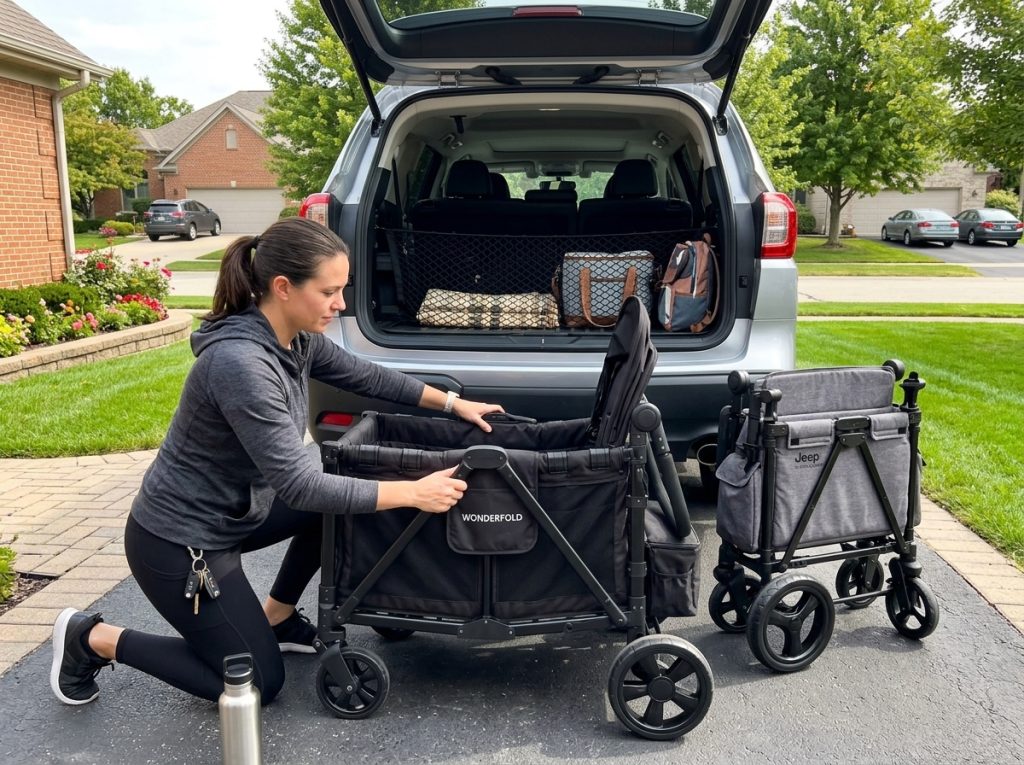
Removing the canopy adds real time to both the Jeep and the W4 Elite’s fold — the Jeep alone drops to just 17 seconds without it. The W4 Elite is the clear outlier here: even folded with the seats left installed to save time, it still took well over a minute and a half, more than triple the Jeep or W1. For a 4-seater, that’s not unusual — WonderFold’s own W4 is nearly 5 cubic feet bigger folded than the Gladly Anthem 4, another 4-seat wagon tested separately — but it’s a real daily-use cost if you’re folding and loading this thing often.
None of these wagons are truly compact. The Jeep doesn’t fit in a Honda Civic trunk at all — it sticks out with the trunk lid unable to close — though it does fit in a minivan with some effort. The W1 is the only one of the three confirmed to fit in a standard sedan trunk. The W4 Elite wasn’t even attempted in the sedan trunk test, given its size.
Kid comfort: seats make the difference
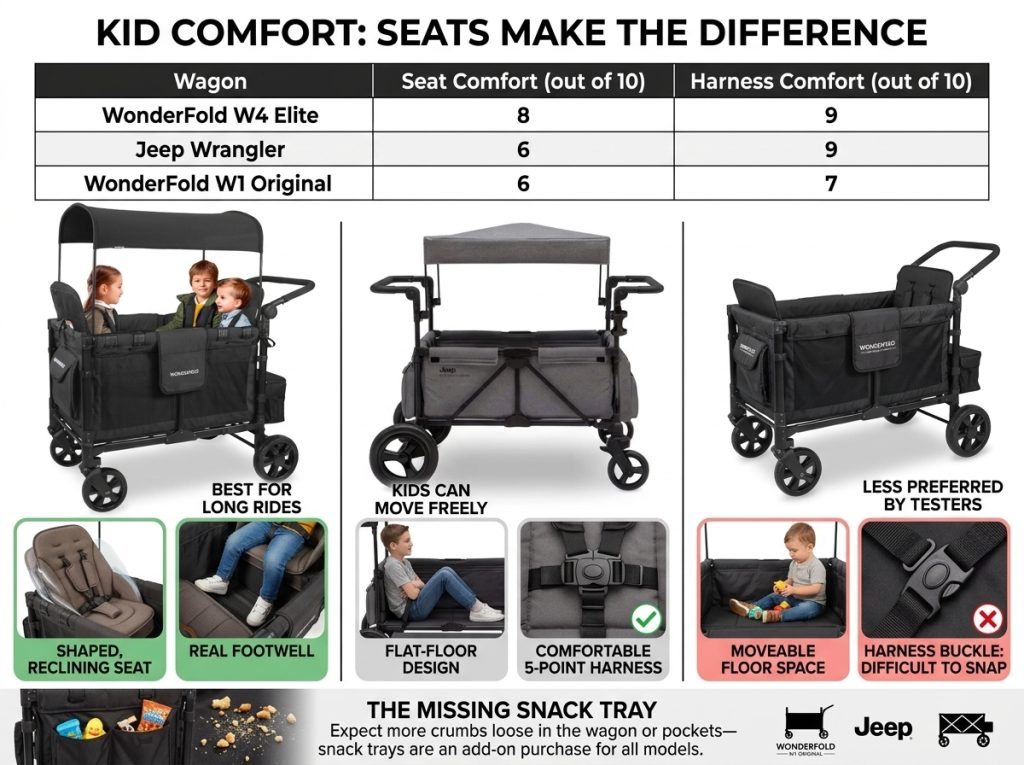
The flat-floor design shared by the Jeep and the W1 does have one upside: kids can move around more freely, and older kids often end up sitting sideways against the walls rather than the ends. But for longer rides, the W4 Elite’s shaped, reclining seats with a real footwell are simply more comfortable to sit in for an extended period. All three use padded 5-point harnesses, though testers specifically disliked how the W1’s harness buckle snaps together compared to the other two.
None of the three wagons in this comparison include a snack tray in the base package — it’s an add-on purchase across the board. Without one, expect more crumbs ending up loose in the wagon and in storage pockets, since that’s where kids naturally stash things instead.
Inner wagon space
| Wagon | Inner dimensions | Floor area |
| Jeep Wrangler | 33″L x 18″W x 12″H | 594 sq in |
| WonderFold W1 Original | 31″L x 17″W x 12″H | 527 sq in |
| WonderFold W4 Elite | 30″L x 19″W x 18″H | 570 sq in |
Even as a 2-seater, the Jeep actually has more usable floor space than the 4-seat W4 Elite — 594 square inches versus 570. The W4’s extra height (18 inches versus 12 on the other two) exists specifically to make room for the hanging, mounted seats, which the flat-floor wagons don’t need.
Canopy and bug protection
Both brands’ canopies were flagged in testing as a hassle to put on and take off — this isn’t a one-brand problem. Where they differ: the Jeep’s canopy includes a pull-down sunshade stored in a zippered compartment, while the WonderFold canopy fabric adjusts more simply once it’s actually mounted. The Jeep also has mosquito netting that rolls down from the canopy ends — it doesn’t seal fully around the edges, so treat it as a partial sunshade more than real bug protection, but it’s still more than the WonderFold offers, which has no netting at all.
Part and material quality: close across the board
| Wagon | Part & material quality (out of 100) |
| Jeep Wrangler | 90 |
| WonderFold W4 Elite | 89 |
| WonderFold W1 Original | 82 |
All three score well here, and testing found few real complaints about Jeep part reliability. WonderFold has scattered owner complaints online about wheels loosening, buckles breaking, and stitching wearing over time, though testers didn’t personally run into those issues during their own testing window.
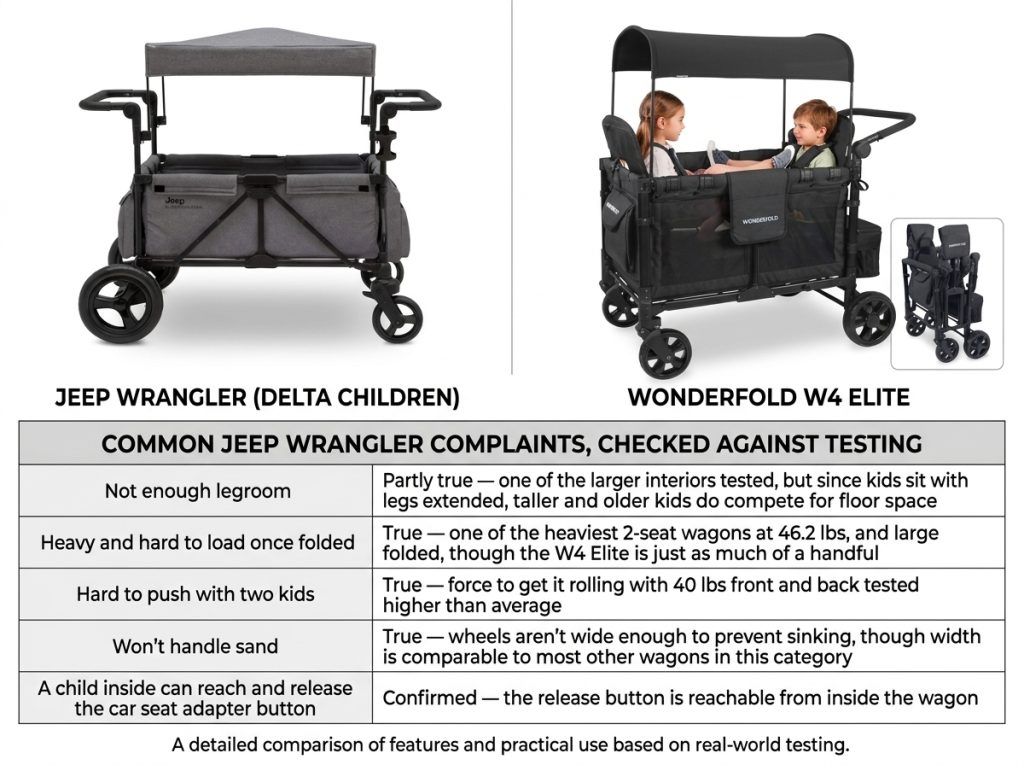
Common Jeep Wrangler complaints, checked against testing
Common WonderFold W4 Elite complaints, checked against testing
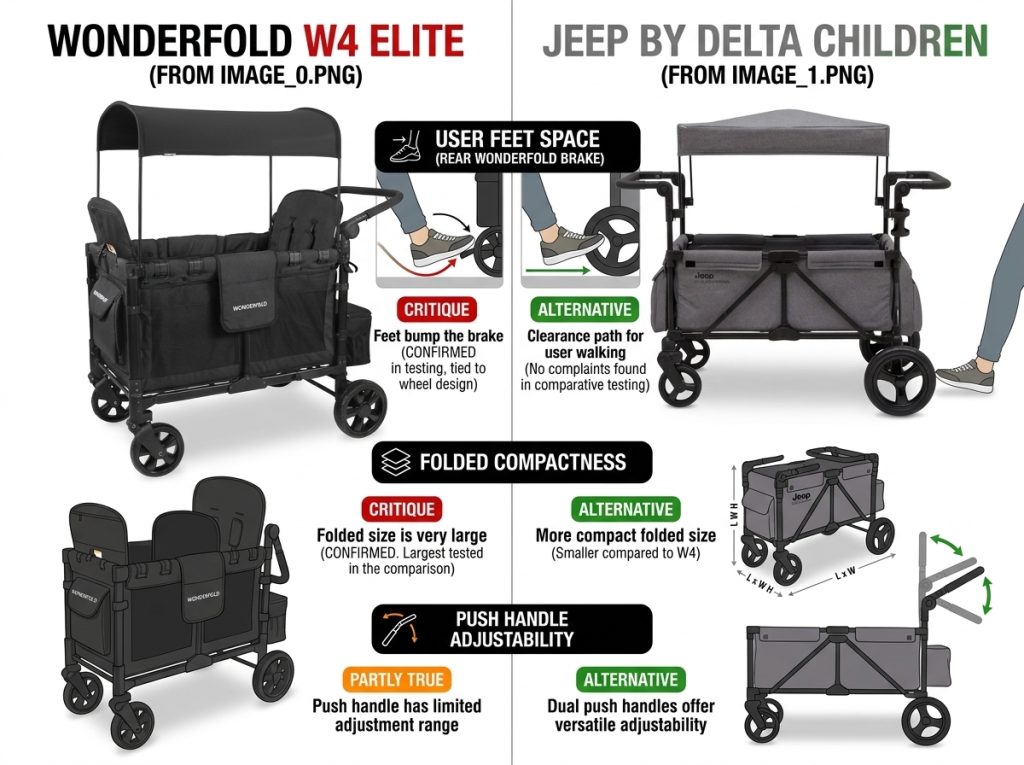
| Complaint | What testing found |
| Feet bump the brake while walking | Confirmed — happened to most testers regardless of height, tied to the smaller rear wheel size |
| Push handle doesn’t adjust | Partly true — it does adjust, but the range doesn’t extend out very far |
| Customer service is slow | Not confirmed — email response came back in just over an hour during testing |
| Folded size is too big | Confirmed — largest folded size of any wagon in a broader 11-wagon comparison, though only two 4-seaters were included and the other one folded smaller |
| Veers to one side while pushing | Not confirmed — tracked straight in veer testing |
So which one should you actually buy
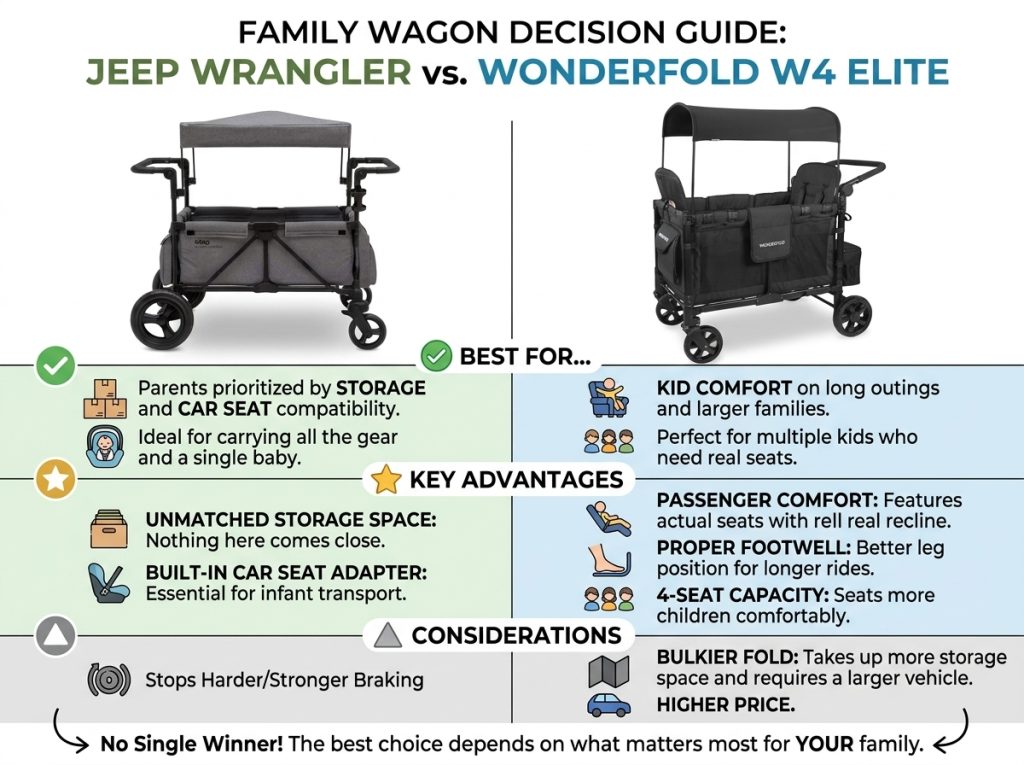
If storage space and a built-in car seat adapter matter most, the Jeep Wrangler is the clear pick — nothing here comes close on either front. If you’re transporting a baby in an infant seat at all, this decision is mostly already made for you.
If kid comfort on longer outings matters most — actual seats, a real recline, a proper footwell — the WonderFold W4 Elite is worth the bulkier fold and the higher price, especially if you need four-seat capacity in the first place. Read our full Jeep Wrangler review and our WonderFold W1 review for the deeper dive on each specific model.
If folding, storing, and fitting the wagon into a smaller car matters more than storage or seat comfort, WonderFold’s smaller W1 beats both of the bigger wagons here by a wide margin — you’re just trading away significant storage space and seat comfort to get there. If you’re still deciding whether a four-seat wagon makes sense for your family in the first place, our 4-seater wagon guide is worth reading before you commit to either brand’s bigger model. And if the real question underneath all of this is whether a wagon makes sense over a double stroller, that comparison is worth a look too.
There’s no single winner here. There’s a Jeep that carries more and stops harder, and a WonderFold that either turns easier and folds smaller, or seats kids more comfortably, depending on which WonderFold you’re actually looking at.