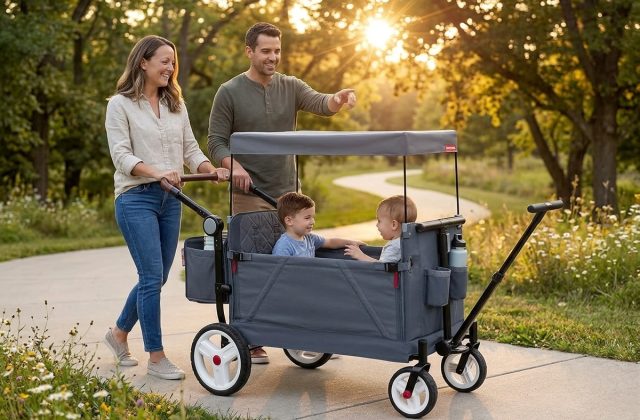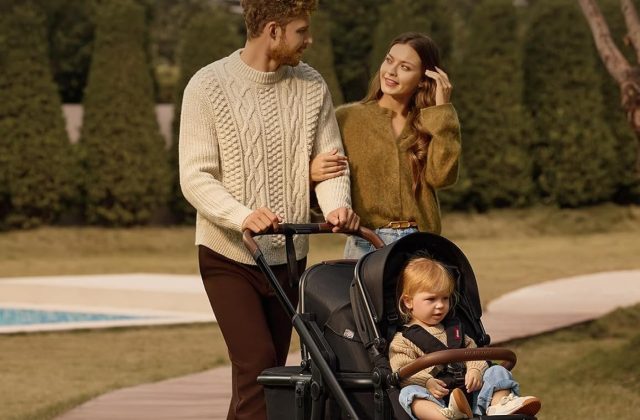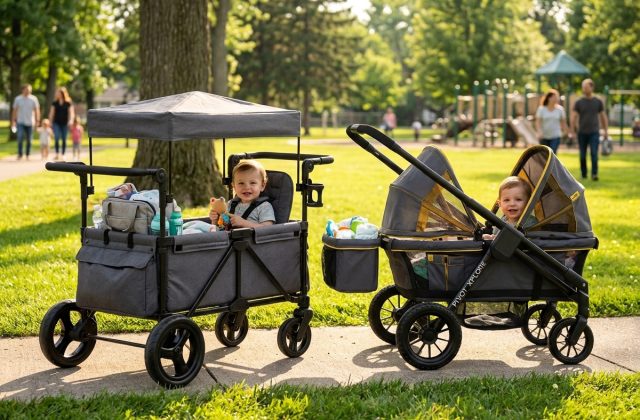
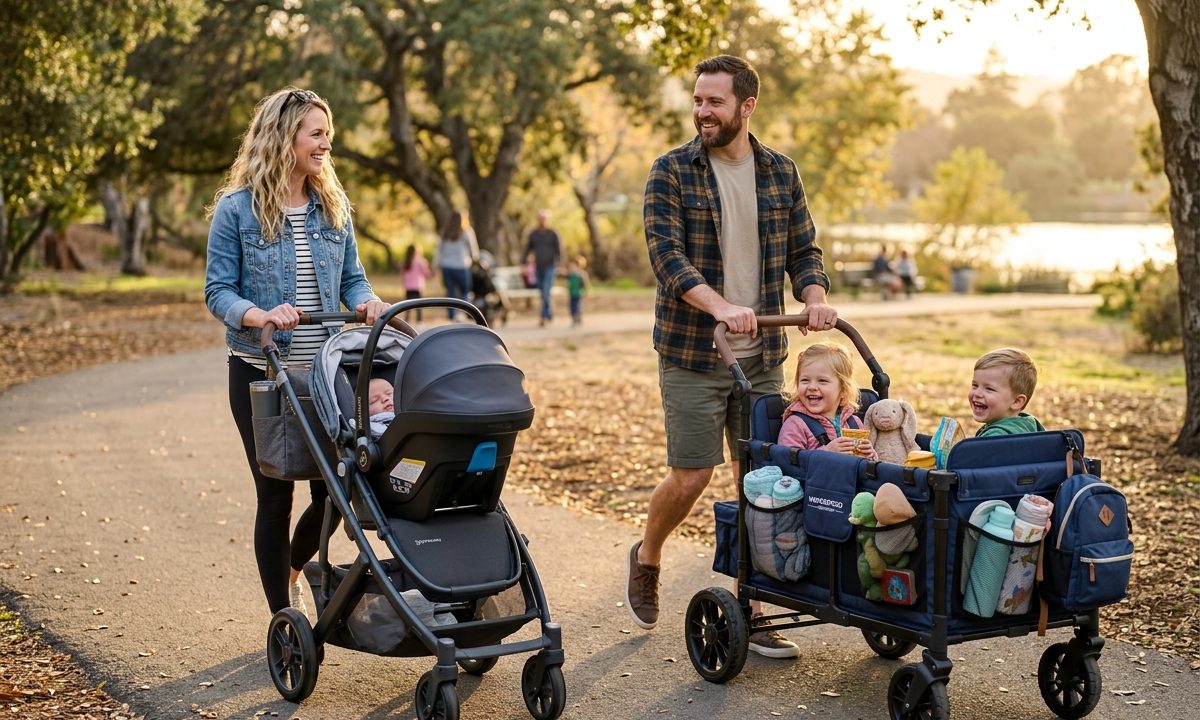
Quick answer: a stroller wins on portability, tight spaces, and infant use. A wagon wins on room, comfort, storage, and letting a toddler move around instead of being strapped in one position. For most families with a toddler between about 18 months and 4 years old, a wagon actually covers more real-world situations than people expect — but it’s not a universal upgrade, and there are specific cases where a stroller is still the better tool.

This isn’t a “wagons are secretly better” article or a “strollers are the classic choice” article. It’s a breakdown of what each one is actually built for, so you’re picking based on how your family uses it, not which one is trending on social media this year.
The core difference isn’t size, it’s posture
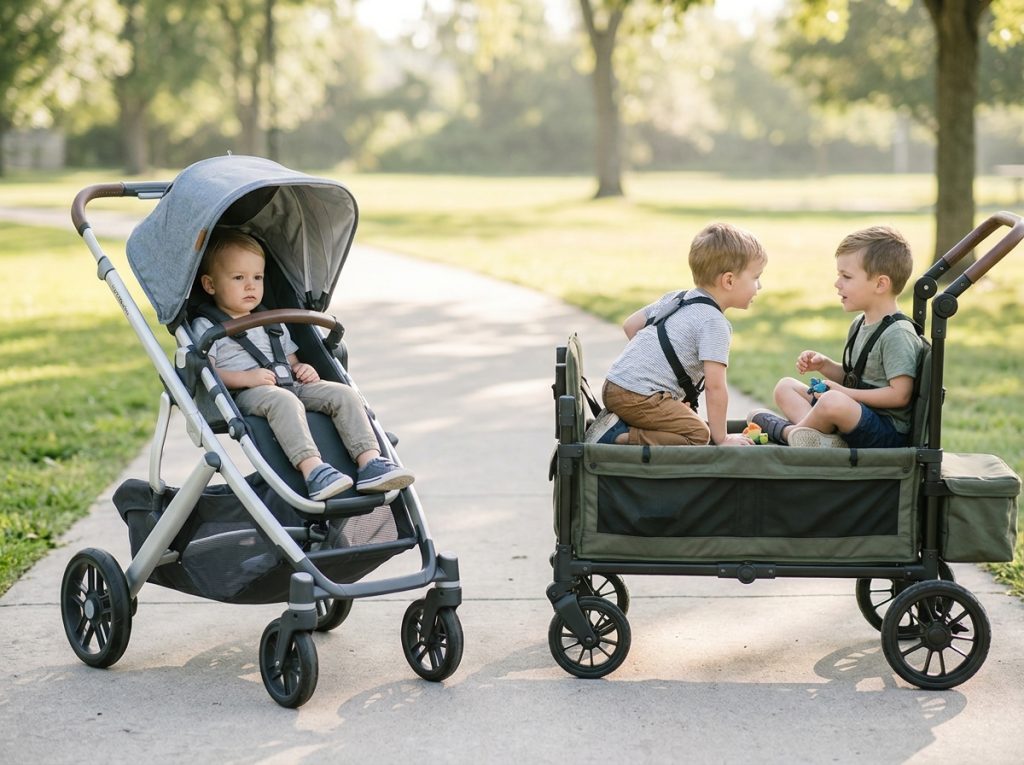
A stroller holds a child in one reclined or upright seated position, facing forward or facing you, with a harness keeping them mostly still. A wagon is an open bench or bed — kids sit, kneel, shift positions, lie down, or face each other, with more freedom to move within the harness. That difference explains almost every other tradeoff on this page.
Strollers are built around controlled positioning. Wagons are built around open space. Neither is objectively better — they’re solving different problems.
Side-by-side comparison
| Stroller | Wagon | |
| Best for | Infants, tight spaces, quick errands | Toddlers and up, longer outings, gear-heavy days |
| Typical weight | 15-30 lbs | 28-60 lbs depending on size |
| Folded footprint | Usually smaller | Usually bigger, though newer models vary a lot |
| Seating | Fixed, reclined or upright | Open bench, more freedom to move |
| Harness | 3-point or 5-point | 3-point or 5-point, varies by brand |
| Storage | Small basket underneath | Large bins, pockets, sometimes a cooler bag |
| Multiple kids | Double stroller needed | Often built in, 2 to 4 seats standard |
| Car seat compatible | Yes, most travel systems | Sometimes, adapter usually required |
| Typical price range | $100-$1,000+ | $200-$1,000+ |
Where a stroller still wins
Newborns and young infants
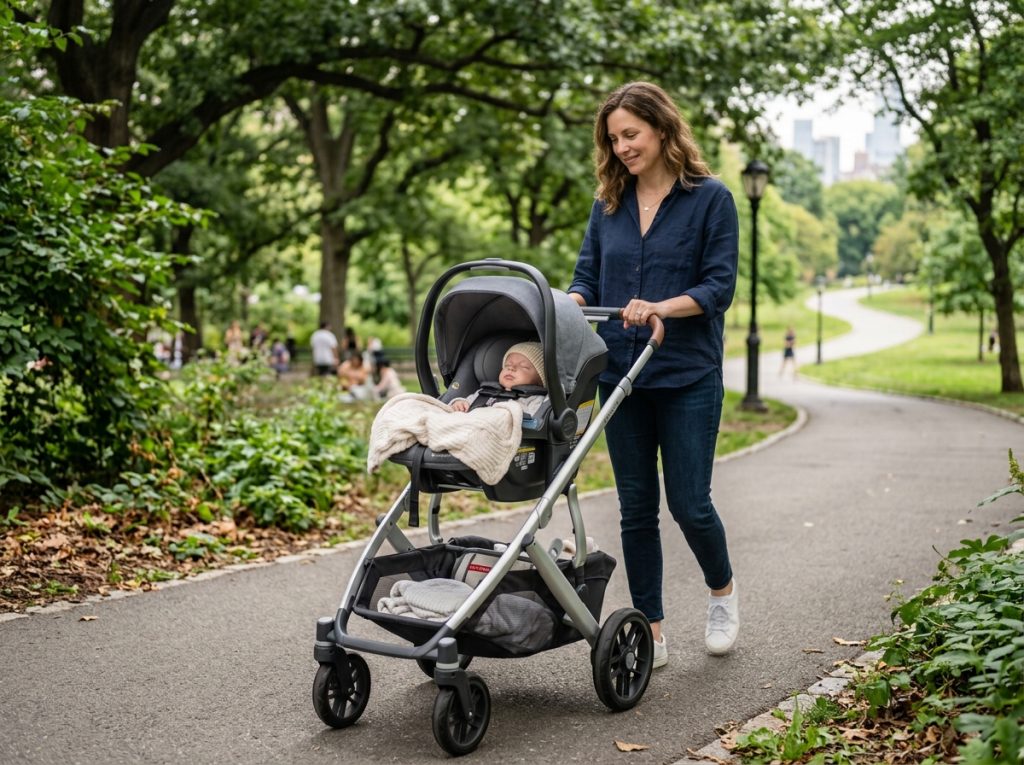
This is the clearest case. Most wagons aren’t built for babies under 6 months without a car seat adapter, and even with one, it’s not the same as a true infant travel system with a proper recline and head support. If you’ve got a newborn, a stroller — or a stroller-and-car-seat travel system — is still the safer, more purpose-built choice.
Tight, indoor spaces
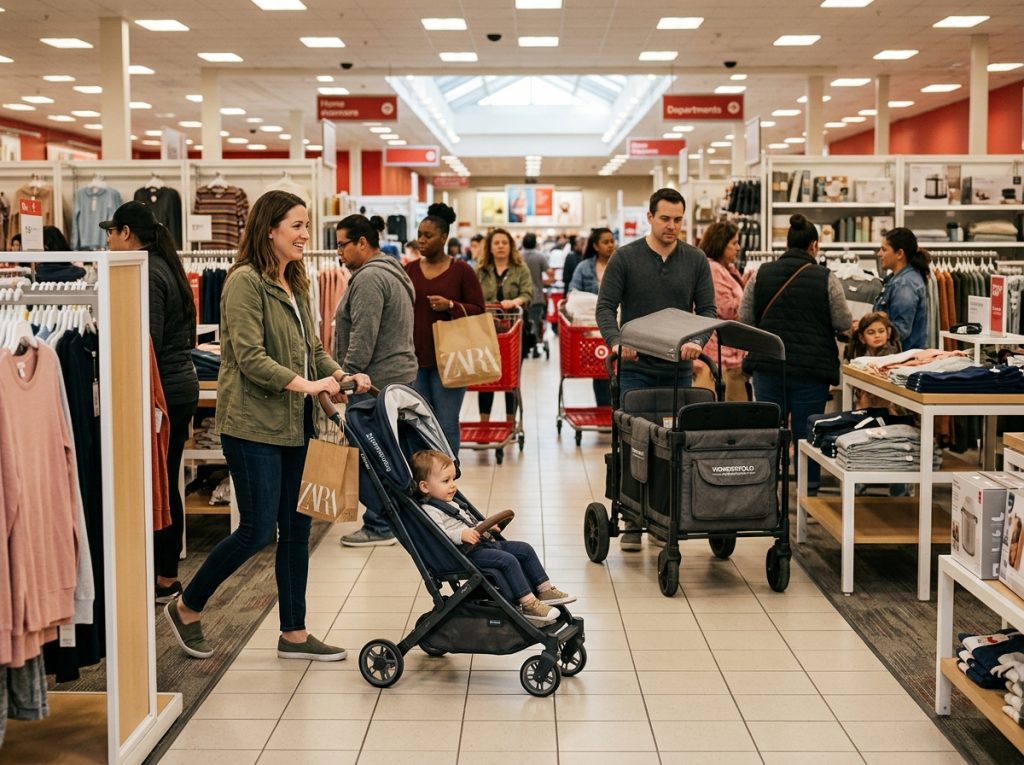
Grocery stores, malls, museums, airports. A stroller’s narrower profile and tighter turning radius make it the more practical tool anywhere aisles are narrow or crowds are dense. Wagons, even compact ones, are wider and longer, and that extra size becomes a real obstacle indoors.
Air travel and public transit

Umbrella strollers fold small enough to gate-check easily or stash in an overhead bin in some cases. Wagons are heavier and bulkier to check, and very few are built with air travel specifically in mind. If your toddler needs to nap on a flight or ride the subway with you, a lightweight stroller is almost always the more practical option.
Cost, if you’re buying the basics
A simple umbrella stroller can run under $50. Wagons rarely get that cheap once you account for real build quality — most start closer to $150 to $250 even at the budget end. If price is the deciding factor and you don’t need extra capacity, a basic stroller is the cheaper entry point.
Where a wagon wins
Longer outings where a toddler needs to move
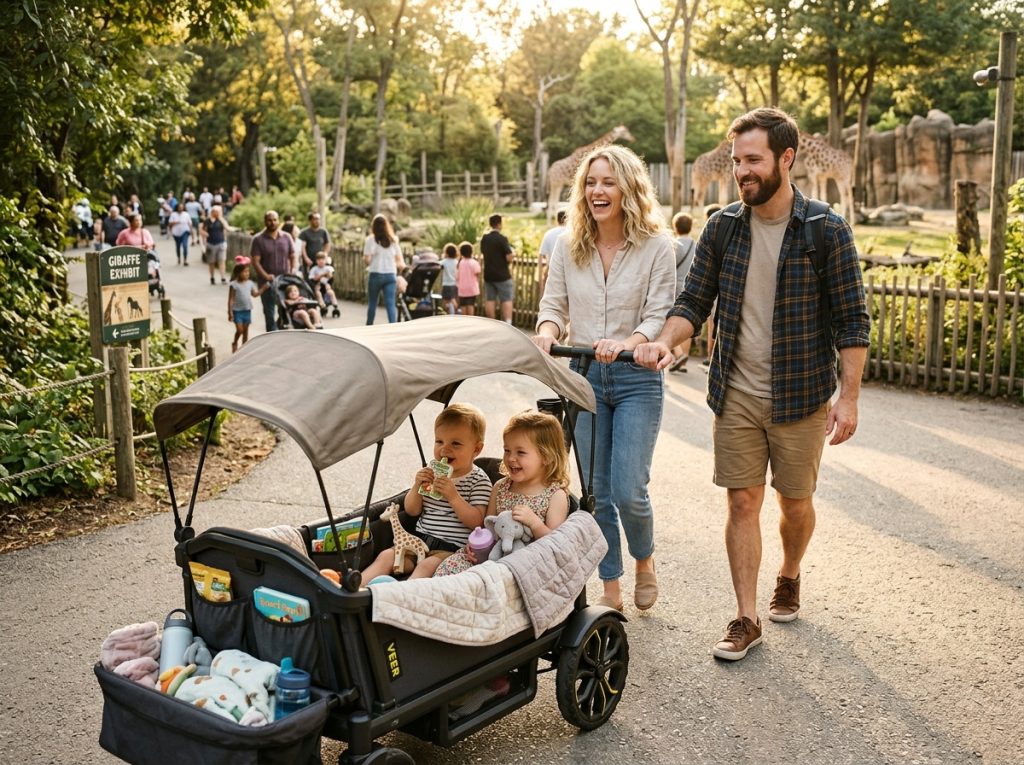
Zoos, farmers markets, festivals, and all-day park visits are where wagons pull ahead. A toddler strapped into a stroller seat for three hours gets uncomfortable and cranky. A wagon lets them shift position, half-recline, sit cross-legged, or lie down for a nap without you needing to stop and adjust a recline lever.
Multiple kids without buying a double stroller
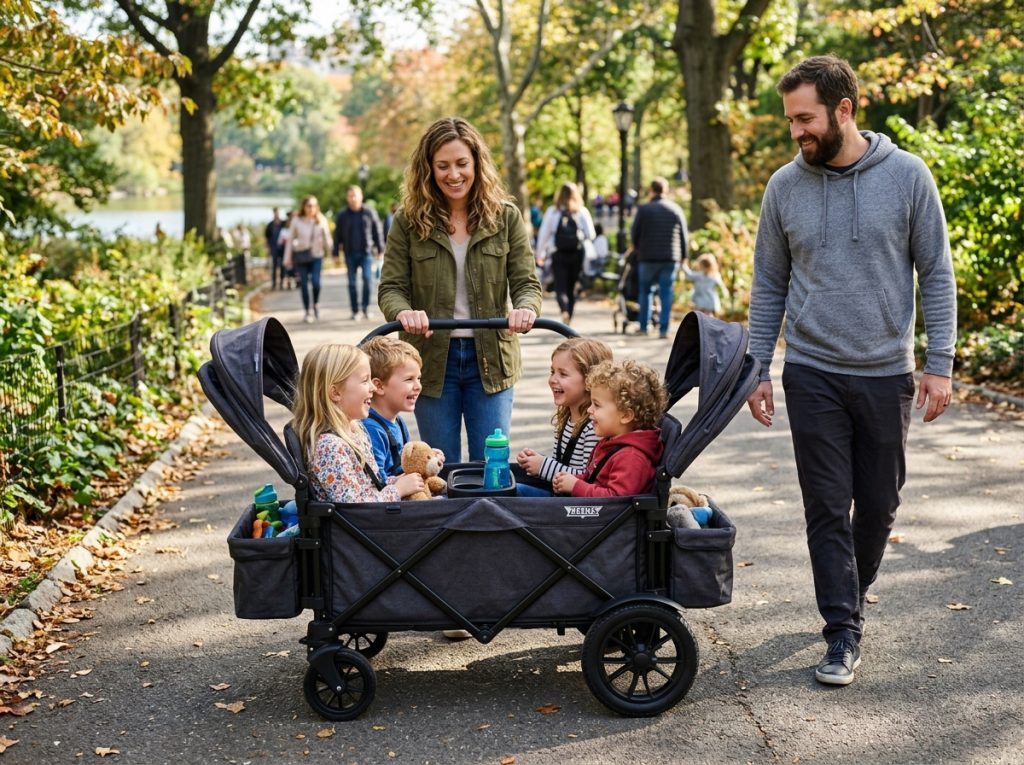
Most wagons seat two to four kids standard, without the width and turning problems that come with side-by-side double strollers. If you’ve got a toddler and a preschooler, or twins, a wagon is often the simpler, more comfortable answer than stacking two stroller seats together. Our double stroller vs. wagon breakdown goes deeper on that specific comparison if two or more kids is your situation.
Hauling gear along with kids
Beach days, camping trips, sports practices — anywhere you’re carrying as much stuff as kids. Wagon storage baskets are dramatically bigger than anything built into a stroller, and several wagons let you remove the seats entirely to turn the whole frame into a cargo hauler when you don’t need to carry kids at all.
Rough or uneven terrain
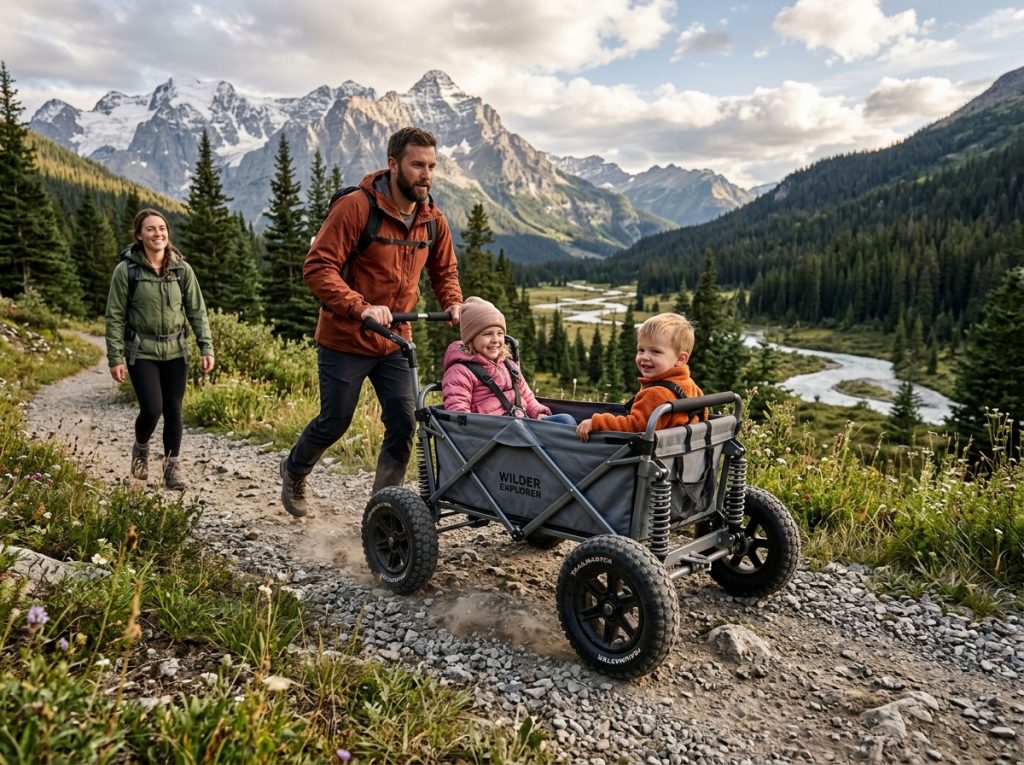
Grass, gravel, sand, dirt trails. Wagon wheels tend to be bigger, and more models come with genuine suspension built in. A stroller’s smaller wheels are optimized for smooth pavement, not repeated bumps and uneven ground.
Letting toddlers socialize instead of sitting in a line
Face-to-face or side-by-side seating in a wagon lets siblings or friends actually interact during the ride, rather than one kid staring at the back of another’s head the way most double strollers arrange things. For families who prioritize that, it’s a real, if less obvious, advantage.
Maneuverability: tight turns vs. straight-line comfort
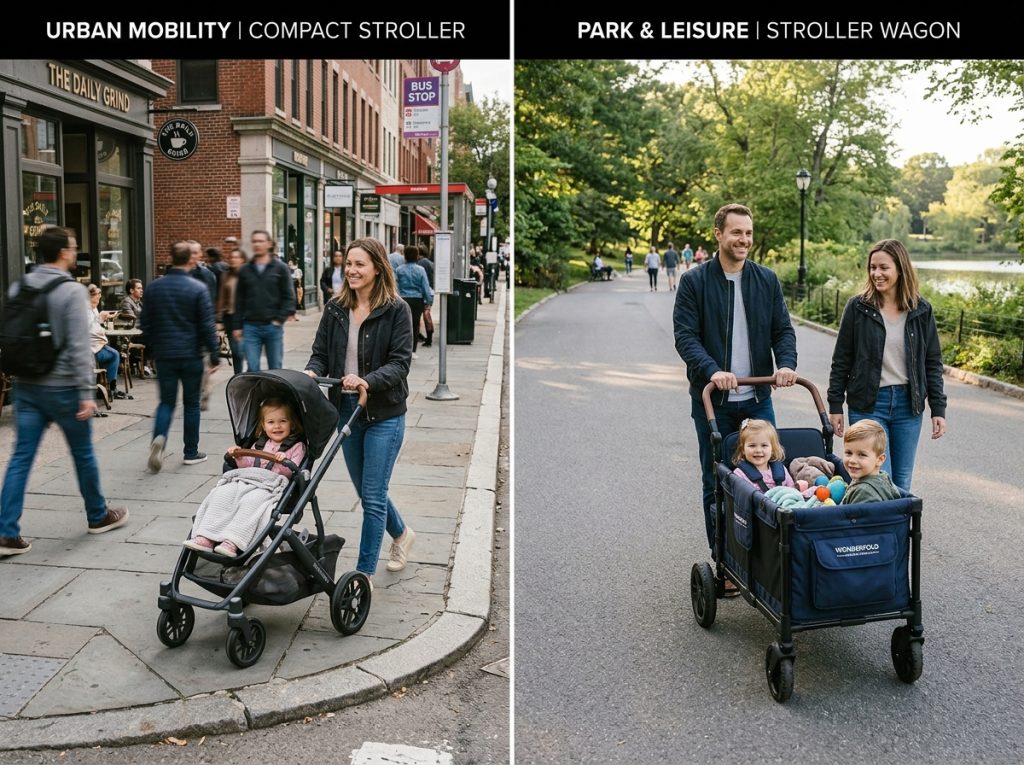
Strollers generally turn tighter and steer with less effort, especially models with a swiveling front wheel. That matters most in crowded, twisty environments — sidewalks with a lot of foot traffic, store aisles, elevators. Wagons, being longer and often wider, need more room to turn and typically favor straight-line pushing over quick direction changes. Neither is wrong, but if your daily walk involves a lot of weaving through people, a stroller’s tighter turning radius will feel noticeably easier day to day.
Push-pull flexibility is where wagons often pull ahead, though. Many wagons let you switch between pushing from behind and pulling from the front, which helps on stairs, curbs, and uneven entryways in a way most strollers simply can’t match.
Setup, assembly, and everyday folding
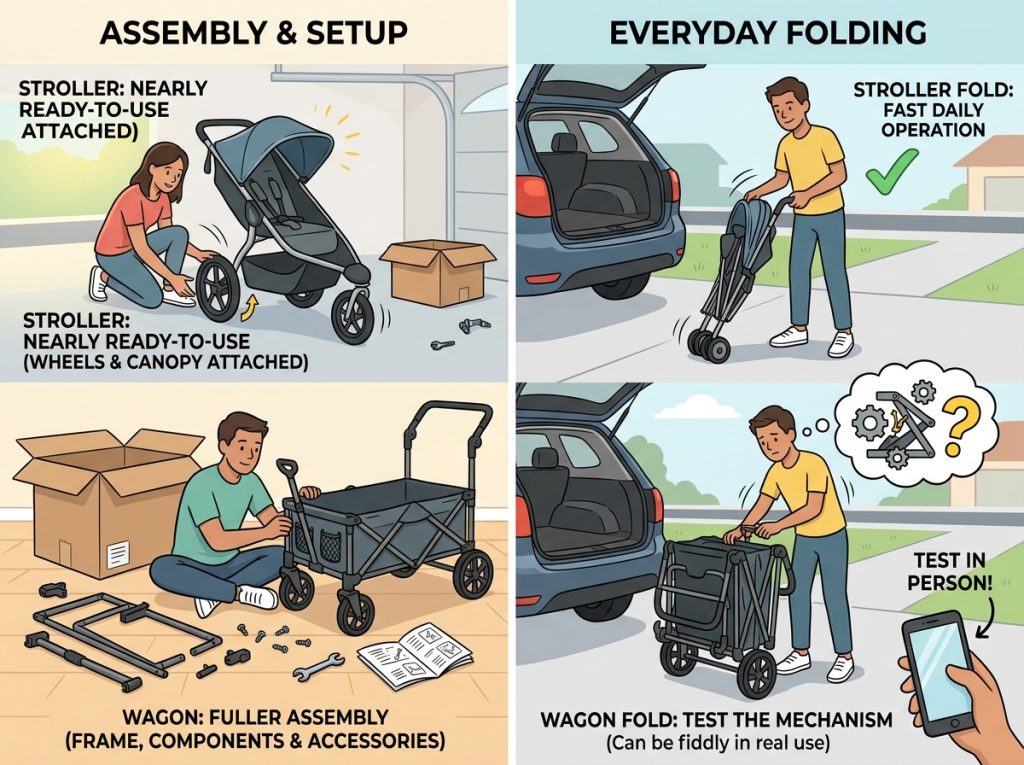
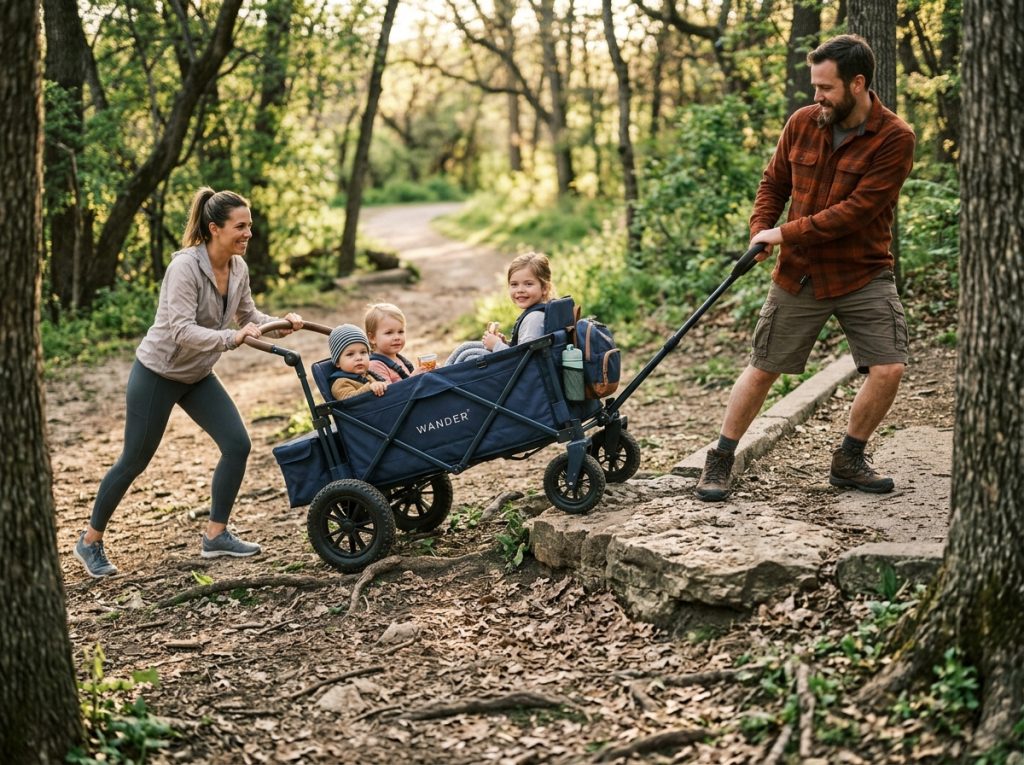
Out of the box, strollers are typically quicker to assemble — many arrive nearly ready to use, needing only wheels or a canopy attached. Wagons more often need a fuller assembly process, sometimes 15 to 20 minutes the first time, though day-to-day folding and unfolding is usually fast on both once you know the mechanism. If you’re the type of family folding and loading gear multiple times a day, test the actual fold motion before buying either one — reviews for both categories are full of complaints about mechanisms that looked simple in a product video and felt fiddly in real use.
Weather and seasonal use
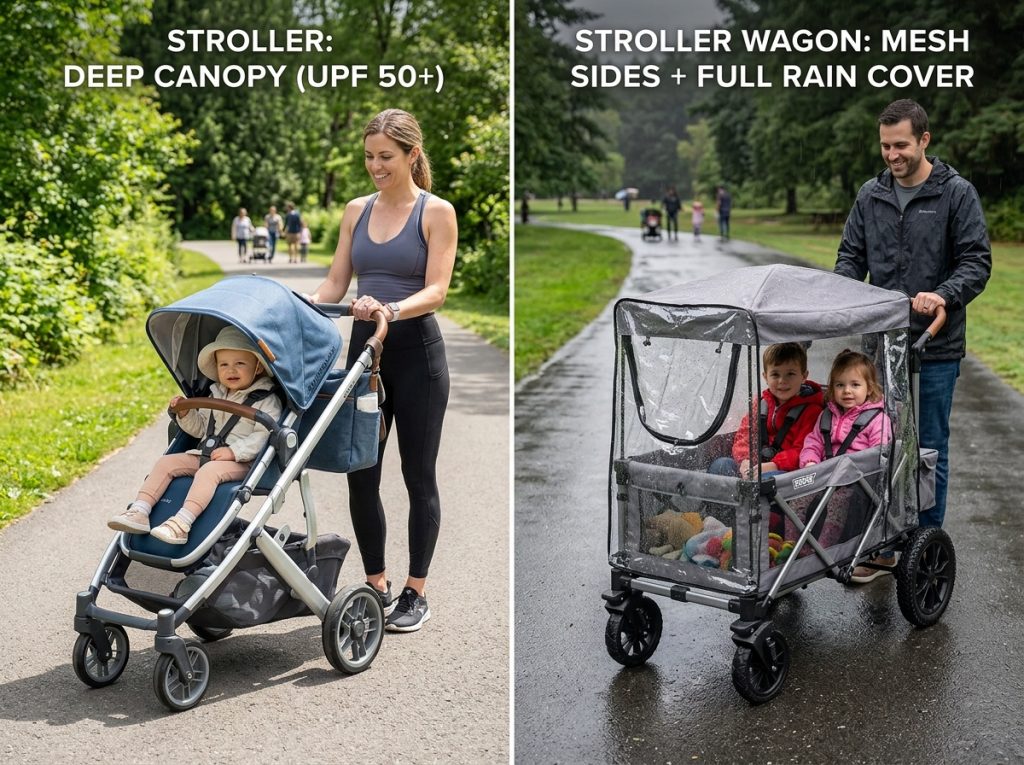
Strollers, especially travel systems, tend to have deeper, more adjustable canopies and sometimes weather shields built for cold, wind, or rain. Wagons increasingly offer similar features — blackout canopies, mesh sides for heat, add-on weather covers — but coverage varies a lot by brand and price tier. If you live somewhere with real seasonal extremes, check a specific wagon’s weather accessories before assuming it covers you the way a stroller’s rain cover and boot typically do.
Resale and hand-me-down value
Both hold resale value reasonably well if kept in good condition, but wagons tend to have a longer usable window per kid — a toddler who’s aged out of stroller use emotionally will often still happily ride in a wagon for another year or two. That extra runway can make a wagon a better multi-kid investment for families planning more children, since it stays relevant across a wider age range before it’s time to sell or pass it down.
Safety: what actually differs, not just what sounds different
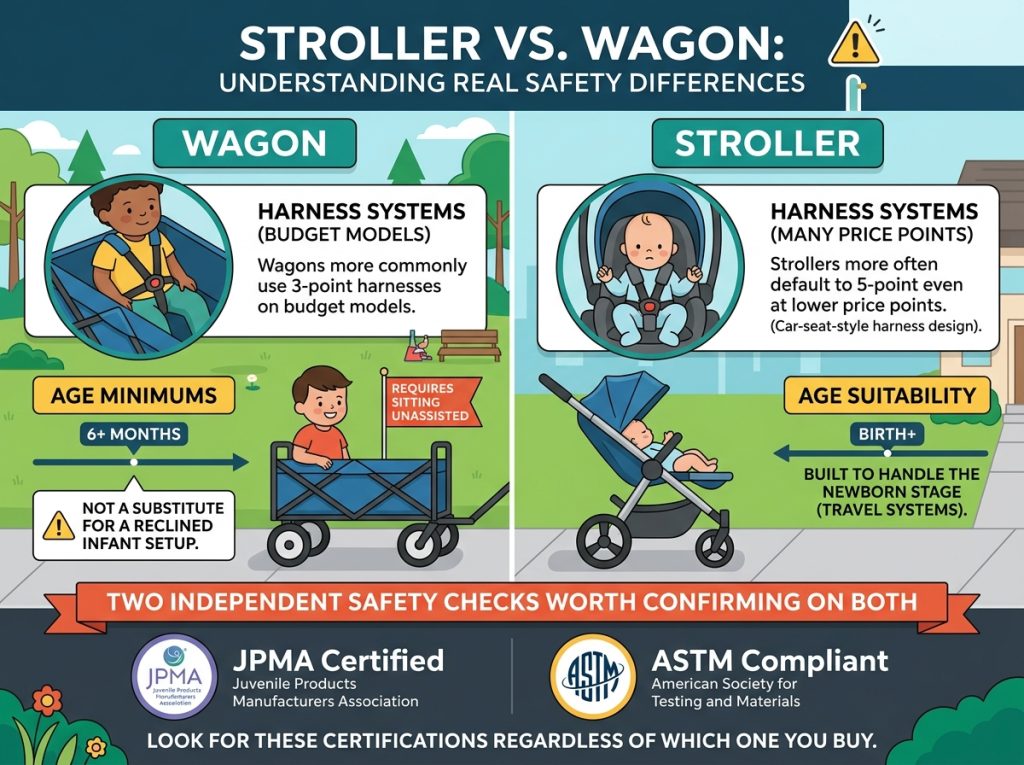
Both categories include well-certified, well-built options and cut-corner budget options — the format itself isn’t the safety factor, the specific product is. That said, a few real patterns show up across the category. Wagons more commonly use 3-point harnesses on budget models, where strollers more often default to 5-point even at lower price points, since car-seat-style harness design carried over into stroller engineering earlier. Look for JPMA certification and ASTM compliance on either format — those are the two independent safety checks worth confirming regardless of which one you buy.
Age minimums matter more for wagons specifically: most require a child to sit up unassisted, typically starting around 6 months, and manufacturers are explicit that wagons aren’t a substitute for a properly reclined infant setup. Strollers, especially travel systems, are built to handle that newborn stage in a way most wagons simply aren’t.
How long each one actually lasts as your kid grows
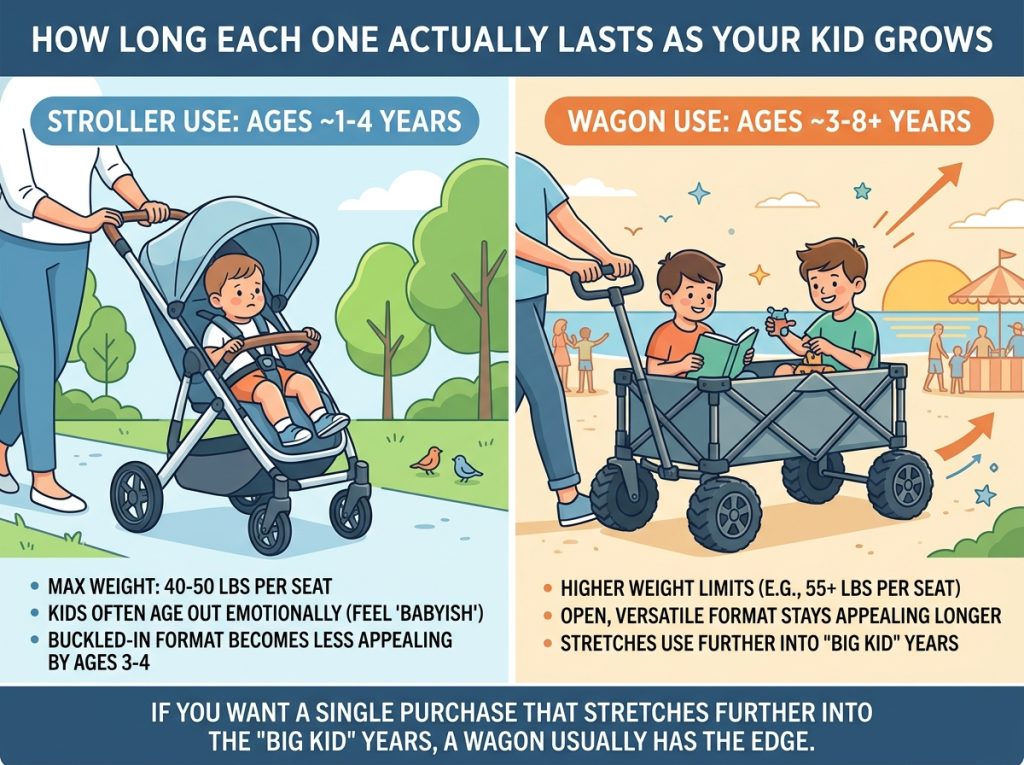
Strollers typically max out around 40 to 50 pounds per seat, and most toddlers age out of stroller use emotionally before they age out of it by weight — somewhere between 3 and 4 years old, a lot of kids just stop wanting to ride in one. Wagons often carry higher per-seat weight limits, sometimes 55 pounds or more, and the open, sit-however-you-want format tends to stay appealing to slightly older kids longer, since it doesn’t feel as babyish as being buckled into a stroller seat. If you want a single purchase that stretches further into the “big kid” years, a wagon usually has the edge.
Portability: the part people get wrong
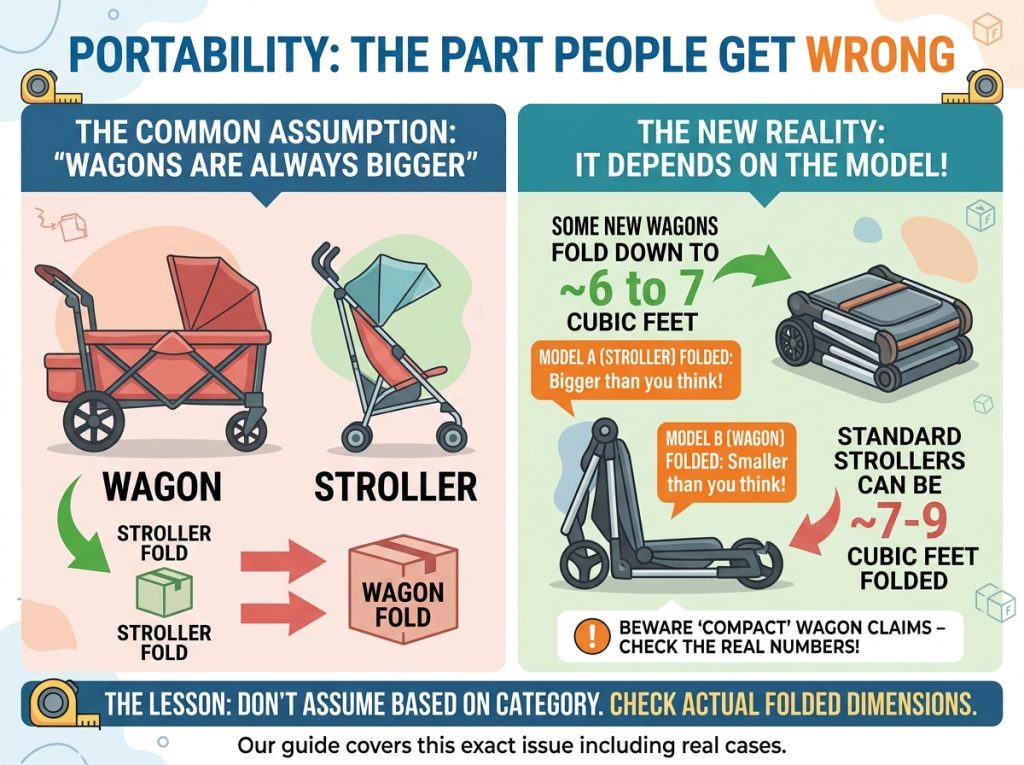
The assumption that strollers always fold smaller than wagons isn’t universally true anymore. Some newer wagons fold down to 6 to 7 cubic feet, smaller than plenty of standard (non-umbrella) strollers. Meanwhile, some wagons marketed as “compact” actually fold bigger than expected once you check the real numbers. The lesson: don’t assume based on category. Check the actual folded dimensions for the specific model you’re considering, whether it’s a stroller or a wagon. Our guide to compact and lightweight stroller wagons covers this exact issue in more depth, including a real case where a brand’s own “smallest” model folded bigger than its competitors.
Budget and premium tiers exist in both categories
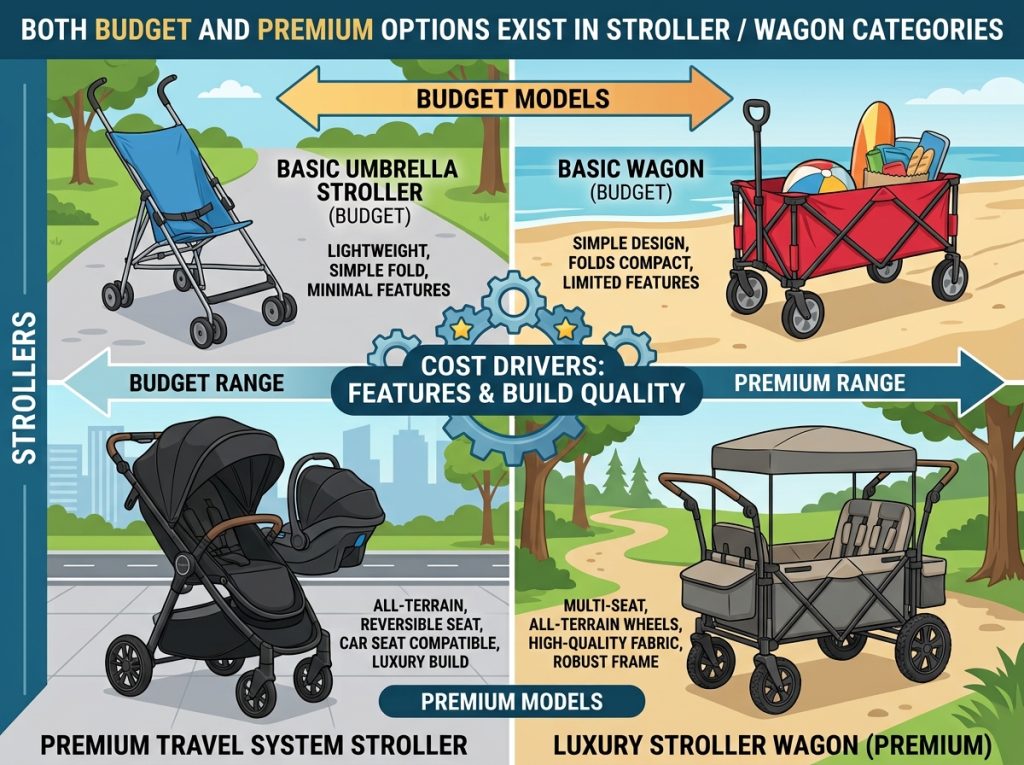
Don’t assume one category is inherently cheaper or more expensive than the other — both span a huge range. A basic umbrella stroller and a budget wagon can land in a similar $150 to $250 window, while premium versions of either — a full-featured travel system stroller or a luxury multi-seat wagon — can run well past $700. The real cost driver is features and build quality within each category, not stroller versus wagon as a category choice. If you’re comparing specific premium wagon options, our guides to heavy-duty stroller wagons and compact, lightweight stroller wagons both cover that upper range in detail.
Cost comparison over time
Sticker price is only part of the real cost. A double stroller plus a separate wagon for gear-heavy days adds up fast. A single well-chosen wagon that seats two kids and hauls gear can replace both purchases for some families. On the other hand, if you only ever need single-child, everyday portability, a $100 stroller does that job without the higher wagon price tag ever being justified. Match the purchase to what you’ll actually use weekly, not what covers every hypothetical scenario.
Can a wagon fully replace a stroller?
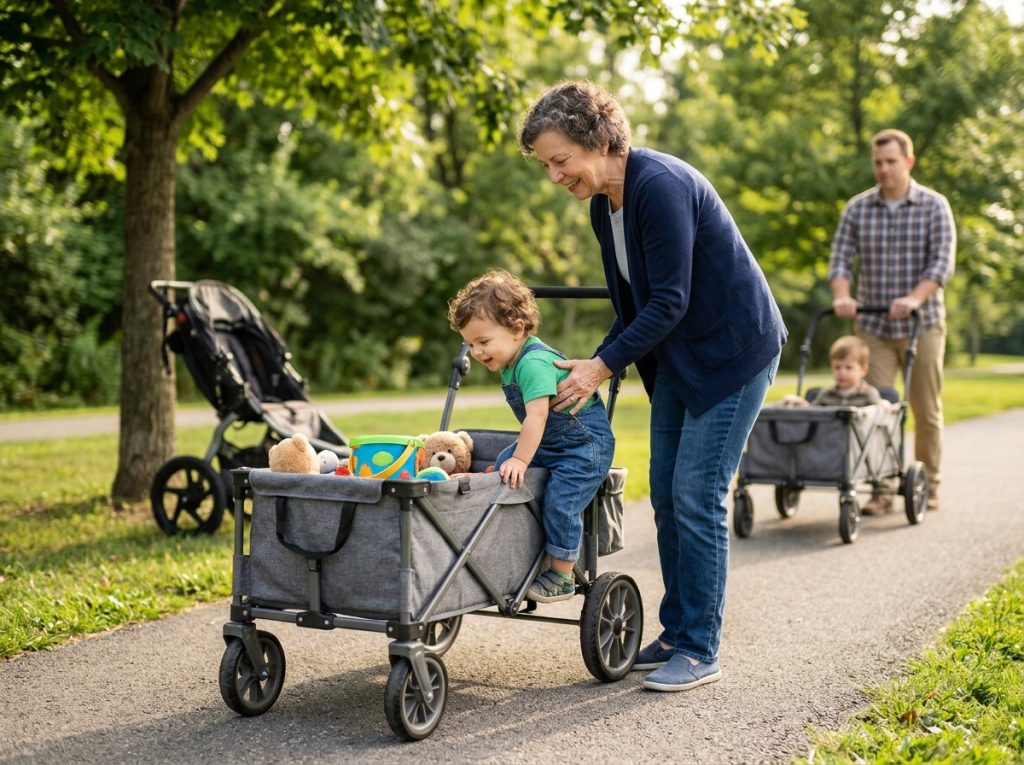
For toddlers past the infant stage, often yes — plenty of families use a wagon as their only mobility gear from about 18 months onward. For newborns and young infants, no, not without a proper car seat adapter and realistic expectations about what that setup can and can’t do. Most families end up owning both at different life stages rather than picking one forever. If you’re trying to figure out whether it’s worth buying a wagon at all before your stroller is fully retired, our guide on whether a stroller wagon is worth it walks through that decision directly.
Common questions
What age is right for a wagon instead of a stroller?
Most wagons are built for kids 6 months and up who can sit unassisted, but wagons really start to shine as the primary choice somewhere around 18 months to 2 years, once a toddler wants more room to move and a stroller starts to feel restrictive.
Are wagons safer than strollers, or the other way around?
Neither format is inherently safer. Certification (JPMA, ASTM), harness quality, and brake reliability matter far more than whether it’s a stroller or a wagon. A cheap, uncertified wagon is not safer than a well-built stroller, and the reverse is just as true.
Can a toddler nap in a wagon the way they can in a stroller?
Often better, actually. Many wagons have flatter, wider surfaces than a reclined stroller seat, and some include a true lay-flat mode. A stroller’s recline is usually more limited by comparison, though a few premium strollers do offer near-flat positions specifically for napping.
Do wagons work for grocery store trips?
Less well than strollers, generally. Most wagons are wider than standard aisles feel comfortable with, and maneuvering one around a crowded store is harder than steering a stroller. For quick errands like this, a stroller usually wins.
Is it worth owning both a stroller and a wagon?
For a lot of families, yes — a lightweight stroller for errands, travel, and the infant stage, and a wagon for parks, beach days, and hauling gear as kids get older. If budget only allows for one, match the purchase to whichever situation you’re in weekly, not occasionally.
Can twins use a wagon instead of a double stroller?
Often, yes. Most multi-seat wagons are built with two or more seats side by side or facing each other, which tends to be more comfortable for twins than a narrow double stroller, and gives each child more shoulder and leg room. Check the per-seat weight limit carefully if your twins are on the larger side for their age.
Do wagons or strollers hold up better outdoors long-term?
It depends more on frame material and certification than the category itself. Steel and aluminum-framed wagons with rust-resistant coatings tend to hold up well outdoors over years; the same is true of well-built strollers with sealed bearings and quality fabric. Cheap versions of either will wear out faster regardless of which type it is.
The bottom line
Pick a stroller for infants, tight indoor spaces, air travel, and pure budget. Pick a wagon for toddlers on longer outings, multiple kids, gear-heavy days, and rougher terrain. Most families outgrow the need to choose just one — they end up with a stroller for the early years and a wagon that takes over as the kids get bigger and want more room. If you’re deciding what to buy first, our roundup of the best stroller wagons for toddlers is a good next stop once you’ve decided a wagon fits your situation.