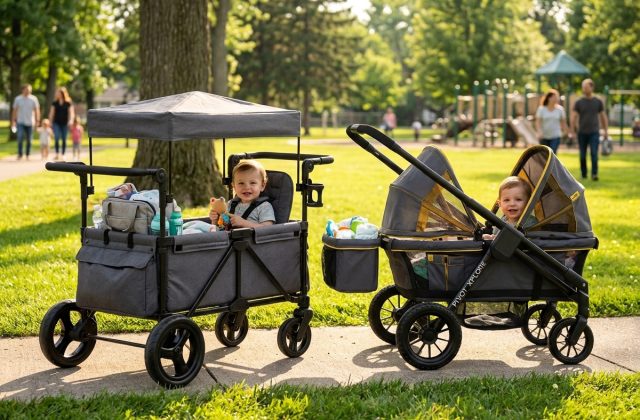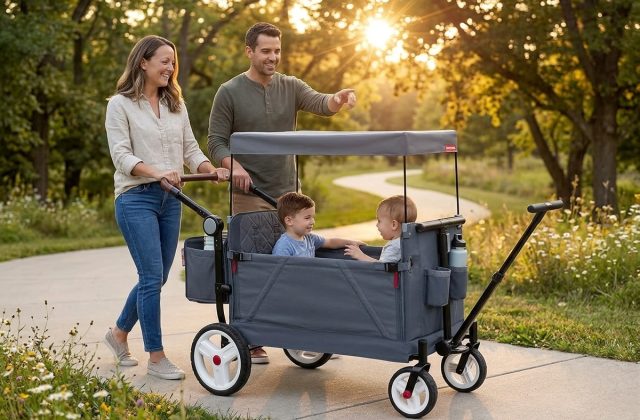
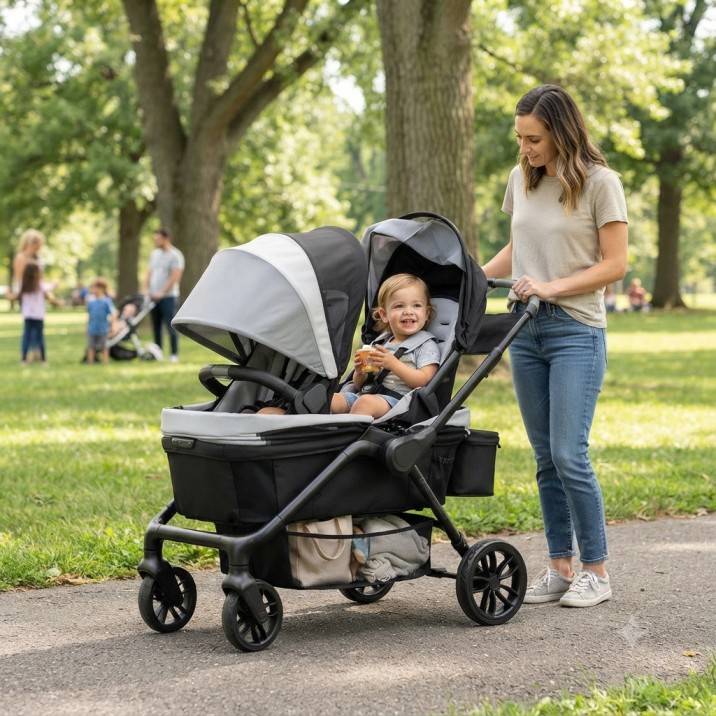
This wagon runs around $180 to $220, which puts it way under Veer or WonderFold territory. For that price, you get two memory-foam seats, a car seat adapter thrown in for free, a zip-up footwell, and a fold that doesn’t eat your whole trunk. It’s made by Monbébé, which is part of Dorel Juvenile — the same company behind Cosco and Safety 1st — and that connection explains a few things about how this wagon is built, for better and worse.
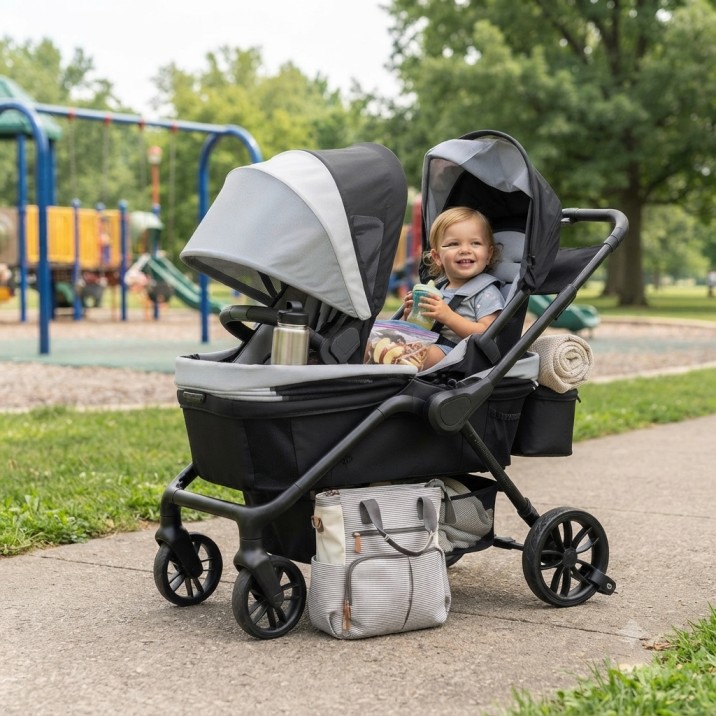
Here’s the part that matters most before you buy: most owners like it. A few don’t, and one report of the front frame snapping after light use, paired with a company that reportedly went quiet when the buyer tried to reach customer service, is the kind of thing worth knowing about going in. Nobody can promise you’ll be fine or you won’t. But it’s on the table, and a review that skips it isn’t doing its job.
What you actually get for the price
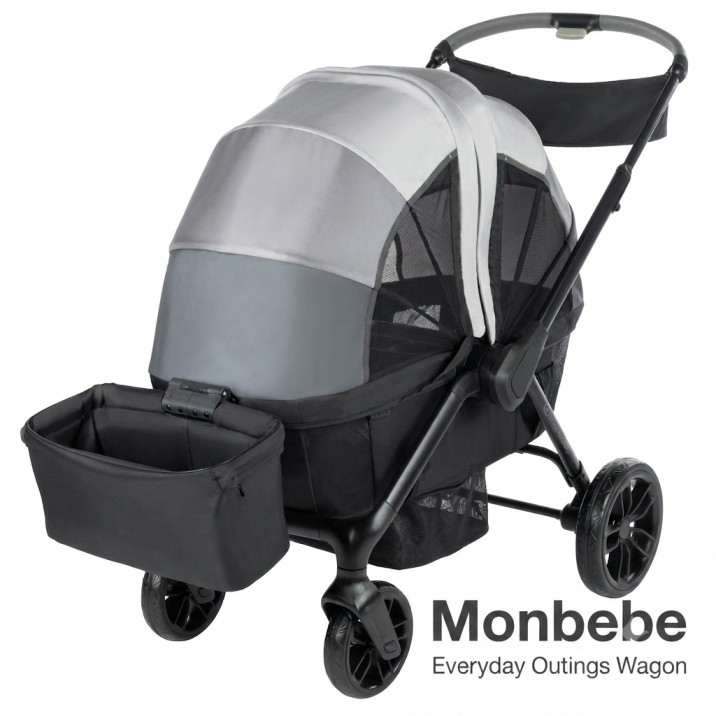
The wagon holds two kids and up to 120 pounds combined, starting around 6 months old once a baby can sit up on their own without an adapter. It comes in a handful of colors — Cobblestone Grey, Cardinal Red, and a Watercolor Geo print — and it’s sold almost exclusively through Walmart, both new and, if you want to save even more, through secondhand baby gear sites like GoodBuy Gear. There’s also a rental version available through BabyQuip if you just need one for a trip or a short stretch rather than owning it outright.
That it shows up in a rental catalog and a resale marketplace is worth noting on its own — those businesses don’t stock gear nobody wants back or nobody trusts. It’s a small signal, not proof of anything, but it’s a real one.
Who actually makes this thing
Monbébé isn’t a wagon-first company the way Keenz or WonderFold are. It’s a baby gear label under Dorel Juvenile, the same parent company as Cosco and Safety 1st. That’s not a red flag by itself — Dorel’s been making car seats and strollers for decades. But it does explain why the included car seat adapter only works with Safety 1st and Cosco infant seats. If you own a Chicco, Graco, or UPPAbaby seat, this adapter isn’t for you, full stop.
The seats: comfortable, but a step down on the harness
Comfort
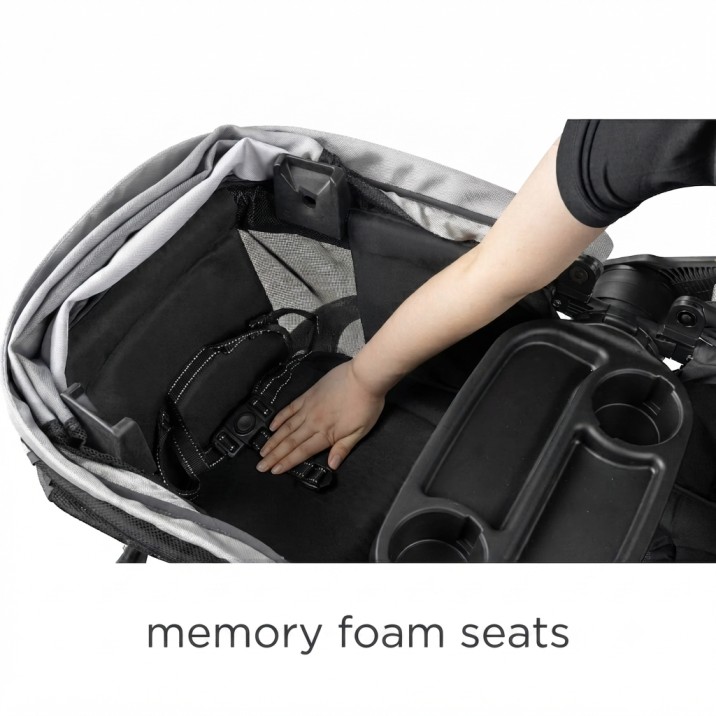
Both seats use memory foam, and multiple owners specifically call the ride comfortable — that’s not nothing for a wagon at this price. It’s the kind of detail budget wagons sometimes skip entirely in favor of thin, flat padding.
Harness
The catch is the harness. It’s a 3-point harness, not the 5-point harness you’d get on a Keenz, WonderFold, or Jeep Aries. A 3-point harness is still a real, functional restraint system, and it’s standard on plenty of budget strollers. It’s just less coverage than the 5-point setups the premium brands lean on, and that gap is worth knowing rather than assuming it’s the same thing under a different name.
Wheels and ride: fine on pavement, questionable long-term
How it actually rides
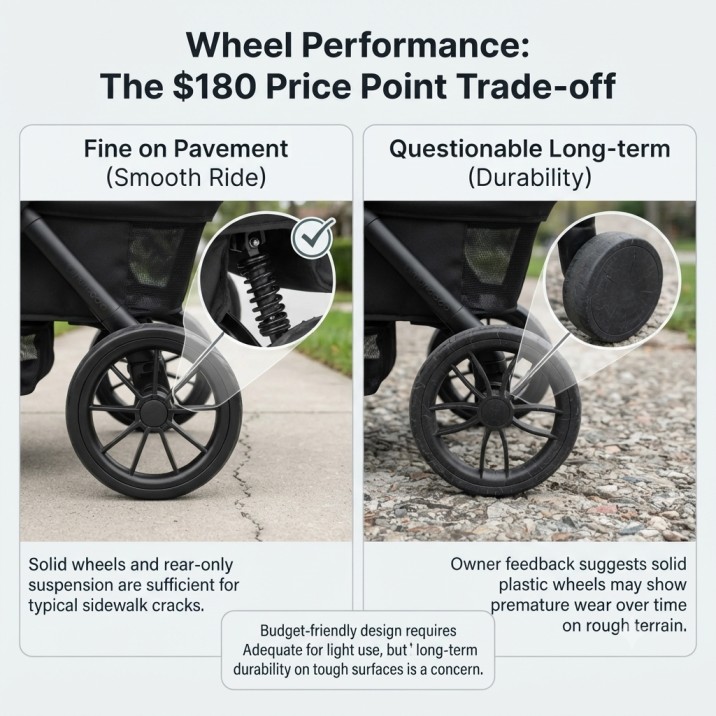
The wheels are solid, not air-filled, with suspension in the rear only — not the four-wheel setups you get on pricier wagons. Owner feedback on the actual ride is good: people describe it handling different terrain smoothly and steering well, and one owner specifically praised the maneuverability and suspension for handling everything they’d run into so far.
The durability question mark
At least one owner flagged the wheels themselves as solid plastic and doubted they’d hold up long-term, especially on concrete. That’s a durability guess from one buyer, not a confirmed pattern, but it lines up with what you’d expect from a wagon built to hit a $180 price point — something gets cut to get there, and wheel material is a common place for that. Rear-only suspension is another one of those spots; it’s enough to smooth out normal sidewalk cracks and bumps, but it’s not doing the same job as suspension on all four corners over consistently rough ground.
Storage and the zip-up footwell
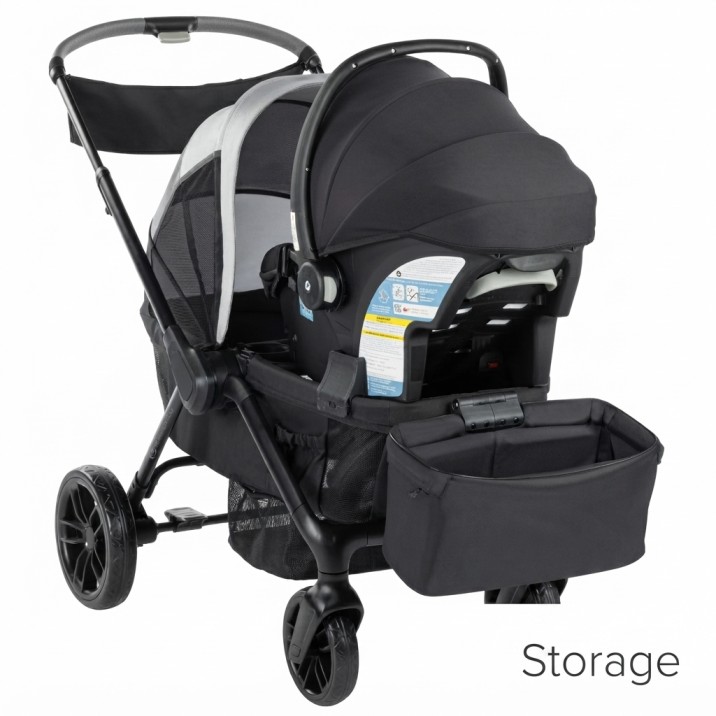
There’s a separate storage basket that owners say is genuinely useful, and several mention clipping it onto whichever side they’re pushing from. The standout feature, though, is the footwell — it zips out for cleaning, or zips shut, turning the bottom into something closer to an enclosed pod. More than one owner brought this up unprompted as their favorite part, mostly for naps. A kid asleep in a wagon with the footwell zipped up stays warmer and more contained than one just sitting in an open seat.
It’s a small design choice that a lot of pricier wagons don’t bother with, probably because their canopies and blackout panels are doing a version of the same job a different way. Here, it’s simpler: zip it up, kid’s contained, zip it down, floor’s exposed for muddy shoes or beach sand. Either way, it comes out for a wash instead of you scrubbing fabric attached to the frame.
The fold: compact once you figure it out
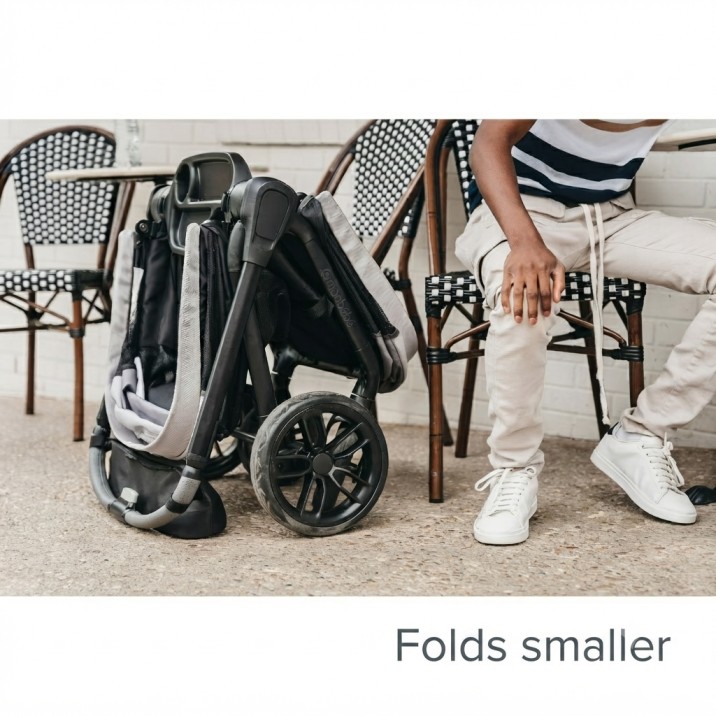
Owners consistently say this folds smaller than a lot of double strollers and weighs less too — genuinely one of its stronger selling points against bulkier wagons. The catch is the learning curve. One reviewer said the instructions for opening it out of the box weren’t clear, and Walmart’s own product page admits the foldability is “tricky to operate” even while calling it compact. Give yourself the first two or three tries in your driveway, not at the store parking lot with a toddler waiting.
Putting it together
One owner said it took about two minutes to assemble once they figured out how to open it, and mentioned doing the whole setup in a parking lot right after buying it. Another said the wagon arrived partially assembled already, which cut down the work even more. Nothing here suggests you’ll need tools or a spare hour — just budget a few extra minutes the first time for figuring out the fold-open mechanism, since more than one buyer mentioned that part being unclear at first glance.
The car seat adapter: included, but narrow
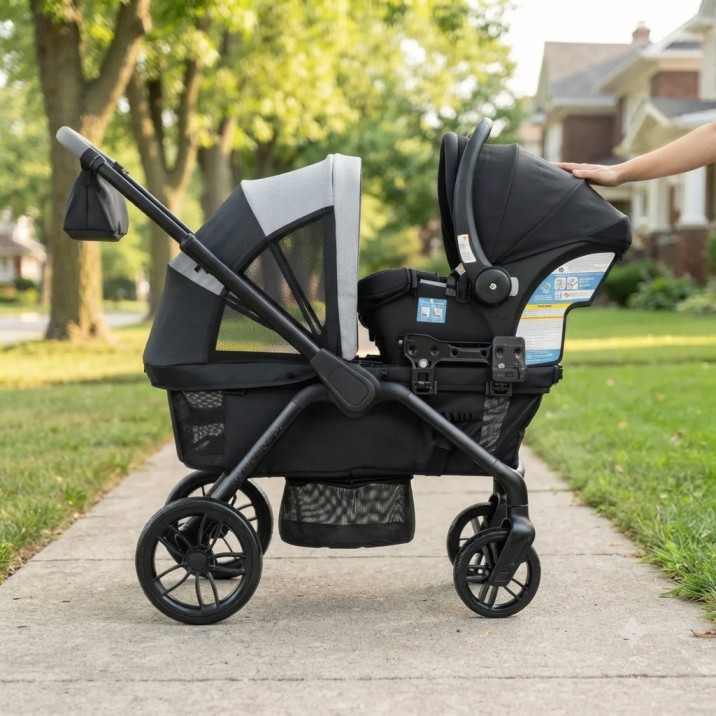
This is one of the few wagons in this price range that throws in a car seat adapter at no extra cost instead of charging $60 to $150 for it later. The tradeoff is the compatibility list is short: Safety 1st and Cosco infant seats, and that’s about it — a direct result of Monbébé, Safety 1st, and Cosco all sitting under the same parent company.
If you already own a Safety 1st or Cosco seat, this is free money compared to what other wagon brands charge for the same function. If you own something else — Chicco, Graco, UPPAbaby, Nuna — the included adapter simply won’t click in, and buying a separate universal or brand-specific adapter isn’t really an option here the way it is with WonderFold or Keenz, since Monbébé doesn’t sell one. Owners with other brands report just setting the car seat into the wagon bed without any adapter and it holding steady enough for careful use, but that’s not the same as a tested, secured fit, and it shouldn’t be treated as one for longer walks or rougher ground.
The part you actually need to know before buying
What most owners actually say
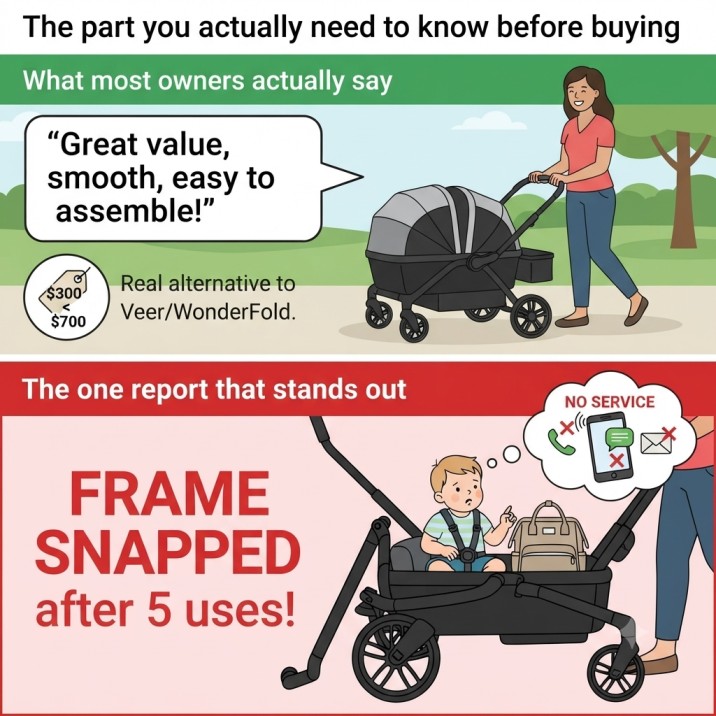
Most of what’s out there on this wagon is positive — people call it a great value, easy to assemble, smooth to push, and a real alternative to spending $500 to $900 on a Veer or WonderFold. One reviewer said flat out they’d wanted one of those pricier wagons for a while but couldn’t justify the cost, and this covered what they needed.
The one report that stands out
There’s at least one report of the front frame snapping after only five uses, with the heaviest load being a 23-pound one-year-old and a diaper bag — nowhere close to the wagon’s stated 120-pound limit. The same owner said reaching customer service afterward went nowhere: no response by phone, text, or email.
How much weight to put on one report
That’s one account, not a pattern confirmed across hundreds of buyers, and plenty of other owners report zero structural issues after regular use. But a frame failure under light, normal use — not overloading, not rough handling, just five ordinary trips — is a serious kind of complaint, not a minor annoyance like a squeaky wheel. Combined with a customer service experience that reportedly went nowhere, it’s the kind of thing that should factor into your decision, especially if you’re leaning toward daily, heavy use rather than occasional outings.
How it stacks up against Veer and WonderFold
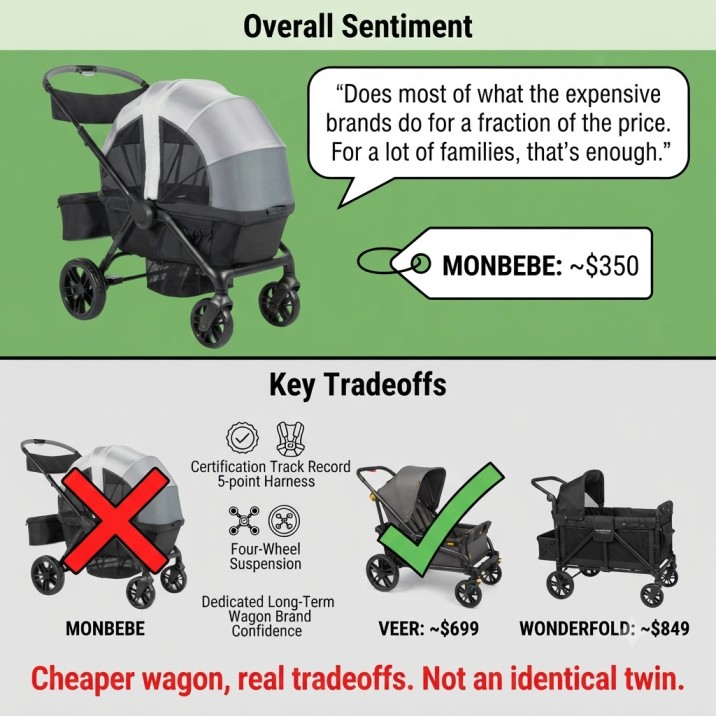
Owners bring this comparison up on their own, unprompted, which says something. The general sentiment: this wagon does most of what the expensive brands do for a fraction of the price, and for a lot of families that’s enough. What it doesn’t match is the certification track record, the 5-point harness, the four-wheel suspension, or the kind of long-term build confidence that comes from a brand that’s been making wagons specifically, not just strollers and car seats, for years. If you’re weighing this against something like the Veer Cruiser or a WonderFold W2, the honest framing is: cheaper wagon, real tradeoffs, not a hidden identical twin at a discount.
Consider renting it first
Given the mixed signals on long-term durability, and the fact that a rental option already exists through BabyQuip, renting for a trip or a two-week trial before committing to a purchase isn’t a bad way to de-risk this one. You get a real sense of the fold, the ride, and whether the seats fit your kids comfortably, without gambling $180 to $220 on something you haven’t put your hands on. That’s not an option every wagon on the market offers, so it’s worth taking advantage of if you’re on the fence.
Who should buy this
Families who want a two-kid wagon for occasional errands, park trips, and outings, without spending premium-brand money, and who are comfortable accepting some uncertainty on long-term durability. If your car seat happens to be a Safety 1st or Cosco model, the included adapter makes this an even easier call, since you’re not paying extra for something other brands charge $60-plus for separately.
Who should skip it
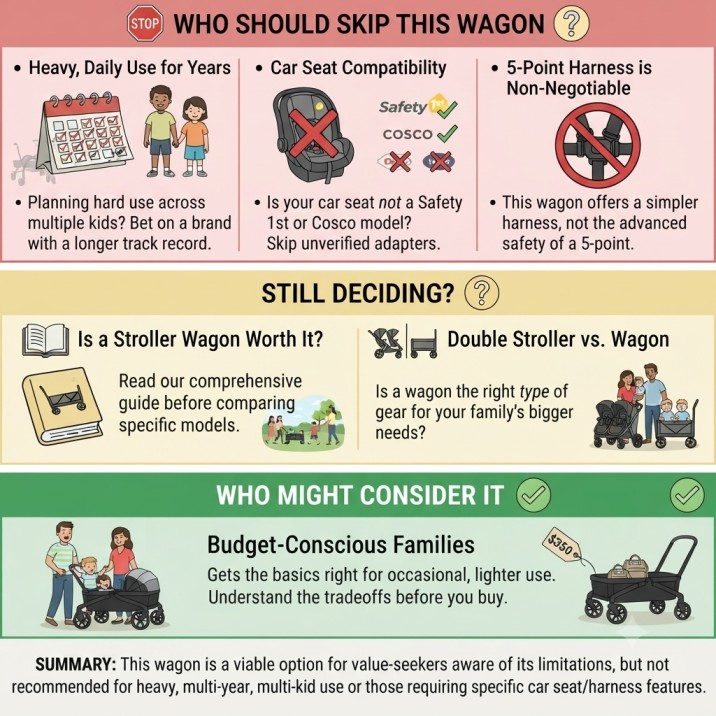
Skip it if you’re planning heavy daily use for years across multiple kids — the frame-snap report, even as a single data point, is enough reason to lean toward a brand with a longer wagon-specific track record if you’re betting on years of hard use. Skip it if your car seat isn’t a Safety 1st or Cosco model and having a properly tested adapter matters to you. And skip it if a 5-point harness is a non-negotiable for you rather than a nice-to-have — that’s simply not what this wagon offers.
If you’re still deciding whether a wagon makes sense for your family at all, our guide on whether a stroller wagon is worth it is worth a read before you compare specific models. And if you’re torn between a double stroller and a wagon in the first place, that comparison covers the bigger decision, not just this one option.
For everyone else — budget-conscious families who want most of what the expensive wagons offer without the expensive-wagon price tag — this one gets the basics right. Just go in with your eyes open about where the corners were cut.