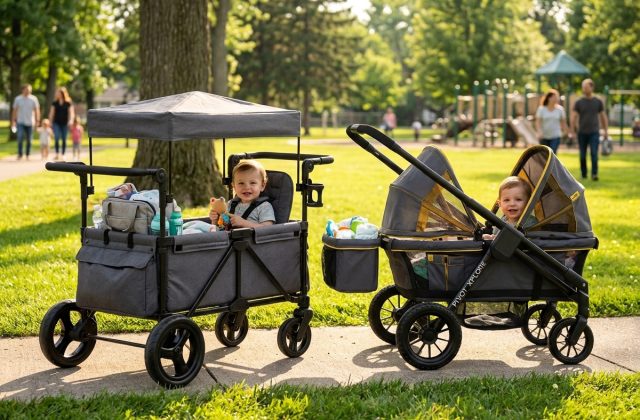
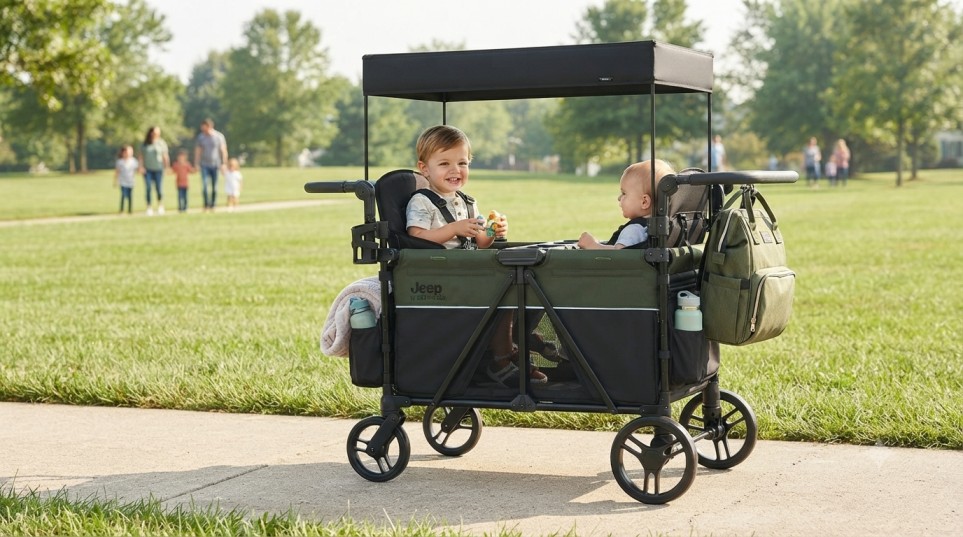
The Jeep Aries is a 2-seat stroller wagon built by Delta Children, and it sits right below the big four-seat wagons in price and size. That’s the whole story of this wagon, more or less. It’s not trying to be a Wonderfold. It’s trying to be the wagon most families actually need without the extra bulk, the extra weight, and the extra $200 to $400.
If you have one or two kids and you’re not sold on hauling around a wagon the size of a golf cart, the Aries is worth a real look. If you’re picturing four kids piled in with a full week of beach gear, this is not that wagon, and no amount of clever folding changes that.
Street price on the Aries usually lands somewhere between $350 and $450, depending on the retailer and the sale. The listed retail price is $499.99, but it’s rare to see anyone actually pay that.
What This Wagon Is Actually Trying to Solve
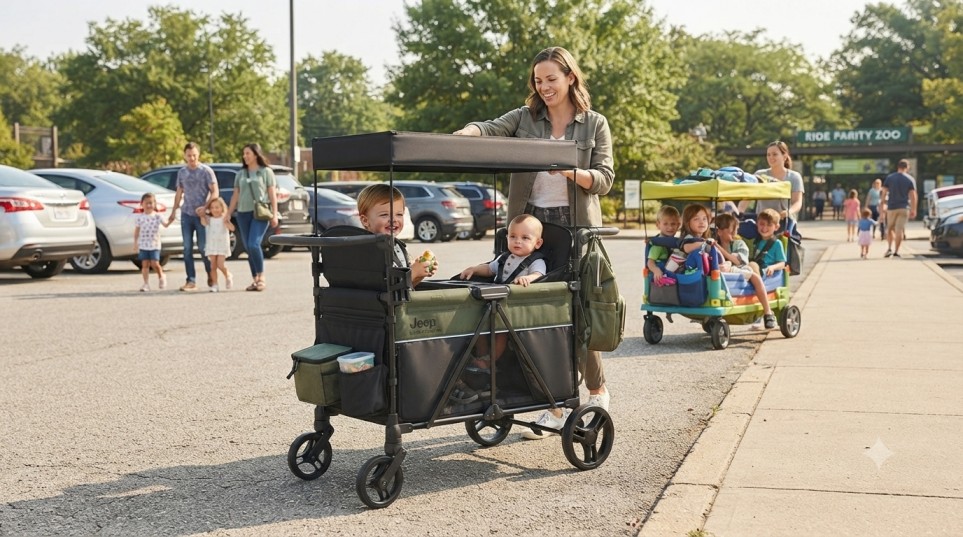
Most parents shopping this category have already looked at a Wonderfold or a Keenz and felt a little sticker shock. Those wagons run $700 to $900 once you add accessories, and they’re heavy. Really heavy. Some push past 55 or 60 pounds before you put a single kid in them.
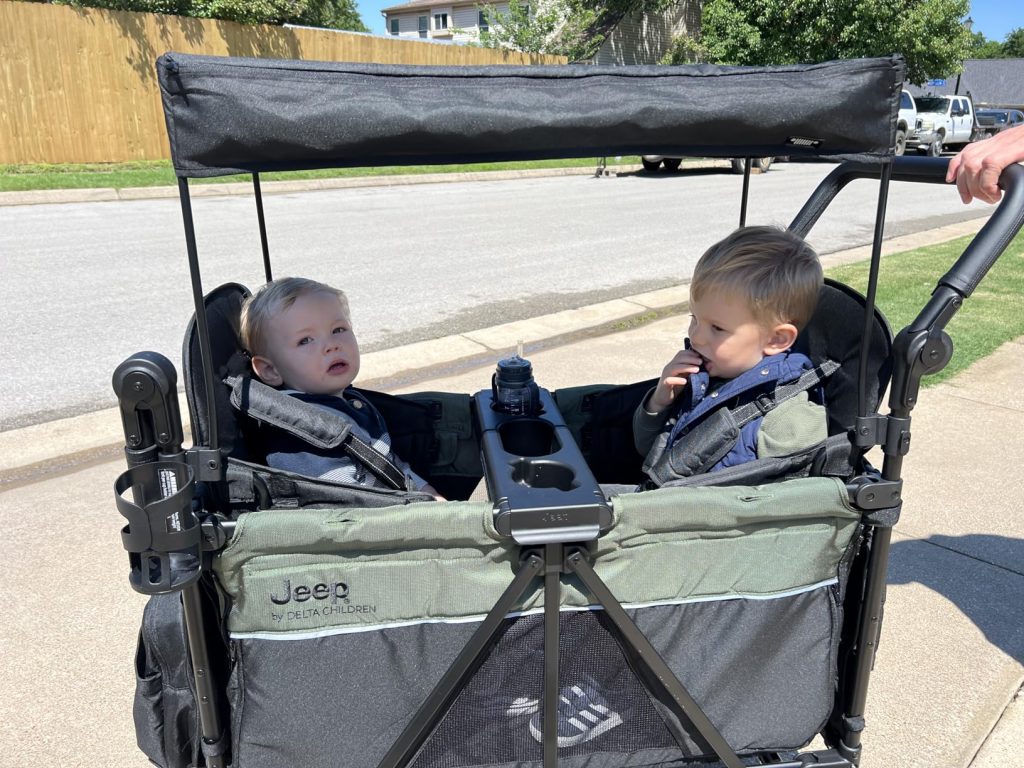
The Aries weighs 47.23 pounds. Still not light, but noticeably easier to muscle into a trunk than a full four-seater. It carries two kids in a bench-and-jump-seat setup, with the seats able to face forward, backward, inward, or outward, or come off entirely so the wagon turns into a straight-up cargo hauler.
A lot of two-seat wagons lock you into stroller mode and nothing else. The Aries doesn’t. Pull the seats and you’ve got open space for a cooler, a beach bag, and whatever else you dragged along.
Fold and Storage: Where the Aries Actually Wins
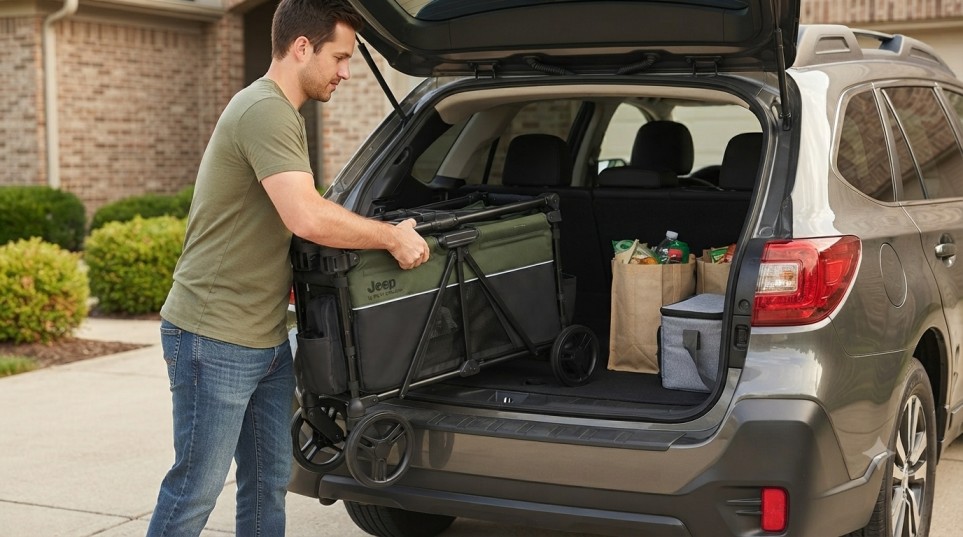
This is probably the strongest single point in the Aries’ favor, and it’s worth spending real time on because it’s the thing that decides whether you’ll actually use this wagon three months from now or let it sit in the garage.
The Aries folds flat. Not folds-into-a-weird-shape-that-still-needs-a-corner-of-the-garage flat. Actually flat, down to about 25.6 inches long, 24.25 inches wide, and 41 inches tall folded. That’s meaningfully smaller than most 4-seat wagons in their folded state, and it’s the difference between fitting in a normal trunk with groceries still in there, versus needing to fold down your back seats every time.
Compare that to something like the Wonderfold W4 Luxe, which folds well for its size but is still built around a much bigger frame. You’re trading raw capacity for a wagon that’s simpler to live with day to day. For a lot of families, that trade is the whole point of buying a smaller wagon in the first place.
Assembly out of the box takes a bit of patience. The tires need to be inflated to the right PSI, the canopy pole slides into place, and the seats attach with hardware and velcro tabs. Give yourself 20 to 30 minutes the first time. After that, the daily fold and unfold is quick.
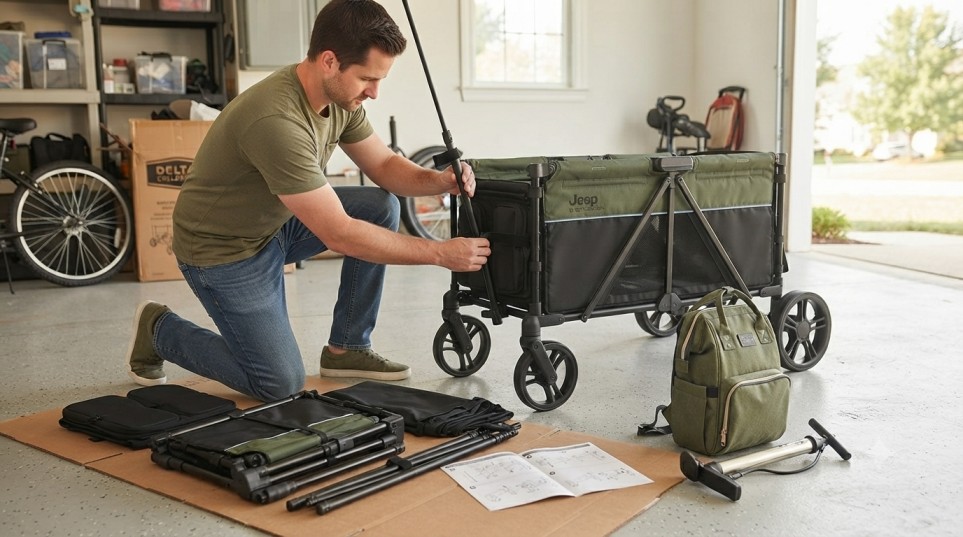
It’s still compact next to a 4-seater, but let’s not pretend it disappears into your trunk the way a double stroller does. If your only frame of reference is an umbrella stroller, the Aries will still feel like a big piece of gear. It just feels big in a manageable way instead of a “rearrange your whole car” way.
At 47.23 pounds folded, it’s also worth being honest that lighter than a 4-seater doesn’t mean light. Lifting it up and into an SUV trunk is still a two-handed job for a lot of parents, especially smaller-framed ones, and it’s not something you’ll want to do one-handed while also holding a kid.
Ride Quality: Good, Not Premium
The Aries rolls on 7-inch front wheels and 10-inch rear wheels, both puncture-proof, with suspension built into the frame. On sidewalks, paved paths, and grass, it handles fine. Nothing about the ride feels cheap or flimsy.
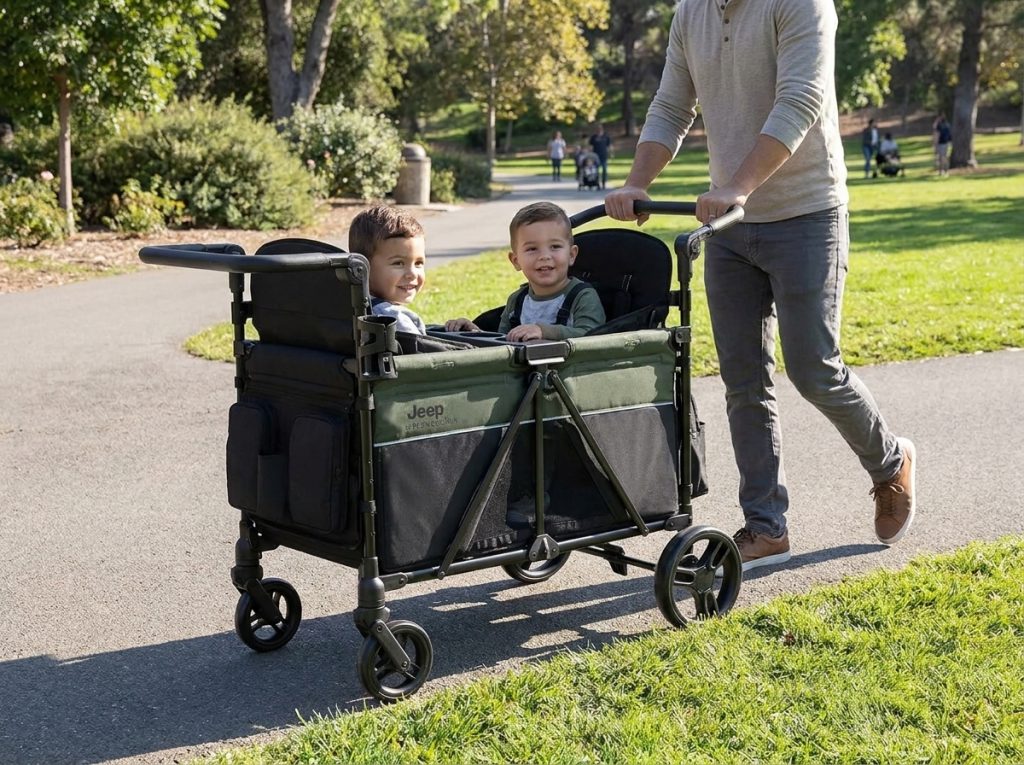
Where it starts to show its price point is on rougher ground. Gravel, uneven trail, and deep sand are where the smaller wheel size becomes noticeable compared to wagons built specifically for all-terrain use. It’s not a bad ride. It’s just not the smoothest ride in the category, and Jeep branding on the wagon doesn’t change the physics of a smaller wheel.
If beach use is a big part of why you’re buying, I’d cross this one off the list. It’ll survive a beach day, but it won’t be effortless, and there are wagons built specifically for that job. Our best beach wagons for kids guide breaks down which wheel setups actually hold up on soft sand, and the Aries isn’t a standout there.
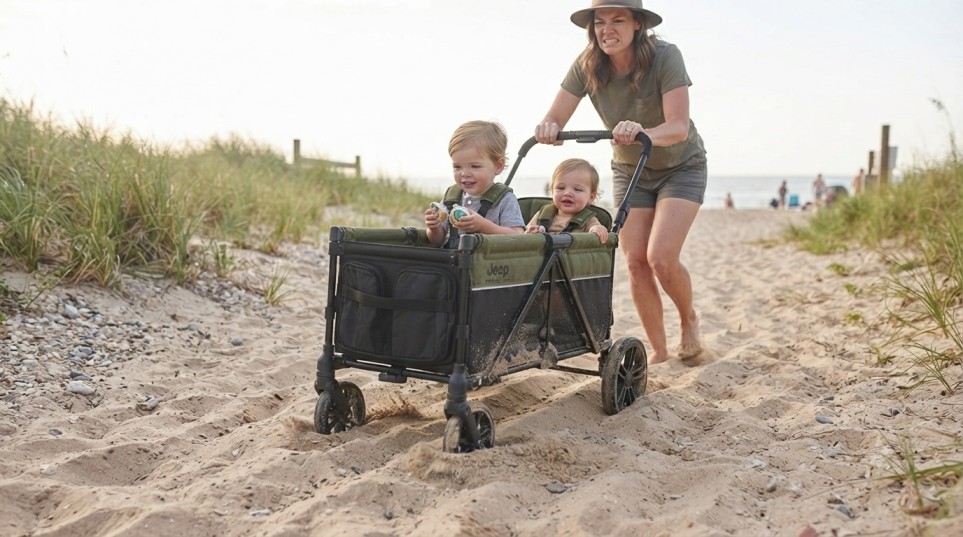
Steering with two kids and a loaded cargo area takes a bit more arm than you’d expect from the marketing photos. It’s manageable. Just don’t expect one-finger steering once the wagon is fully loaded, and if you’re a smaller parent, know that 47 pounds of empty wagon plus two kids and a diaper bag is real weight to push uphill or off a curb.
How Comfortable Is It for the Kids Actually Riding In It?
This is the part most spec sheets skip, and it’s usually the part parents care about most.
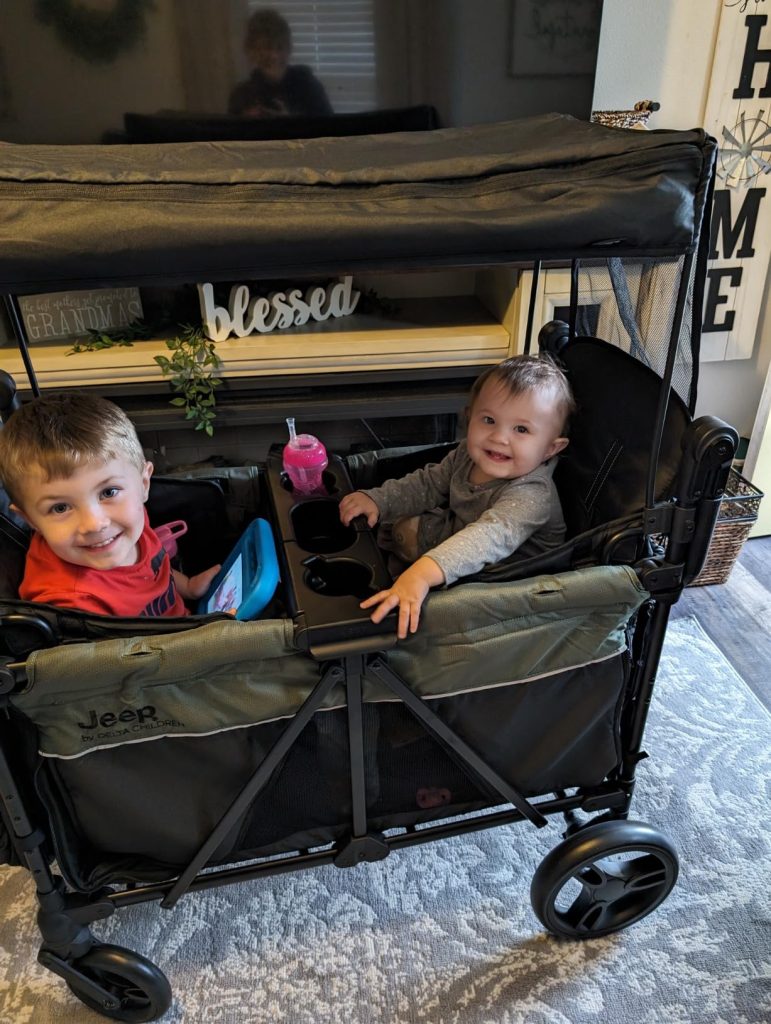
The two seats are not equal, and it’s worth knowing that going in. The bench seat is wider and sits lower, so a toddler or preschooler has room to shift around without feeling boxed in. The jump seat is smaller by design, and a bigger kid will notice it faster than a smaller one does. For a toddler-plus-preschooler pairing, put the older kid on the bench and the younger one in the jump seat. It just works better that way, and doing it the other way around tends to make the older kid complain within a couple outings.
Toddler plus toddler is a more even match. Two similarly sized kids in the two-to-four range generally do fine in either spot, and swapping them between seats on different outings doesn’t seem to cause any real problem. The jump seat rider still gets a bit less legroom, but at that size it rarely seems to register.
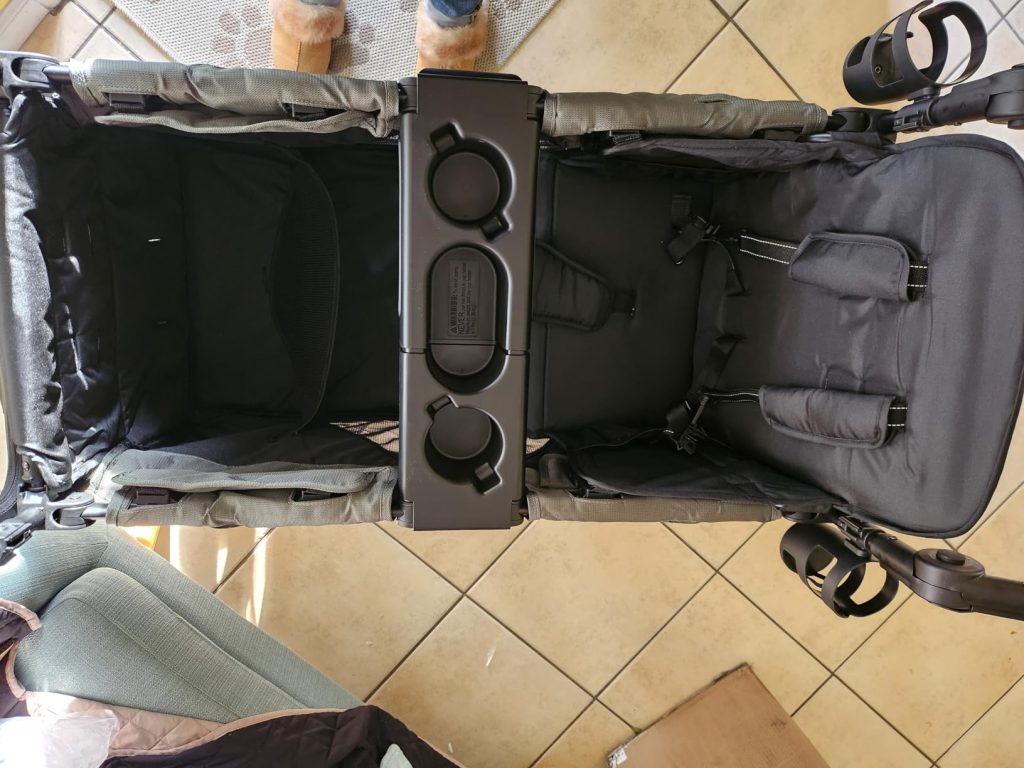
Whether this replaces a true double stroller depends on what you’re using a double stroller for. For walking, errands, and kids who are content to sit and look around, it holds up fine, and the wagon layout actually gives both kids more shoulder room than most side-by-side doubles. Where it falls short of a real double stroller is recline. There isn’t a proper recline position here, so for a child who needs to lie back to sleep comfortably, this is closer to a wagon that happens to have harnesses than a stroller replacement. The seating position is upright and open, which plenty of kids like because they can see everything, and which some kids fight when it’s actually time to sleep.
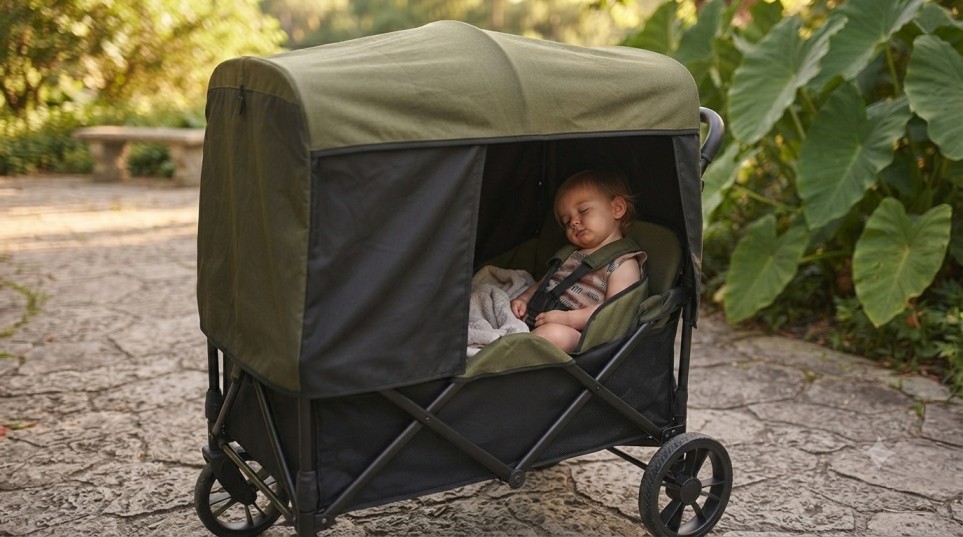
Naps are possible, not guaranteed. The canopy has a blackout panel, and that helps block light. But without recline, a kid who naps easily anywhere, like in a car seat on a drive, will probably nod off here too. A kid who needs to lie flat and needs it quiet and dark to actually stay asleep is going to have a harder time in this wagon than in a stroller built around recline. Worth knowing before you plan a long outing around nap timing.
One Place the Aries Looks Better Than a Lot of Budget Wagons
Why the Jeep Aries Safety Certifications Actually Matter
The Jeep Aries comes with two certifications that are genuinely worth paying attention to, not just skimming past in a specs table: JPMA and GREENGUARD Gold.
JPMA Certification
This means the wagon has been independently tested against U.S. juvenile product safety standards. In plain English, it’s not just a marketing label slapped on by Delta Children. It’s a real third-party check, and that matters when you’re comparing the Aries to cheaper no-name wagons that either skip certification entirely or make it hard to verify.
GREENGUARD Gold
GREENGUARD Gold is about low chemical emissions, not crash safety or frame strength. It means the materials have been tested for reduced off-gassing, which is more important than it sounds for a product your child may sit in for long outings, naps, or everyday errands.
What this actually means in real life: these certifications don’t make the Aries indestructible, and they don’t guarantee that nothing can ever go wrong. But if you’re comparing it to a stroller wagon that’s $100 cheaper from a random Amazon brand, JPMA + GREENGUARD Gold are two of the biggest reasons the Aries costs more—and one of the clearest signs that Delta Children put real effort into safety and material quality.
The Real Question: Aries vs. the Bigger 4-Seat Wagons
Here’s where the Aries earns its place, or doesn’t, depending on your family.
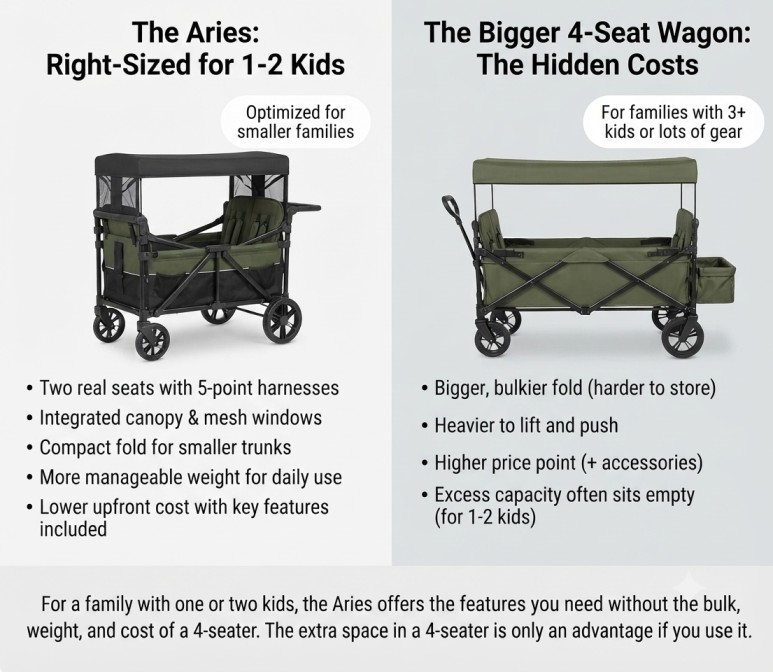
The appeal of a 4-seat wagon is obvious on paper. More kids, more room, more flexibility as your family grows. But in daily use, that extra capacity comes with real costs that don’t show up on the product page:
- A 4-seater is heavier to lift, heavier to push, and harder to store
- The fold is bigger, even when it’s a good fold
- The price jumps by hundreds of dollars once you add the accessories most people end up buying anyway
- If you only have two kids, half that capacity sits unused most days, and you’re still hauling the weight of it
For a family with one or two kids, none of that extra capacity is doing you any favors. You’re paying for space you don’t fill and hauling weight you don’t need. The Aries strips that down. Two real seats, real safety harnesses, a real canopy, and a fold that doesn’t require a truck-sized trunk.
When the Aries Is the Smarter Buy
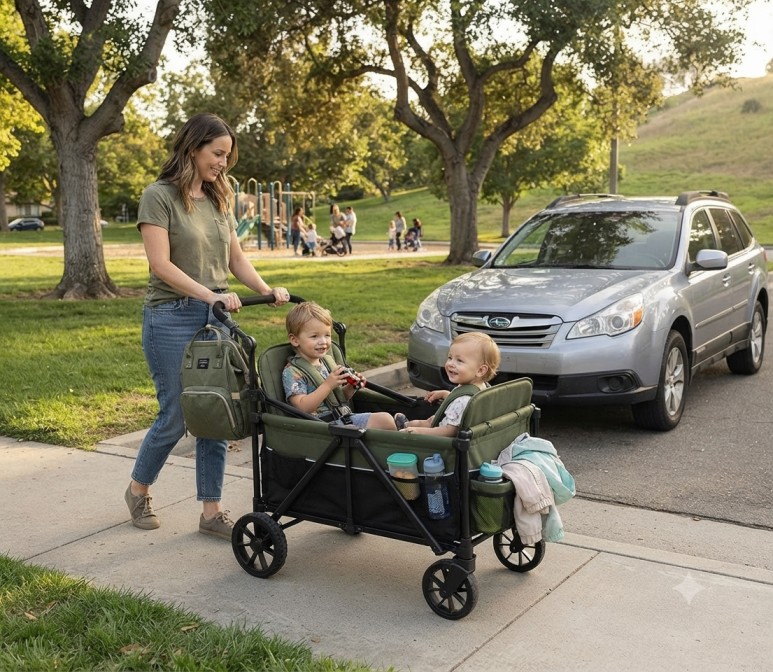
Put plainly, the Aries makes more sense than a Wonderfold-style wagon if most of these are true for you:
- You’re an apartment or small-house family without a dedicated garage bay for gear
- You drive a sedan or a smaller SUV, not a minivan with a third row folded down
- You have one kid plus a lot of gear, or two kids under five
- Your outings are mostly park trips, errands, the zoo, sports practice pickup, and neighborhood walks, not multi-day travel or daily off-road use
- You’d rather spend the $300 you save on something else, like the double stroller you’re not buying instead
If that’s your household, a bigger wagon just adds weight and clutter you’re not getting anything back for.
The math flips fast once you have three or more kids, or you regularly walk neighborhood kids around too. At that point the Aries’ 2-seat limit becomes the actual bottleneck, not the price. If that’s your situation, our best 4-seater wagon stroller roundup is a better starting point than this review.
The Aries isn’t the only Jeep-branded wagon on the market either. Delta Children makes a few, and the Jeep Wrangler stroller wagon is the more classic boxy version, closer in size and price to the bigger wagons. If you’re comparing Jeep to Jeep, the Wrangler leans toward more room and a heavier frame, while the Aries leans toward compact and manageable.
Does the Lower Price Come With Real Compromises?
Some, yes. This wagon doesn’t do everything the $800 options do, and it’s better to say that plainly than pretend otherwise.
Seating capacity is the big one. Two kids, period. No stretching this into a 3 or 4-kid wagon the way some competitors allow with add-on seats.
Wheel size limits terrain performance. Fine on pavement and grass. Not the wagon for regular gravel trails or soft sand.
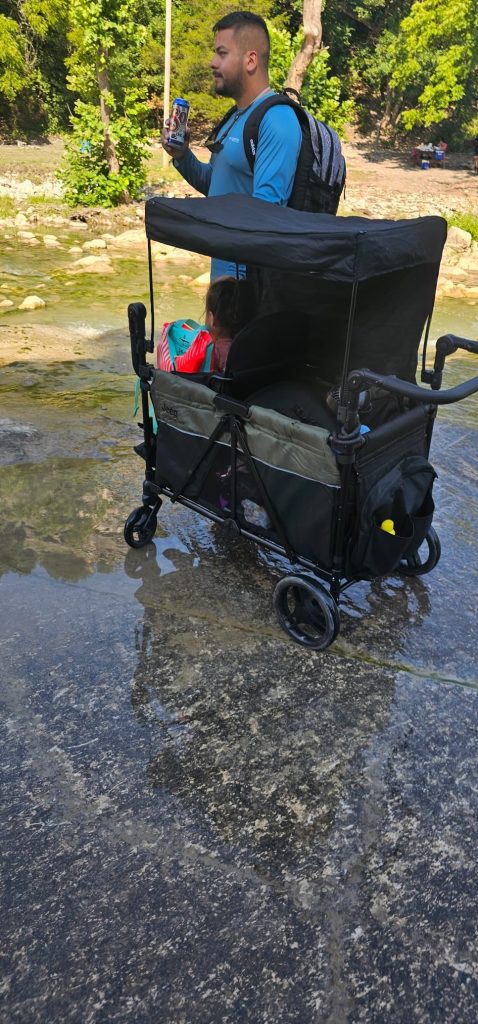
The canopy is functional, not fancy. It covers, it rolls down mesh panels, it has a blackout option for naps. It does the job without the premium fabric feel of pricier wagons. It’s also a little fiddly to fold down compared to snapping it flat in one motion — you’ll get used to it, but the first few times it feels like more steps than it should be.
Car seat compatibility requires an extra purchase. The car seat adapter isn’t included, and neither is the car seat itself. If infant-stage use matters to you, factor that cost in before comparing sticker prices across wagons.
A 2-kid family doing parks, errands, and neighborhood walks probably won’t hit any of these limits often. Families expecting rough-trail or heavy beach performance out of this wagon tend to hit them faster than they expect, usually on the first real test of the terrain rather than gradually.
Storage, Seating, and the Stuff You’ll Actually Use Every Day
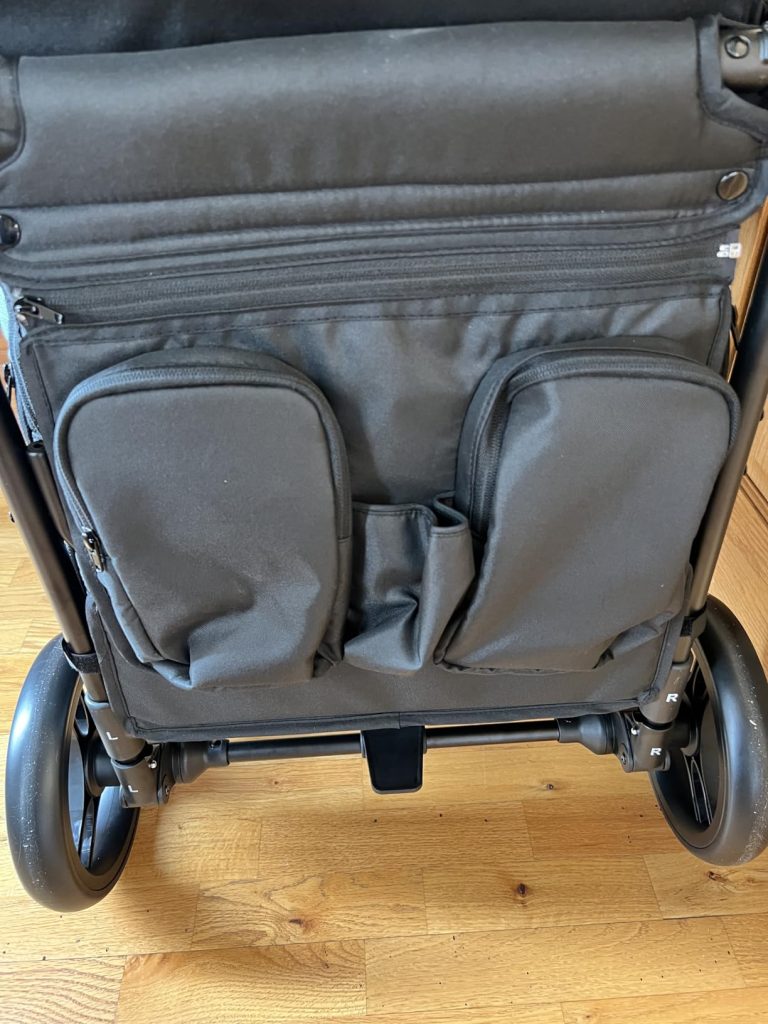
The under-seat storage is generous for the wagon’s size, and having front pockets, a rear pouch, and a canopy pocket means you’re not stuck digging through one giant bag every time you need a snack or a wipe. Two cup holders up front is a small detail, but it’s the kind of thing you notice missing on wagons that skip it.
The seats being fully removable is useful, though it comes with a small annoyance nobody puts on the product page: once you take them off for cargo mode, you now have two loose seats to carry, store, or leave in the trunk. Do this at a beach parking lot or a packed driveway and you’ll feel it. It’s a minor hassle, but it’s the kind of thing that shows up in month two, not on day one when you’re just excited about the cargo space.
The multiple seating directions get talked up a lot in the marketing, and honestly, most families pick one configuration in the first week and leave it there. Forward-facing for a toddler who wants to see where they’re going, or inward-facing so two kids can actually interact with each other. It’s a nice feature to have, not one you’ll be adjusting daily. Don’t let it be the deciding factor in your purchase.
Washable seat fabric is a plus for anyone who’s dealt with spilled juice boxes in a stroller seat before. Being able to unclip and toss the fabric in the wash beats scrubbing at stains with a wet wipe on the sidewalk.
Who Should Skip This Wagon
A few types of buyers are better off looking elsewhere:
Families with three or more kids who regularly need everyone riding at once. The seat limit alone rules the Aries out, and stretching a 2-seat wagon to fit a third kid is more trouble than it’s worth.
Families planning heavy beach or off-road use. The wheels are fine for everyday ground, not built for sand or gravel trails on a regular basis.
Parents who need infant seating from day one without buying extra gear. The minimum combined weight recommendation for the seats means very young infants aren’t the target use case unless you’re adding a compatible car seat and adapter, both sold separately.
Anyone who’s already decided a 4-seat wagon is non-negotiable for future kids. Buying the Aries now and upgrading later usually costs more than just buying the bigger wagon once. If you’re still weighing whether a wagon makes sense at all versus a double stroller, our double stroller vs. wagon stroller comparison is a better place to start than this review.
Specs at a Glance
| Feature | Details |
|---|---|
| Seating | 2 kids, bench seat + jump seat |
| Weight capacity | Combined limit varies by retailer listing; check current product page before buying |
| Product weight | 47.23 lbs |
| Unfolded size | 38.75″L x 24.25″W x 47″H |
| Folded size | 25.6″L x 24.25″W x 41.14″H |
| Wheels | 7″ front, 10″ rear, puncture-proof, suspension |
| Brake | One-step rear brake |
| Canopy | Removable, mesh + blackout panels, UV protection |
| Certifications | JPMA, GREENGUARD Gold |
| MSRP | $499.99 (commonly sold $350–$450) |
Where This Leaves You
The Aries isn’t trying to out-feature the premium wagons. It’s a smaller, lighter, cheaper wagon built around one job: get two kids and their stuff around without turning your garage and trunk into a storage problem. It does that job well.

No amount of Jeep badging turns a two-seat wagon into a four-seat one, and it shouldn’t have to. If you’re not sure a wagon fits into your routine at all, it’s worth reading through is a stroller wagon worth it before spending on any model, Aries included.