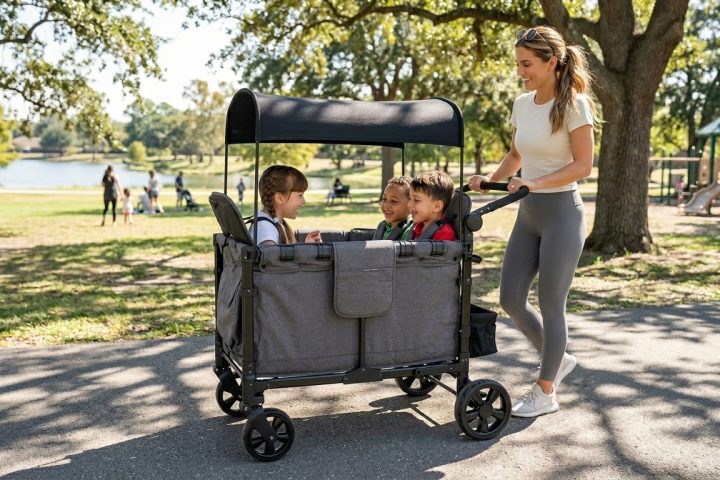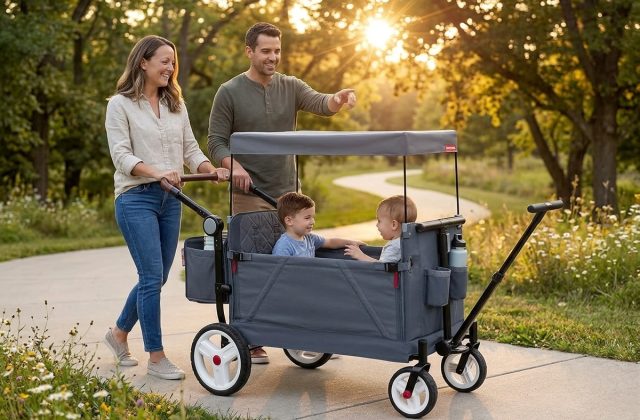

If you’ve been searching for an electric wagon stroller and landing on product pages that describe “motorized push assist” in breathless marketing language without ever mentioning the price — it’s $1,999. That’s the number for the Ellavate Wagon, which is currently the only commercially available electric stroller wagon on the market. Not $300, not $600. Two thousand dollars before you add a second battery.
So before anything else: is an electric wagon stroller worth that? For a specific kind of family — one dealing with hilly terrain, soft sand, long distances, or a parent with physical limitations — yes, the Ellavate makes a real case for itself. The motor assist means pushing 110 lbs of kids and gear uphill feels like pushing 20. The automatic downhill braking prevents the loaded wagon from running away on steep descents. These aren’t luxury features. For the right context, they’re functional solutions to real problems.
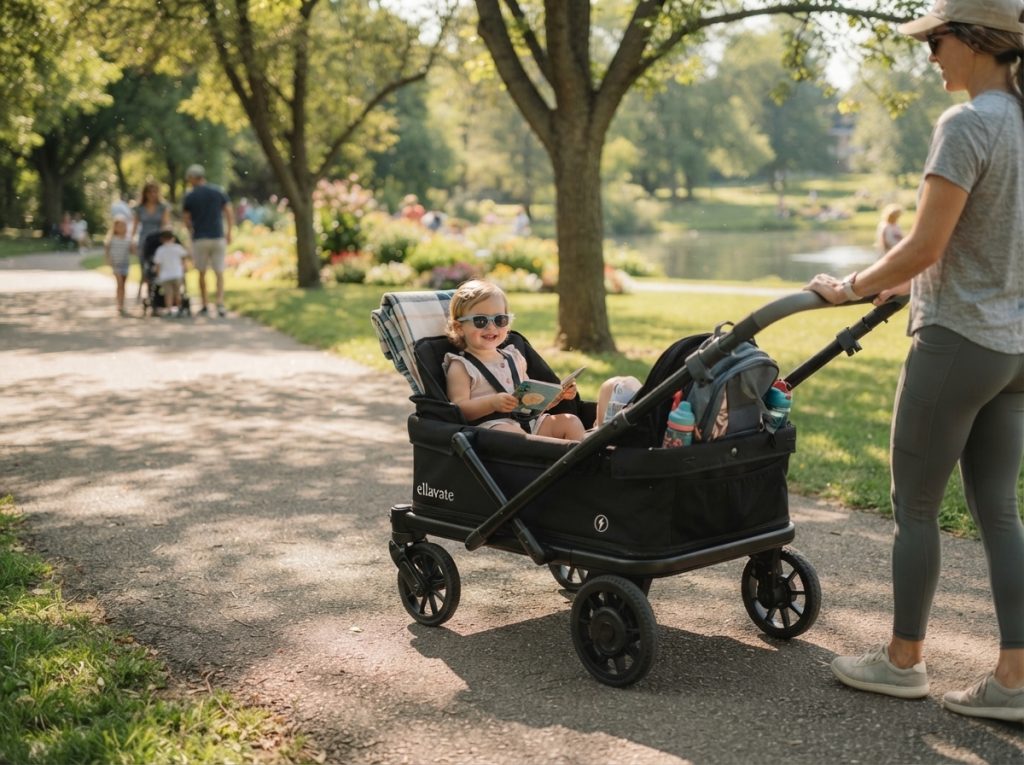
For the majority of families doing parks, sidewalks, and farmers markets on relatively flat ground? A standard stroller wagon in the $400–$900 range almost certainly covers your needs at a fraction of the cost, and you won’t face battery-management logistics before every outing.
This article explains what electric wagon strollers are, how the technology works, where it genuinely helps, and how to decide whether the price makes sense for your specific situation — rather than someone else’s Instagram feed.
What an Electric Wagon Stroller Actually Is
The term gets used loosely across three different things, so let’s clear it up before you spend money on the wrong product.
Category 1: True Electric Assist Stroller Wagons
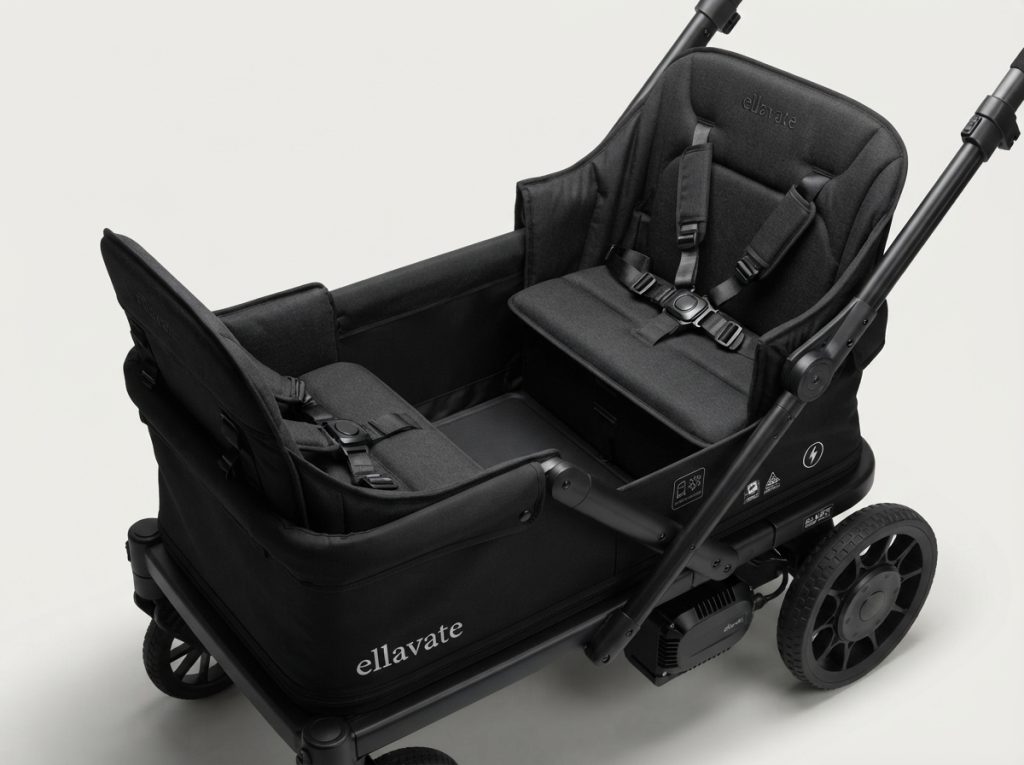
The Ellavate Wagon is the only product in this category that exists as a genuine stroller wagon with an electric push-assist motor built into the frame. It’s certified to both child safety standards (CPSC) and UL electric mobility standards, which means the electrical system has been tested specifically for use around children. The motor activates through handlebar touch sensors — grip the bar and the motor engages; release and it applies resistance braking. No remote, no buttons, no app. Your hands are the switch.
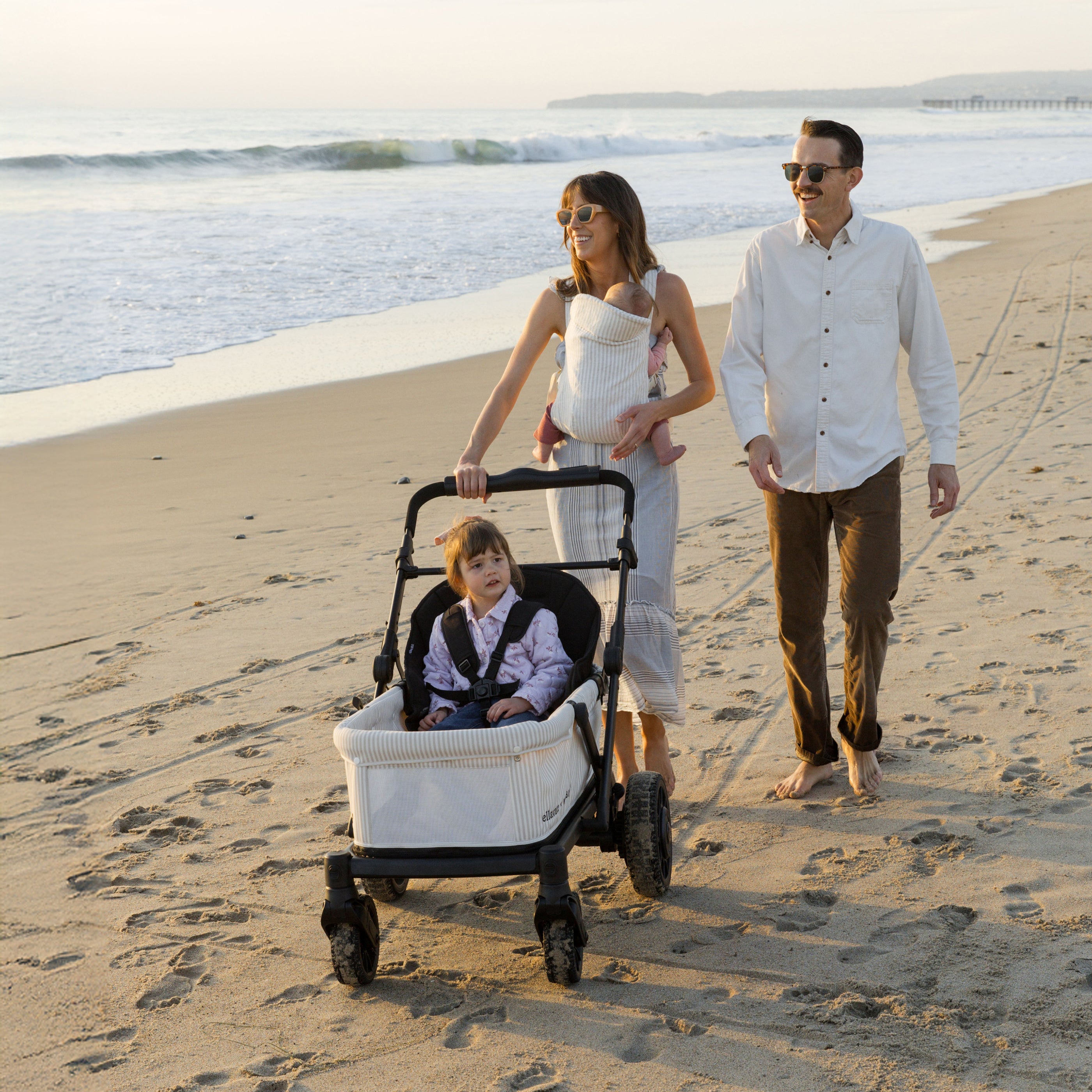
Ellavate Electric Wagon
- ✔ Electric assist with dual 150W rear motors
- ✔ Three power modes plus manual mode
- ✔ Downhill assist for added safety
- ✔ Up to 8 miles of electric assist per battery charge
- ✔ Handles sand, grass, gravel, dirt, and pavement
- ✔ Folds compactly for storage and travel
- ✔ Machine-washable removable fabrics
- ✔ Includes child seat, battery, and charger
The Ellavate is a 2-seat wagon. It’s not a 4-seater. Max child seat capacity is 45 lbs per seat, with a total vehicle load of 110 lbs (kids plus gear combined). For context: two 25-lb toddlers plus a loaded cooler bag gets you close to that ceiling.
Category 2: Electric Ride-On Wagons for Kids
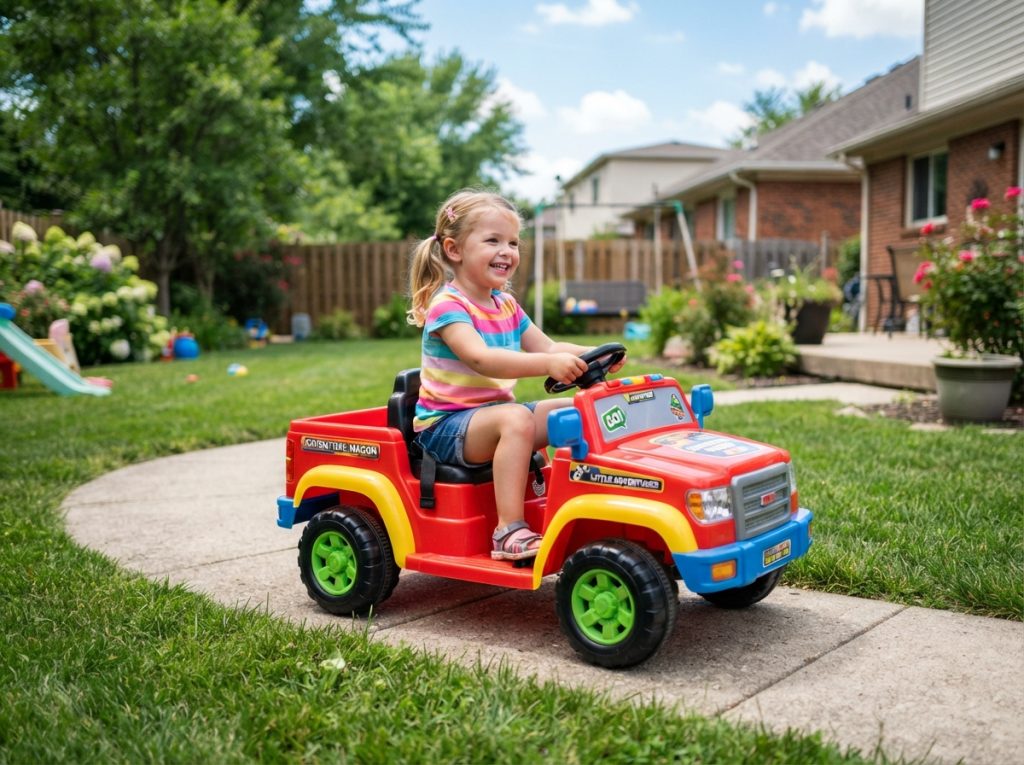
These are a completely different product — battery-powered toy wagons that children ride in and operate themselves, like a slow-moving ride-on car in wagon form. Brands like Costzon and various Amazon-generic manufacturers sell these in the $100–$300 range. They’re not stroller replacements. They’re play equipment that children drive. If you’re searching for an “electric wagon” for a 4-year-old to drive in the backyard, this is what you want — but it has nothing to do with transporting multiple children on outings.
Category 3: Multi-Seat Electric Wagons (Institutional)
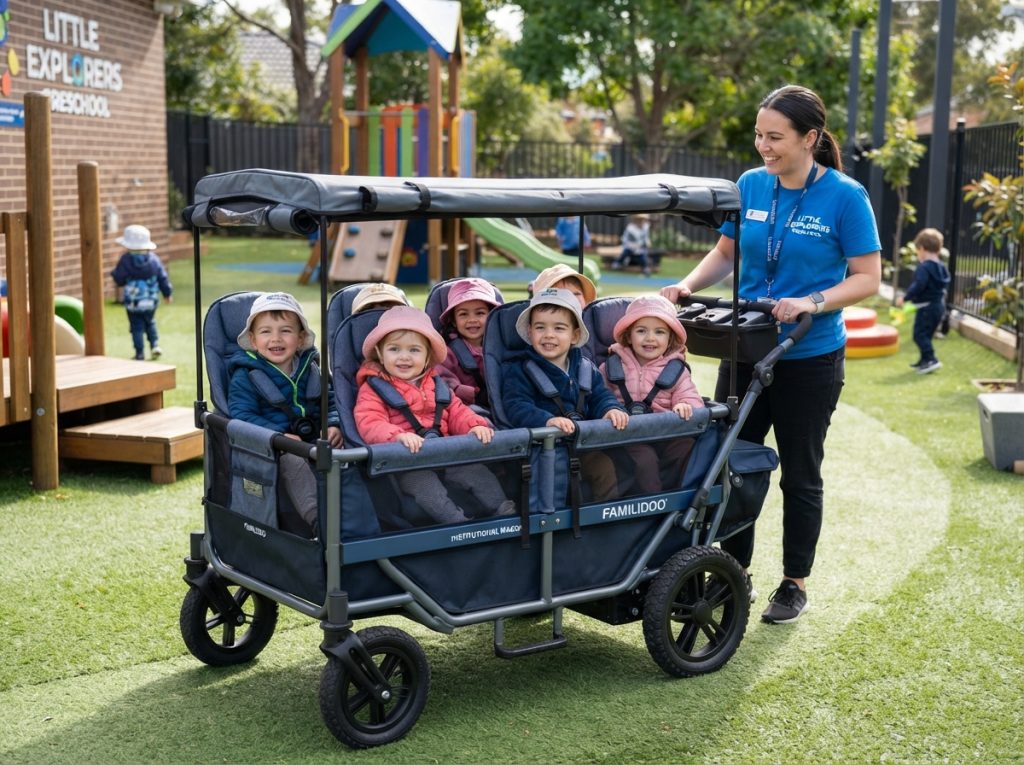
The Familidoo range — including the Familidoo Adventure 2024 and Model D — makes multi-seat motorized wagons for daycare centers, preschools, and childcare facilities. These seat 3–6 children and are designed for institutional use rather than family purchase. They’re larger, more expensive, and built around caregiver workflows rather than parent-vehicle-compatible design. If you’re researching for a childcare center rather than personal family use, these are worth looking at. For home family use, they’re overkill at the wrong price.
| The phrase ‘electric wagon stroller’ most commonly refers to the Ellavate Wagon in 2025. When you’re reading reviews or comparing options, check which category the product actually falls into — the three categories above serve completely different needs and have almost nothing in common beyond the word ‘electric.’ |
The Ellavate Wagon: How the Technology Works
The engineering is genuinely well-thought-out, so it’s worth understanding before deciding whether you need it.
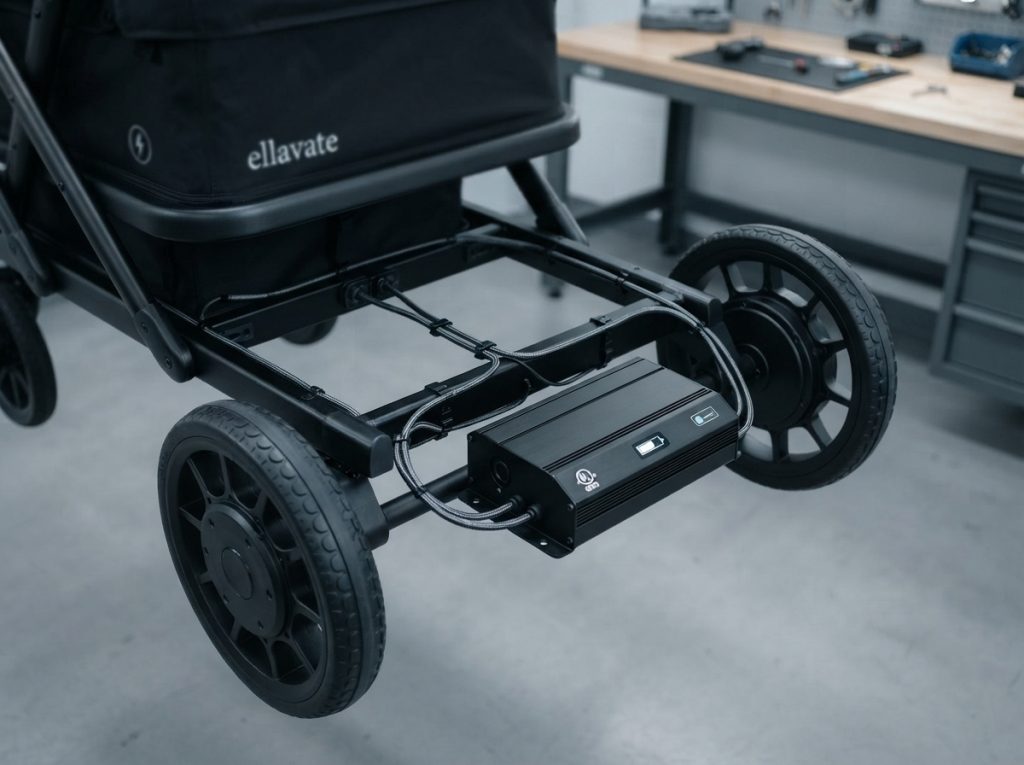
The Motor System
Two rear hub motors provide forward and reverse power. Three power modes let you dial in how much assist you want — low for flat terrain where you want some exercise, high for steep hills or soft sand where you want maximum push. In manual mode (motors off) the wagon functions as a standard non-electric pull wagon, though the added motor weight is present.
The handle sensors are the key interface design decision: the motor only activates when at least one hand is on the handlebar. Release both hands — to pick up a dropped item, to open a gate, to help a child — and the braking resistance kicks in automatically. The wagon can’t roll away unattended. This is not a small safety detail when you’re talking about a fully loaded wagon on any kind of slope.
The Battery
The 37V / 2.6 Ah lithium-ion battery is the same chemistry used in e-bikes. It charges via a standard outlet connection built into the wagon in approximately 2 hours. One charge gives up to 8 miles of continuous powered use — with the caveat that heavier loads and steeper terrain reduce that range, so plan on 4–6 miles of realistic range for a typical loaded family outing. A second battery can be added for back-to-back heavy-use days; it runs around $299 extra.
The batteries are UL certified and comply with airline lithium-ion carry-on regulations when removed from the wagon. For family travel, that matters — you can fly with this wagon by checking the wagon itself and carrying the batteries onto the plane, rather than being stuck at check-in trying to explain a lithium-ion system in a stroller.
Downhill Braking — the Feature Nobody Talks About Enough
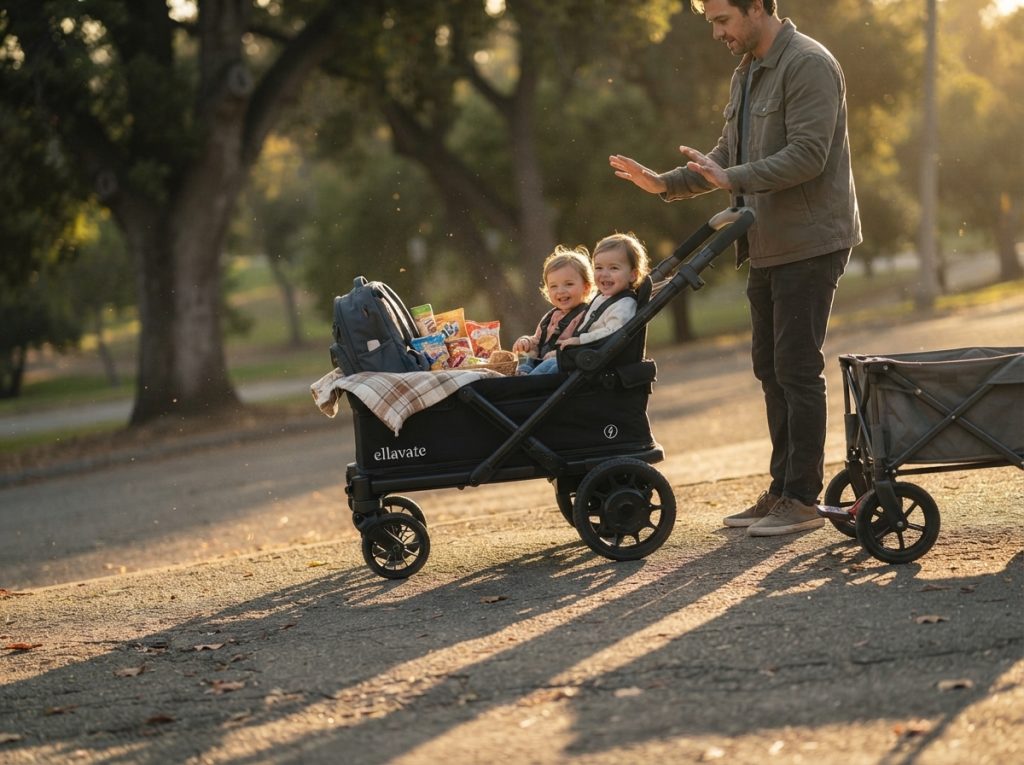
Standard wagons — even the $900 premium ones — have a rear foot brake for stopping, but no resistance system that prevents a loaded wagon from slowly rolling away on a decline. With 100 lbs of kids and gear in a wagon, a 5% grade can build momentum faster than you’d like. The Ellavate’s release-to-brake system means removing your hands from the handle immediately activates resistance. The wagon slows down rather than speeding up. For a family that regularly navigates sloped park paths, hilly neighborhoods, or beach access ramps, this addresses a genuine safety scenario that no standard wagon solves.
Full Specifications
| Spec | Details |
| Price | $1,999 (includes one battery; second battery sold separately at ~$299) |
| Motor | Two rear hub motors — forward and reverse; 3 power mode settings |
| Battery | 37V / 2.6 Ah lithium-ion (UL certified); 2-hour charge time; supports up to 2 batteries |
| Range per charge | Up to 8 miles continuous — drops with heavy load and incline; plan ~4–6 miles in real use |
| Battery life (years) | ~5 years expected useful life before significant capacity decline |
| Motor activation | Handlebar touch sensors — motor engages when both hands grip; releases and brakes when you let go |
| Downhill assist | Automatic resistance braking activates on downhill — prevents runaway; footbrake for full stop |
| Max load capacity | 110 lbs total (100 lbs recommended for tough terrain — sand, hills) |
| Child seat capacity | 45 lbs per seat (5-point harness; suitable from 6 months) |
| Safety certifications | CPSC (Consumer Product Safety Commission) + UL electric mobility standard; lithium-ion battery airline-safe |
| Car seat compatibility | Nuna PIPA, Maxi-Cosi Mico, Cybex, Britax Willow and Cypress |
| Folded dimensions | 37″ L × 27″ W × 17″ H (front wheels removable for more compact storage) |
| Terrain | All-terrain: sand, snow, grass, gravel, dirt, pavement |
| Water resistance | Hoseable with low-pressure water; do not submerge; fabric machine washable (removed) |
| Airline travel | Airline-safe with batteries removed — batteries comply with lithium-ion carry-on rules |
| Manual mode | Yes — fully functional without power assist; motor adds weight but doesn’t impede |
| Designed by | Mother-daughter team (US-based) — first electric stroller wagon commercially sold |
| Warranty | 2-year limited warranty against manufacturing defects |
Electric vs. Standard: The Honest Comparison
| Factor | Electric Wagon | Standard Wagon | Edge | What This Means |
| Price entry point | $1,999 (Ellavate) | $279–$899 (standard stroller wagons) | Standard | Electric costs 2–7x more |
| Uphill performance | Motor assist — negligible physical effort | Manual push — effort scales with load | Electric | The clearest win for electric; hills become effortless |
| Sand and soft terrain | Motor pushes through; downhill assist controls descent | Manual effort increases significantly; narrow wheels sink | Electric | All-terrain use is where electric earn its price most clearly |
| Range / outing length | 8 miles per charge (real: ~4–6 under load) | Unlimited — no battery constraint | Standard | Most park/market outings are well under 4 miles; rarely a practical issue |
| Weight | Heavier — motor and battery add to base weight | Standard wagons: 32–58 lbs; electric adds more | Standard | Already heavy wagons get heavier with motor hardware |
| Charging dependency | Must charge between uses; 2-hour charge time | No charging needed | Standard | Forgetting to charge before a big outing is a real failure mode |
| Kid comfort / ride | Motor vibration reported to soothe young children; smooth acceleration | Manual pushing creates minor jolts on rough surfaces | Electric | One Ellavate reviewer notes kids stay in longer due to soothing motor hum |
| Downhill safety | Auto-resistance braking — wagon can’t run away when loaded | Manual effort to resist runaway on steep descents | Electric | Meaningful safety advantage on hilly terrain with full load |
| Maintenance | Motor, battery, sensors require monitoring; electric components add failure points | Frame, wheels, fabric — low maintenance overall | Standard | Electric adds long-term complexity that non-electric wagons don’t have |
| Longevity / resale | Electric components age; battery degrades after ~5 years | Mechanical wagons last 5–8 years with normal use | Standard | Electric wagons may face battery replacement costs after year 5 |
| Airline / travel | Airline-safe with batteries removed; batteries comply with lithium carry-on rules | Easier to transport; no battery logistics | Standard | Electric is manageable for travel; just more steps |
| Terrain variety (urban) | Overkill for flat sidewalks; manual mode works but heavier | Compact stroller wagons handle urban better | Standard | City flat-terrain use doesn’t justify the electric premium |
| The table above makes it clear: electric assist wins decisively on hills, soft terrain, and downhill safety. Standard wagons win on price, weight, maintenance simplicity, and long-term durability. Most families need to be honest about how much of their actual outings involve hilly or soft terrain before concluding that the electric premium is justified. |
The $1,999 Question — Breaking Down Whether It Makes Financial Sense
There’s a version of this math that makes the Ellavate look reasonable, and a version that makes it look absurd. Both are honest.
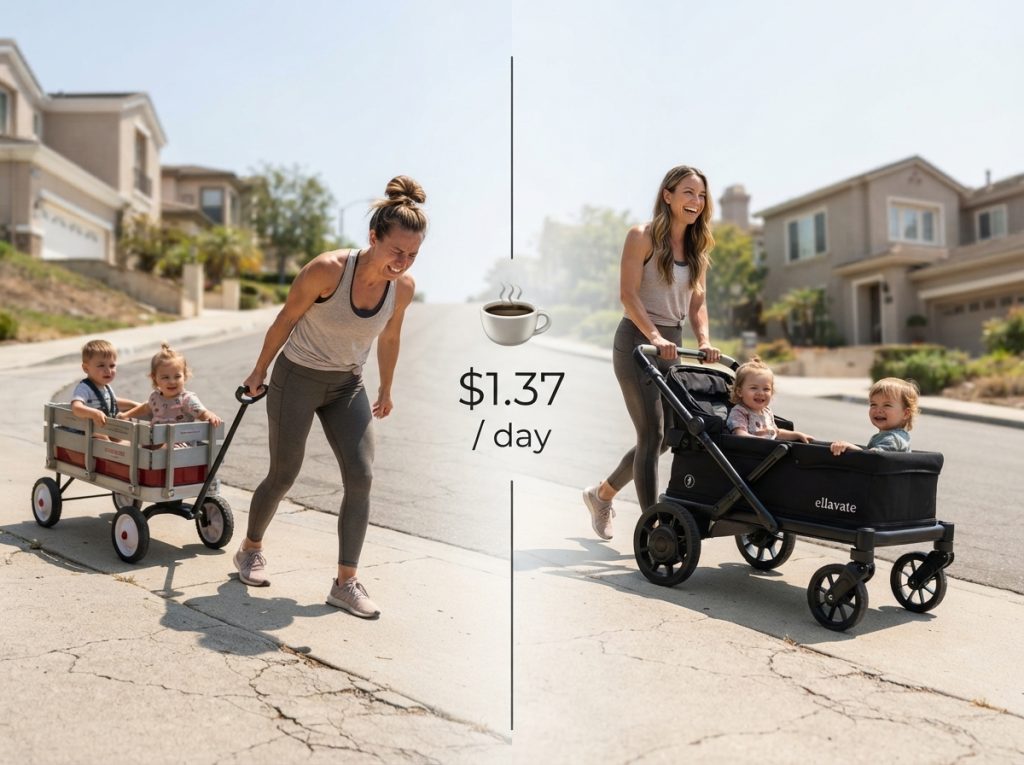
The reasonable version: if you’re currently managing hilly neighborhood walks with two kids in a standard wagon and it’s exhausting — genuinely, physically limiting — then the Ellavate solves a real daily problem. Spread across 4 years of daily use, $1,999 works out to roughly $1.37 per day. Put that way, it’s cheaper than a daily coffee. The motor requires no fuel, the maintenance costs are low absent a battery replacement, and you’re solving a problem that affects your quality of life constantly.
The absurd version: you could buy a premium Veer Cruiser at $649, a second battery for a portable power bank to charge a device, and a good backpack carrier for the rare occasions you need extra capacity — and still have $1,000 left over. For families on flat terrain doing typical suburban outings, that $1,000 represents the pure cost of electric assist you’ll use only occasionally.
The honest answer sits between them. Families with consistent hilly, sandy, or rough-terrain use justify the price. Families doing predominantly flat-path outings are buying technology for problems they don’t have.
If you’re not yet sure which category you’re in, our guide on whether a stroller wagon is worth it covers the core buying decision framework before you get into specific models.
The Terrain Scenarios Where Electric Actually Changes the Experience
Hilly Neighborhoods — Daily Use
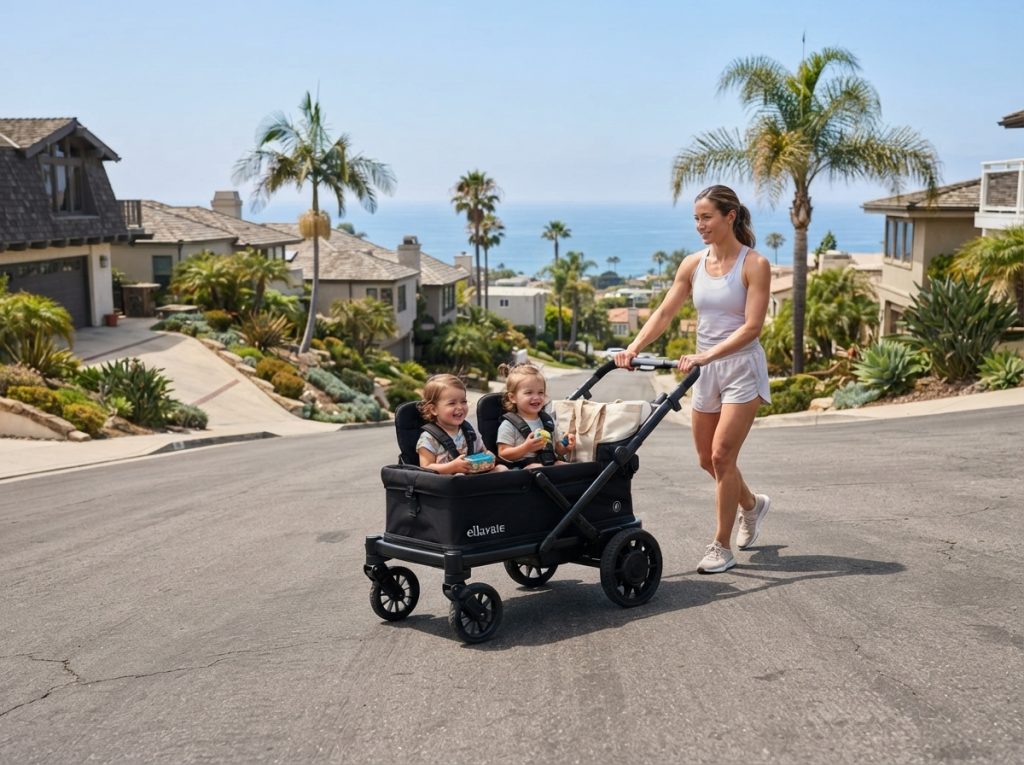
This is the most compelling single use case. Parents who walk neighborhoods with any meaningful grade report that standard wagon pushing becomes physically exhausting with two toddlers and a gear bag — especially on the return trip when kids are heavier from the snacks they’ve consumed and you have less energy. Multiple Ellavate reviews from parents in hilly areas (one specifically from Ocean Beach, San Diego, which has significant grade variations) describe the product as transformative in exactly this context. The motor doesn’t feel like a gadget in this scenario; it feels like a structural solution.
Beach Days With Soft Sand
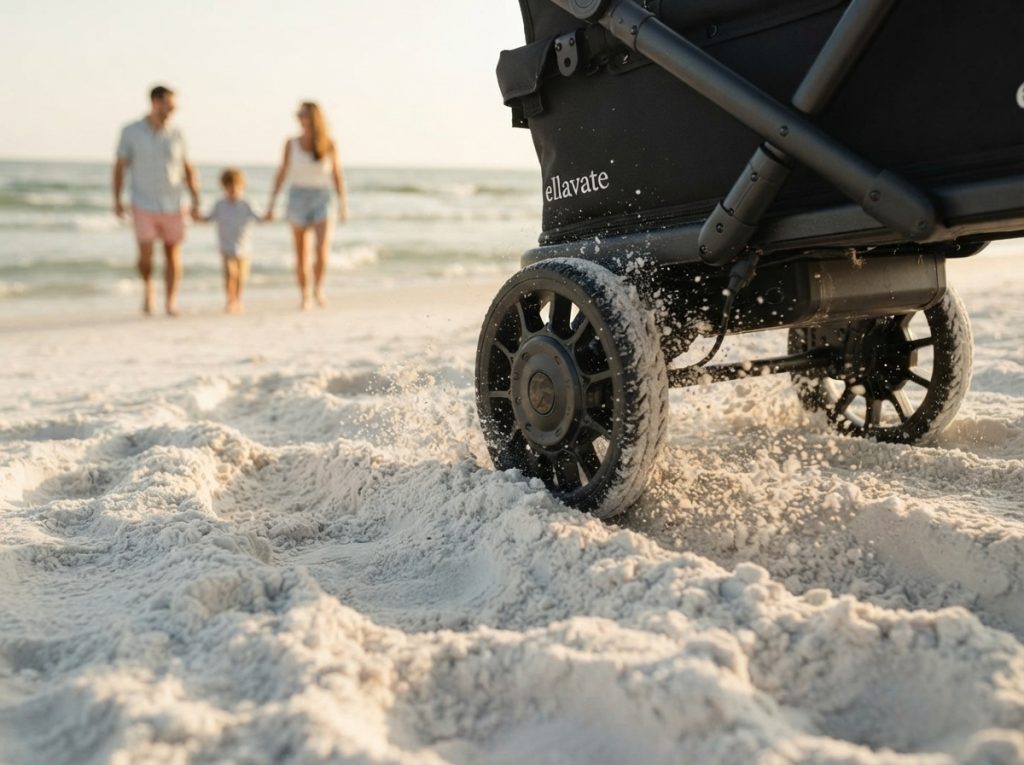
Soft sand is the terrain nemesis of standard stroller wagons. Even XL polyurethane wheels sink and drag under load, turning what should be a relaxed beach walk into a shoulder workout. The Ellavate’s motor pushes through soft ground without the parent bearing the resistance. An Ellavate reviewer describing a vacation beach outing said they were ‘immediately sold’ after using it on sand with multiple kids. This isn’t hyperbole — sand resistance on a loaded standard wagon is a genuinely unpleasant physical experience that electric assist eliminates.
For families specifically choosing between a standard wagon and electric for beach use, we’ve covered the best beach wagons for kids separately — including how different wheel types perform on packed vs. soft sand, which affects whether electric assist is even necessary for your specific beach conditions.
Long-Distance Park and Event Days

State fairs, botanical gardens, multi-venue outdoor events — situations where you’re on your feet for 5+ hours and covering significant total distance. In these contexts, the cumulative effort of pushing a loaded wagon across 4–6 miles adds up. The Ellavate’s 8-mile range (real-world: 4–6 miles under load) is specifically calibrated for this window. Reviewers at water parks and all-day outdoor venues consistently describe the effort savings as significant on these long-duration outings, even on relatively flat ground.
What the Ellavate Doesn’t Do
It seats two children, not four. Families with three or more kids looking for a multi-seat solution won’t find it here — the Ellavate is a 2-passenger wagon. The child seat handles 45 lbs per seat, which covers most kids through age 5 or 6 but starts to limit the upper age range of use compared to higher-capacity wagons.
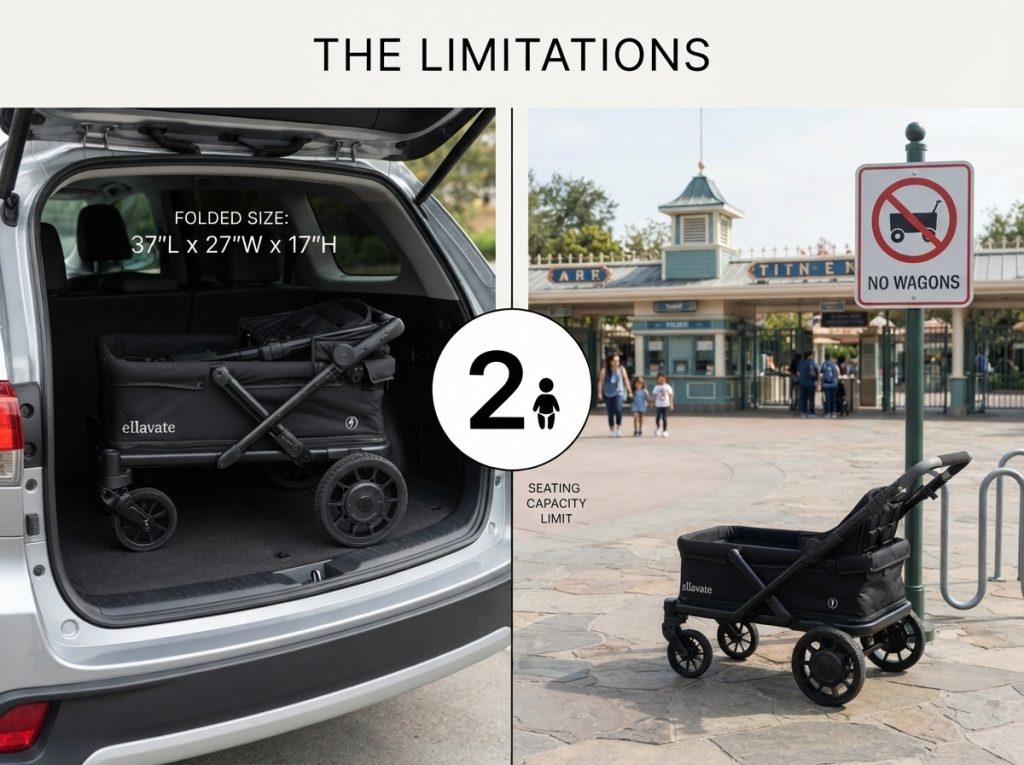
The 100 lb practical terrain limit (110 lbs in ideal conditions) means a loaded wagon with two 40-lb kids and 25 lbs of gear is already at the edge of what the motor handles comfortably over tough terrain. That’s a realistic combination for families with 4 and 5 year olds, and it means the electric advantage on sand and hills narrows as kids grow.
It also doesn’t fold to the compact dimensions of lighter standard wagons. At 37″ × 27″ × 17″ folded (with front wheels removed), it’s manageable but not small. Vehicle compatibility matters here the same way it does with any premium wagon — verify your trunk dimensions before purchasing.
| The Ellavate cannot be used at Disney World, Disney California Adventure, or most major theme parks — wagons are banned at those venues regardless of power source. If a Disney trip is the primary outing you’re imagining when you picture using this wagon, a stroller is your only option there. |
Who This Is and Isn’t For
| Family Profile | Fit | Why |
| Parent with hilly neighborhood doing daily walks | Strong Yes | This is the clearest electric wagon use case. Uphill effort with kids and gear becomes effortless; downhill auto-braking prevents accidents. |
| Beach family — soft sand outings several times per month | Strong Yes | Standard wagons sink and drag in sand. The Ellavate’s motor pushes through soft ground without the physical effort that makes beach trips exhausting. |
| Parent with physical limitations (back issues, joint problems) | Yes | Push-assist reduces the strain of moving a loaded wagon. Downhill braking prevents sudden force requirements. Designed for exactly this situation. |
| Family doing parks, farmers markets, zoo — mostly flat | Consider standard first | Flat terrain is where electric assist provides the least value. A WonderFold W2 Luxe or Veer Cruiser at $500–$650 covers this excellently. |
| Family in dense city, mostly sidewalks and public transit | Not recommended | Electric weight adds to an already heavy product. Urban strollers are optimised for compactness; an electric wagon is a poor fit here. |
| Family primarily doing Disney World or theme parks | Not applicable | Wagons banned at Disney and most major theme parks since 2019 — electric or not. This product cannot be used in that context. |
| Outdoor-adventurous family: hiking trails, beach, parks, events | Yes, if budget allows | Multiple terrain types in regular rotation is where the motor’s consistency pays off most. Budget and charging discipline are the main constraints. |
| Family prioritizing value — one wagon to last 5+ years | Depends on budget | At $1,999 before a second battery, the cost is real. Standard wagons at $500–$900 cover most needs and hold resale value for 5+ years. |
The Standard Wagon Alternatives if Electric Isn’t the Right Call
Most families searching for an electric wagon stroller are actually in the market for a premium stroller wagon with excellent terrain capability — and that’s a much larger and more affordable category.
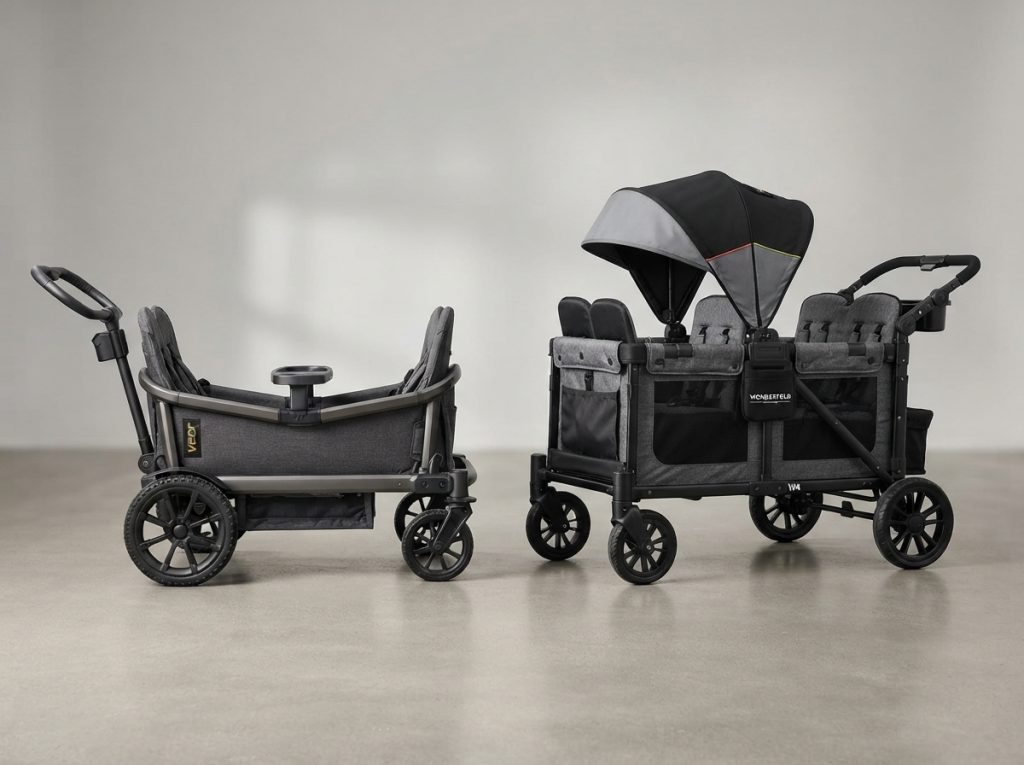
The Veer Cruiser ($599–$649) is the highest-performing standard stroller wagon in comparative testing, with the best terrain handling in the non-electric category. It weighs 32.6 lbs — less than half the Ellavate’s weight — folds in 20 seconds, and handles gravel, mild sand, and grass easily. For most families describing ‘rough terrain’ in their outings, the Veer’s large all-terrain wheels cover everything except steep hills and deep sand without any motor needed.
For families with four kids who need more capacity, the WonderFold W4 Luxe at $799–$899 seats four children with premium harnesses and XL wheels. It’s heavy, but it solves the multi-kid capacity problem the Ellavate can’t address.
If you’re actively comparing stroller wagon options at various price points before making a final decision, our full stroller wagon guide covers the complete field from $279 to $900+ with honest tier-by-tier assessments.
The One Thing No Electric Wagon Review Addresses

Battery degradation is the hidden long-term cost of any lithium-ion powered product. The Ellavate rates its battery at a 5-year expected useful life. At year 5, when the battery holds 70% of its original capacity, the range drops and the performance on tough terrain decreases. A replacement battery runs approximately $299. That’s not a dealbreaker — it’s a known cost — but it should be factored into the total ownership calculation, especially when comparing to a standard wagon that has no equivalent recurring expense.
No review of the Ellavate has yet been written by someone who owned one long enough to experience battery degradation, because the product is relatively new. The 5-year battery life claim comes from the manufacturer’s testing, not from long-term independent data. Worth acknowledging before spending $2,000 on the strength of enthusiastic first-year reviews.
An electric wagon stroller is a genuinely useful product for a specific family in a specific context — and an expensive answer to a problem the majority of families don’t have. If hills, sand, distance, or physical limitations are consistent features of your outdoor life with kids, the Ellavate Wagon is the only product that addresses them with motor assist and it does so thoughtfully. If your outings are mostly flat parks and neighborhood sidewalks, spend $500–$900 on a premium standard wagon and invest the remaining $1,000–$1,500 in actual family adventures. The wagon is the vehicle, not the destination.