
Everything Parents Need to Know Before Buying an All-Terrain Kids Wagon
Last Updated: 2026 | 12 min read | Covers: Terrain types, wheel technology, top-rated models, safety, and expert buying advice
Why All-Terrain Wagons Are a Game-Changer for Outdoor Families

Not every family adventure happens on a smooth sidewalk. Hiking trails, sandy beaches, grassy parks, muddy campsites, and gravel pathways all demand more from a kids’ wagon than a standard plastic-wheeled model can deliver. That’s where all-terrain wagons come in — purpose-built for families who refuse to let the ground beneath them decide where they can and can’t go.
All-terrain kids wagons differ from standard wagons in several fundamental ways: larger and more durable wheels, reinforced frames, improved ground clearance, and suspension systems designed to absorb the shock of uneven surfaces. The result is a smoother, safer, and more capable ride for your child — whether you’re navigating a forest trail, crossing a beach, or making your way across a festival field.
This guide is built for parents who spend meaningful time outdoors and want a wagon that can genuinely keep up. We cover everything: what makes a wagon truly all-terrain, how different wheel types perform on different surfaces, a full comparison of the best models available in 2026, and a step-by-step framework for choosing the right wagon for your family’s specific adventures.
Whether you’re an occasional weekend hiker or a family that spends every summer weekend at the beach, there’s an all-terrain wagon designed for your lifestyle. Let’s find it.
What Makes a Wagon Truly All-Terrain?

The term ‘all-terrain’ gets applied loosely in product marketing, so it’s worth understanding what genuinely separates an all-terrain wagon from a standard one. True all-terrain capability comes from a combination of four engineering factors working together.
1. Wheel Size and Material
This is the single most important factor. All-terrain wagons use larger-diameter wheels — typically 12 to 16 inches — compared to the 6 to 8 inch plastic wheels on standard wagons. Larger wheels roll over obstacles more easily and maintain momentum on soft surfaces like sand and grass. Material matters too: foam-filled EVA tires resist punctures while still absorbing impact, while air-filled pneumatic tires provide the best cushioning but require pressure maintenance.
2. Suspension System

Mid-range and premium all-terrain wagons often include independent suspension on each wheel. Suspension absorbs shock from rocks, roots, and uneven ground before it reaches the wagon frame and its occupants. For children who nap during outdoor adventures, suspension makes the difference between a smooth, undisturbed rest and a bumpy, wake-up-inducing ride.
3. Frame Construction and Ground Clearance

All-terrain wagons have stronger, often steel or heavy-duty aluminum frames that withstand the torque and stress of rough terrain. Higher ground clearance — the distance between the bottom of the wagon and the ground — prevents the chassis from bottoming out on rocks, roots, or raised terrain features. Standard wagons sit low and scrape on almost anything that isn’t perfectly flat.
4. Handle Design and Steering
On rough terrain, handle design dramatically affects control. The best all-terrain wagons have telescoping handles with multiple height positions, allowing the parent to maintain comfortable posture regardless of incline. Some models include a front swivel wheel with a lock-out for straight-line stability, which is essential for steep descents or loose surfaces.
| Feature | Standard Wagon | All-Terrain Wagon |
| Wheel diameter | 6–8 inches | 12–16 inches |
| Wheel material | Hard plastic | EVA foam or air-filled rubber |
| Suspension | None | Spring or independent (premium models) |
| Frame material | Plastic or thin steel | Heavy-duty steel or aluminum |
| Ground clearance | Low (2–3 inches) | High (4–6 inches) |
| Terrain capability | Smooth surfaces only | Trails, grass, sand, gravel |
| Handle | Fixed height | Telescoping, multi-position |
| Weight | 15–25 lbs | 28–50 lbs |
| Price range (USD) | $50–$150 | $250–$800+ |
Terrain-by-Terrain Performance Guide
Different outdoor environments make different demands on a wagon. Understanding how all-terrain wagons perform on specific surfaces helps you pick the right model for your family’s most common adventures.
Beach and Sand

Sand is one of the most demanding surfaces for any wagon. Fine, loose sand creates resistance that standard wheels simply cannot overcome — they dig in and stop rolling. For beach use, you need the largest available wheels (14–16 inches minimum) with wide, balloon-style profiles that distribute weight and float over the surface rather than sinking into it. Air-filled tires perform best on sand, followed closely by large foam-filled tires. The Veer Cruiser XL and similar beach-optimized models with wide tires are designed specifically for this environment.
Also consider the wagon’s rust resistance for beach environments. Saltwater corrodes steel frames rapidly. Look for powder-coated or stainless steel frames, and rinse your wagon thoroughly after every beach session.
Forest Trails and Hiking Paths

Moderate hiking trails with packed dirt, gravel, tree roots, and small rocks suit most mid-range all-terrain wagons well. For this environment, suspension becomes more important than it is on sand — you want the wagon to absorb constant small jolts rather than transfer them to your child. A front swivel wheel with a lockout is valuable here too: swivel for tight turns around obstacles, locked straight for stability on descents.
Trail width matters for wagon selection as well. Many hiking paths are 24–30 inches wide. Check your wagon’s width when loaded — most all-terrain wagons measure 25–32 inches across.
Grass and Parks
Mown grass is relatively forgiving for all-terrain wagons, but soft or wet ground can still bog down standard wheels. Foam-filled or air-filled wheels of at least 12 inches handle grass easily. The main challenge on grass is resistance — it takes more pushing effort than a hard surface. Look for a smooth-rolling bearing system and low rolling resistance tires for grass-heavy use. Most mid-range all-terrain wagons perform comfortably on maintained grass.
Gravel and Campsite Terrain

Gravel, bark chips, and loose campsite terrain demand good ground clearance and durable tires that won’t be punctured by sharp stones. Foam-filled tires are actually preferable to air-filled tires for gravel environments, since they’re puncture-proof. A rigid rear axle provides better stability on loose gravel than independent rear suspension, which can cause slight sway on uneven, shifting surfaces.
Urban and Mixed Surfaces
Many families use their all-terrain wagon for a combination of city errands and weekend outdoor adventures. For mixed use, look for a wagon with medium-sized foam-filled tires (12–14 inches) that handle both pavement and moderate terrain comfortably. True air-filled tires, while superior on challenging terrain, can be a hassle for urban use — you don’t want to worry about a flat tire on the school run.
| Terrain Type | Minimum Wheel Size | Best Tire Type | Suspension Needed? | Recommended Models |
| Beach / Sand | 14–16 inches | Wide air-filled | Not essential | Veer Cruiser XL, Mac Sports |
| Forest Trails | 12–14 inches | Air or EVA foam | Yes — recommended | Veer Cruiser, Wonderfold W2 |
| Grass / Parks | 12 inches | EVA foam or air | Optional | Most mid-range models |
| Gravel / Campsite | 12–14 inches | EVA foam (puncture-proof) | Optional | Radio Flyer Cargo, Gorilla Carts |
| Urban / Mixed | 12 inches | EVA foam | Optional | Keenz, Larktale Caravan |
Best All-Terrain Wagons for Kids in 2026: Full Reviews
The following reviews cover the top-performing all-terrain wagons across different use cases, budgets, and family sizes. Each review is based on detailed analysis of product specifications, real parent experiences, and hands-on performance data.
1. Veer Cruiser XL — Best Overall All-Terrain Wagon

Veer All-Terrain Cruiser XL | Premium Off-Road Wagon Stroller for Babies, Toddlers, and Kids | Push/Pull/Push-Along Steering for Uneven Terrain | JPMA Certified | Lightweight and Collapsible | 4 Seats
- ALL-TERRAIN DURABILITY: Cruiser XL’s strength comes from a single-frame, patented wall system, robotic welds, and aircraft grade aluminum, with rugged oversized tires that can handle any terrain with ease whether sand, snow, or the little league field, as well as soft yet durable sidewalls that are water, stain, and fade resistant.
- LIGHTWEIGHT: Easily lift the 4-seat Cruiser XL into the trunk of your car at only 36.7 lbs., or 28.7 lbs. with the wheels removed—less than many double strollers.
- HOSE WASHABLE: All components are easy to clean and completely hose washable, from the frame to the fabric sidewalls.
New starting from: 799.00 $
Go to AmazonOverview: The Veer Cruiser XL is consistently ranked among the best all-terrain wagons available, and for good reason. It was engineered from the ground up for outdoor performance — not adapted from an existing wagon design. The air-filled pneumatic tires, modular frame, and robust accessory ecosystem make it the most versatile all-terrain option for active families.
| Specification | Details |
| Wheel type | Air-filled pneumatic tires |
| Wheel size | 14 inches |
| Weight capacity | 110 lbs total / 55 lbs per seat |
| Wagon weight | 38 lbs |
| Seating | 2 children (face-to-face optional) |
| Harness | 5-point on both seats |
| Terrain rating | Sand, trails, grass, gravel, pavement |
| Price range | USD $600–$700 |
Pros: Air-filled tires for true all-terrain performance; modular design with extensive accessories; full flat recline; face-to-face seating option; exceptional build quality; grows with child from infant to older kid
Cons: Air-filled tires require periodic pressure checks; canopy sold separately; heaviest in its class at 38 lbs; premium price point; accessories add significant additional cost
Best for: Families who hike, go to the beach regularly, or want one wagon that genuinely handles all outdoor environments
2. Wonderfold W2 Luxe — Best All-Terrain Stroller Wagon for 2 Kids

WONDERFOLD W2 Luxe Double Stroller Wagon (2 Seater) – Collapsible Wagon Stroller with Seats with Magnetic Buckle 5-Point Harnesses and Adjustable Sun Canopy, Charcoal Gray
- Perfect Baby & Toddler Stroller – Wagon stroller for 2 kids collapses easily for storage and carries passengers in removable reclining seats, with five-point adjustable safety harnesses with automatic magnetic buckles to keep the little ones secure
- Easy-Access Front Zipper Door – Foldable wagon for kids with easy-access door that lets kids get in and out easily; it also makes storage a breeze
- Deep Carriage Basket – Toddler wagon keeps kids safe and comfortable, with zippered mesh panels for optimal Ventilation, and provides tons of space when using as a beach cart or utility cart
New starting from: 579.00 $
Go to AmazonOverview: The Wonderfold W2 Luxe combines the stroller wagon format with genuine all-terrain capability. Where many stroller wagons sacrifice terrain performance for convenience features, the W2 Luxe manages to deliver both. Large foam-filled tires, a sturdy frame, and full flat recline make it ideal for outdoor-adventuring families with two young children.
| Specification | Details |
| Wheel type | EVA foam-filled (puncture-proof) |
| Wheel size | 12 inches |
| Weight capacity | 100 lbs total / 50 lbs per seat |
| Wagon weight | 32 lbs |
| Seating | 2 children |
| Harness | 5-point on both seats |
| Terrain rating | Grass, gravel, moderate trails, pavement |
| Price range | USD $450–$550 |
Pros: Puncture-proof EVA foam tires; full flat recline; individual canopies per seat; excellent storage; compact fold; no tire maintenance required
Cons: Not as capable as air-filled tires on deep sand; heavier than basic wagons; premium price for stroller wagon category
Best for: Families with 2 children who want strong all-terrain performance without the hassle of air tire maintenance
3. Mac Sports Collapsible Folding Wagon — Best Value All-Terrain Pick

Mac Sports Collapsible Folding Outdoor Utility Wagon, Black
- LARGE CAPACITY – Sets up in seconds, No assembly required! Outside Dimensions Approx: 35″ x 20″ x 23″ Inside Dimensions Approx: 32.5 x 17.5 x 10.5
- CONVENIENT COMPACT STORAGE – Wagon folds to only 8″ thick! Folded size approx. 29.5″ x 20″ x 8″ and includes a convenient carry case. Weighs 24.5 Lbs.
- LIGHTEN THE LOAD! – The heavy duty frame allows loads up to 150 lbs., and the Durable 600D Fabric can be easily cleaned. UV and mildew resistant
List Price :
Offer: 98.5 $
Go to AmazonOverview: The Mac Sports wagon is one of the most popular outdoor wagons in its price range, and it earns that popularity through a combination of practical design and genuine outdoor capability. It’s not a stroller wagon — it has no harness system — but for older children (5+) who can sit independently or for cargo-heavy outdoor adventures, it’s an outstanding value proposition.
| Specification | Details |
| Wheel type | Heavy-duty polyurethane |
| Wheel size | 10 inches |
| Weight capacity | 150 lbs total |
| Wagon weight | 15 lbs |
| Seating | Open cargo/bench (no harness) |
| Harness | None — not suitable for young toddlers |
| Terrain rating | Grass, packed gravel, pavement, light trails |
| Price range | USD $80–$120 |
Pros: Extremely lightweight at 15 lbs; folds flat for easy transport; 150 lb capacity; very affordable; durable construction; great for cargo + older kids combined
Cons: No harness system — unsuitable for toddlers under 4 without supervision; smaller wheels limit rough terrain capability; no canopy; no recline
Best for: Families with children aged 4+ for parks, campsites, and outdoor events; also excellent as a utility/cargo wagon
4. Radio Flyer Cargo & Carry Wagon — Best for Campsites

Radio Flyer Stroller Wagon for Kids and Cargo, All-Terrain Wagon with Rubber Tires, Red
- Multifunctional Kids Wagon Design: Toddler wagon toy offers options for 2 kids riding, flatbed hauling, and bench seating for a variety of experiences
- Baby Wagon Safety Features: Includes high seat backs, thick padded seats, and seat belts; Radio Flyer wagon for kids meets the ASTM F963-16 Toy Safety Standard
- Convenient Toy Wagon Storage: Includes a 1-hand fold mechanism to easily fold and unfold the all terrain stroller wagon, making it a hassle-free option for on-the-go families
List Price :
Offer: 119.99 $
Go to AmazonOverview: Radio Flyer’s Cargo & Carry Wagon is purpose-built for the demands of camping and outdoor adventures. It features a reinforced steel frame, large rubber tires, a flat-fold design for vehicle storage, and a removable seat bench. The brand’s decades of outdoor wagon heritage show in the build quality and durability that this model delivers.
| Specification | Details |
| Wheel type | Rubber tires on steel rims |
| Wheel size | 13 inches |
| Weight capacity | 200 lbs total |
| Wagon weight | 22 lbs |
| Seating | Removable bench seats (2) |
| Harness | Optional — not included standard |
| Terrain rating | Grass, gravel, sand, campsite terrain |
| Price range | USD $150–$200 |
Pros: 200 lb capacity handles kids plus gear; large rubber tires on steel rims; removable bench seats; flat fold; trusted brand with strong warranty support; excellent price for capability
Cons: No harness for young toddlers; no canopy; no recline; heavier than plastic alternatives at similar price
Best for: Camping families, festival-goers, and parents who need maximum cargo capacity combined with a seat for older children
5. Gorilla Carts Heavy-Duty Kids Wagon — Best for Heavy-Duty Outdoor Use

Gorilla Carts Collapsible Folding Outdoor Utility Wagon, 7 Cu Ft Oversized Bed, 150 lb Load Rating, Black – Foldable Rolling Cart w/ Pockets & Cup Holders for Beach, Camping, Sports or Picnic
- Oversized Hauling Capacity: Large 36-inch long by 21-inch wide by 15-inch high bed offers nearly twice the space of comparable wagons, holding up to 150 pounds of gear
- Compact Folding Design: Folds down to 25 inches in length and 8 inches in width for easy storage in a closet, garage, vehicle trunk, or tight living space when not in use
- Comfortable Pull Handle: Ergonomic handle design reduces strain while hauling, making it easier to transport heavy loads over long distances without fatigue or discomfort
New starting from: 137.66 $
Go to AmazonOverview: Gorilla Carts brings its expertise in heavy-duty outdoor utility equipment to the kids’ wagon category with impressive results. The Heavy-Duty Kids Wagon is built for families who need serious carrying capacity and rugged terrain performance. With a poly dump bed, padded seat insert, and pneumatic tires, it handles demanding outdoor conditions that most wagons simply aren’t built for.
| Specification | Details |
| Wheel type | Pneumatic (air-filled) tires |
| Wheel size | 13 inches |
| Weight capacity | 400 lbs total |
| Wagon weight | 31 lbs |
| Seating | Padded seat insert (removable) |
| Harness | Lap belt included |
| Terrain rating | All terrain — sand, gravel, trail, grass, mud |
| Price range | USD $200–$280 |
Pros: Exceptional 400 lb capacity; pneumatic tires for true all-terrain; poly dump bed is easy to clean; dual-position handle; excellent stability on challenging terrain
Cons: Utilitarian design — less polished than stroller wagon competitors; lap belt only (not 5-point harness); pneumatic tires require air pressure maintenance; large footprint
Best for: Families with older children (4+) who need maximum outdoor capability and carrying capacity over refined aesthetics
6. Larktale Caravan All-Terrain — Best for Travel + Outdoor Crossover
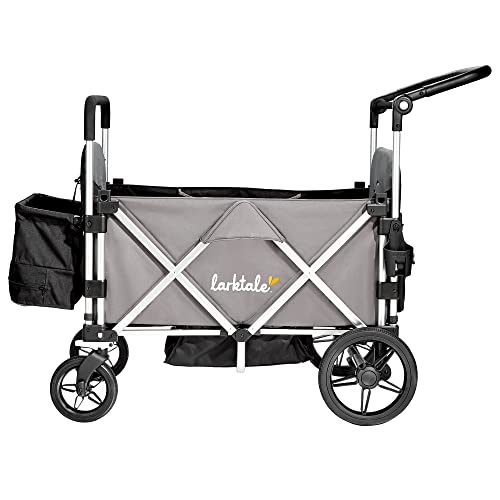
Larktale caravan – Double Seater Collapsible Wagon, All-Terrain Stroller Wagon for Kids, Baby, Toddler
- Easy Folding, All Terrain Stroller Wagon: A double stroller alternative, this collapsible wagon stroller is made for active families of babies and toddlers. Featuring all-wheel suspension and all terrain wheels, the Larktale caravan soaks up all the road bumps no matter your destination.
- Patent Pending Reclining Seats: Two individually reclining seats with 5-point harness for baby. Drop-down footwell offers natural seating. One seat flips to create flat, supportive base to haul gear or let your child stretch out.
- Lots of Storage & Organization: Features a large storage basket to hold all outdoor essentials, parent organizer for personal items, and an interior pocket for toys, snacks, and more. Fits kids of varied ages, up to 50 pounds per seat, and is a comfortable solution for special needs families.
New starting from: 299.99 $
Go to AmazonOverview: The Larktale Caravan positions itself at the intersection of travel convenience and outdoor capability. Its compact fold, airline-compatible design, and decent all-terrain wheels make it one of the few wagons that genuinely works both as a travel companion and a moderate all-terrain vehicle. Families who want one wagon that fits in the overhead bin and handles weekend trails will find it compelling.
| Specification | Details |
| Wheel type | EVA foam-filled |
| Wheel size | 12 inches |
| Weight capacity | 100 lbs total |
| Wagon weight | 26 lbs |
| Seating | 2 children |
| Harness | 5-point on both seats |
| Terrain rating | Grass, gravel, moderate trails, pavement |
| Price range | USD $350–$450 |
Pros: Most compact fold in the all-terrain category; airline travel-friendly; 5-point harness; solid outdoor performance; good canopy; lightweight for its class
Cons: Not as capable on deep sand or technical trails as larger-wheeled competitors; moderate storage capacity; premium price for the terrain capability offered
Best for: Families who travel frequently and also want moderate all-terrain capability; airport trips to beach destinations are the sweet spot
All-Terrain Wagon Comparison Table 2026
Use this comprehensive side-by-side comparison to evaluate all six reviewed wagons across the key performance and specification categories.
| Model | Wheel Type | Size | Capacity | Weight | Harness | Price (USD) | Best Terrain |
| Veer Cruiser XL | Air-filled | 14″ | 110 lbs | 38 lbs | 5-point x2 | $600–700 | All terrain |
| Wonderfold W2 Luxe | EVA foam | 12″ | 100 lbs | 32 lbs | 5-point x2 | $450–550 | Trails, grass |
| Mac Sports Folding | Polyurethane | 10″ | 150 lbs | 15 lbs | None | $80–120 | Grass, gravel |
| Radio Flyer Cargo | Rubber/steel | 13″ | 200 lbs | 22 lbs | Optional | $150–200 | Campsite, sand |
| Gorilla Carts HD | Air-filled | 13″ | 400 lbs | 31 lbs | Lap belt | $200–280 | All terrain |
| Larktale Caravan | EVA foam | 12″ | 100 lbs | 26 lbs | 5-point x2 | $350–450 | Trails, urban |
Understanding Wagon Wheel Technology

Wheel technology is the single most important factor in all-terrain performance, yet it’s also one of the most misunderstood. Here’s a plain-language breakdown of every wheel type you’ll encounter when shopping for an all-terrain kids wagon.
Air-Filled (Pneumatic) Tires
Air-filled tires are the gold standard for all-terrain performance. They work on the same principle as bicycle tires — a pressurized air chamber inside the tire absorbs impact and conforms to the ground surface, providing genuine cushioning and traction across virtually any terrain including deep sand, technical trails, and wet grass.
The trade-off is maintenance. Pneumatic tires need periodic pressure checks (typically 20–35 PSI for most wagon tires), and they can be punctured by sharp objects on trails or campsites. For families who use their wagon primarily on challenging terrain, the performance benefit far outweighs this inconvenience. For families who mainly stay on pavement or maintained grass, the maintenance overhead may not be worth it.
EVA Foam-Filled Tires
EVA (Ethylene-Vinyl Acetate) foam tires are the most popular choice in premium stroller wagons and mid-range all-terrain models. They provide a meaningful improvement over plastic wheels — better shock absorption, improved traction, and zero maintenance since they cannot go flat. They perform well on grass, gravel, moderate trails, and pavement. Their limitation compared to pneumatic tires is that they’re stiffer and provide less cushioning on very rough or loose terrain.
For most families — especially those who value convenience and don’t regularly tackle technical terrain — EVA foam tires are the sweet spot. No punctures, no pressure checks, and genuinely good outdoor performance.
Hard Plastic Wheels
Hard plastic wheels are found on entry-level and standard wagons. They work perfectly well on smooth, hard surfaces — pavement, indoor floors, and flat concrete. On grass, gravel, or anything uneven, they create significant rolling resistance, vibration, and noise. They’re also the most prone to cracking or shattering on repeated impact. If all-terrain performance matters to you, avoid wagons with plastic wheels regardless of price.
Polyurethane and Rubber Wheels
Many utility-style outdoor wagons use solid rubber or polyurethane tires on steel rims. These perform better than plastic on mixed terrain and are puncture-proof like foam tires, but they transmit more vibration than air-filled tires. They’re a practical choice for campsite and outdoor event use where traction and durability matter more than ride comfort.
| Wheel Type | Best Terrain | Puncture Risk | Maintenance | Ride Comfort | Typical Models |
| Air-filled pneumatic | All terrain, sand, trails | Medium | Monthly pressure check | Excellent | Veer Cruiser XL, Gorilla Carts |
| EVA foam-filled | Grass, gravel, light trails | None | None | Good | Wonderfold, Larktale, Keenz |
| Hard plastic | Pavement only | None | None | Poor | Budget/standard wagons |
| Rubber on steel rim | Grass, gravel, campsite | None | None | Moderate | Radio Flyer Cargo, utility wagons |
All-Terrain Wagon Safety: What Outdoor Use Changes

All-terrain use introduces additional safety considerations beyond standard wagon use. The environments where these wagons perform best — trails, beaches, campsites — are also environments with more hazards. Here’s what to know before heading off-road with your children.
Harness Requirements by Age and Terrain
On flat terrain, a lap belt or side rails may be acceptable for older children who can sit independently. On uneven terrain — hills, gravel, roots — a 5-point harness is strongly recommended for any child under 5 years old. The sudden jolts and angle changes of rough terrain can dislodge a child from a poorly restrained seat far more easily than smooth-surface use.
For children under 6 months, no all-terrain wagon use is recommended without a flat-recline infant insert that provides full head and body support. Even with such inserts, avoid technical trail use with infants under 12 months.
Incline and Hill Safety
Hills are where most outdoor wagon accidents occur. When descending a hill, grip the handle firmly with both hands, engage any available brake, and control your walking pace rather than allowing the wagon’s momentum to dictate your speed. Never release the handle on an incline. When ascending steep terrain, a second adult to guide or support the rear of the wagon is advisable.
Some premium all-terrain wagons include foot-activated parking brakes specifically designed for incline use. This feature is worth prioritizing if you plan to use your wagon on hilly terrain.
Weather and Environmental Safety
All-terrain adventures often mean exposure to sun, heat, wind, and rain. Key safety practices for outdoor wagon use include checking canopy UPF rating (look for UPF 50+), bringing extra water for children in warm weather, using the canopy consistently in direct sun, and checking weather forecasts before extended outdoor excursions. In hot weather, check the wagon’s seat fabric temperature before placing a child in it — dark fabric on metal-framed wagons can become uncomfortably hot in direct sun.
Terrain Assessment Before Use
Before taking your wagon onto an unfamiliar trail or outdoor environment, do a quick visual assessment. Check for: drop-offs or steep sections that exceed your wagon’s safe incline rating (most manufacturers specify a maximum gradient); surfaces that could cause wheel sink-in or loss of control; gate widths and trail widths narrower than your wagon; and obstacles that would require the wagon to be lifted over.
- Always check the weight capacity before loading children plus gear
- Ensure all harness buckles are fully engaged before moving on rough terrain
- Test the wagon’s stability on a flat surface before attempting inclines
- Carry a basic puncture repair kit if using air-filled tires on trail use
- Wear appropriate footwear yourself — pulling a loaded wagon on rough terrain is physical work
- Keep children’s hands and feet inside the wagon on all terrain types
- Check wheel tightness and frame integrity before each outdoor session
How to Choose the Right All-Terrain Wagon: Complete Buyer’s Framework

With the range of all-terrain wagons available in 2026, narrowing down the right choice comes down to matching product specifications to your family’s specific outdoor lifestyle. Use this framework to guide your decision systematically.
Step 1: Define Your Primary Terrain
Be honest about where you’ll actually use the wagon most often. A wagon that excels on beach sand needs different specifications than one optimized for forest trails or campsite use. If you genuinely use multiple terrain types regularly, prioritize air-filled tires and a strong frame over cost savings. If you’re primarily on grass and occasional gravel, EVA foam tires at a lower price point will serve you well.
Step 2: Decide Between Stroller Wagon and Utility Wagon
All-terrain wagons fall broadly into two categories: stroller wagons (with harness systems, canopies, and recline features) and utility wagons (open beds, higher capacity, simpler design). Stroller wagons are essential if you have toddlers or young children who need securing during transit. Utility wagons suit older children aged 4+ who can sit independently and families who also need significant cargo capacity.
Step 3: Assess Age and Weight of Your Children
This determines whether you need a harness system (mandatory for under 4 years), how much per-seat weight capacity you need, and whether you require a recline feature for nappers. If your youngest child is under 18 months, ensure the wagon is compatible with an infant insert or flat recline position. If your children are older and heavier, prioritize total and per-seat weight limits.
Step 4: Consider Transport and Storage Logistics
All-terrain wagons are generally heavier and bulkier than standard wagons. Before purchasing, measure your vehicle’s boot space and compare to the wagon’s folded dimensions. If you’ll be transporting the wagon to trailheads or campsites, ease of loading and unloading matters. Lighter wagons (under 25 lbs) are significantly easier to lift alone. Heavier models (30–40 lbs) often need two people to load into taller vehicles.
Step 5: Set Your Budget Honestly
All-terrain wagons range from approximately USD $80 to over $700. Entry-level models under USD $150 typically use smaller wheels and lack harness systems — suitable for older children and primarily outdoor utility use. Mid-range models (USD $200–$450) offer the best value for families wanting a harness system, decent terrain capability, and reasonable weight. Premium models (USD $500+) deliver the best combination of terrain performance, safety features, and durability, and are worth the investment for families who use their wagon multiple times per week in demanding environments.
| Your Situation | Best Choice | Why |
| Beach use is primary | Veer Cruiser XL | Air-filled tires handle sand best |
| Moderate trails + 2 kids | Wonderfold W2 Luxe | EVA foam + stroller wagon safety |
| Budget under USD $150 | Mac Sports Collapsible | Best value for older kids |
| Camping + heavy loads | Radio Flyer Cargo / Gorilla Carts | High capacity + rugged build |
| Travel + outdoor crossover | Larktale Caravan | Compact fold + decent all-terrain |
| Maximum terrain capability | Veer Cruiser XL / Gorilla Carts | Air-filled tires on both |
Essential Accessories for All-Terrain Wagon Use

The right accessories can significantly extend the capability and usability of your all-terrain wagon. Here are the most worthwhile additions for outdoor-focused families.
Cargo Organizers and Cooler Bags
Many all-terrain wagons have open cargo areas that benefit from organization systems. Fitted cooler bags, soft-sided organizers, and divider inserts help separate food, gear, and children’s items efficiently. For beach and camping use, a dedicated cooler insert that fits the wagon’s cargo area is one of the most practical add-ons available.
Canopy Upgrades
Some all-terrain utility wagons — including the Veer Cruiser — sell canopies separately or as an upgrade. A full-coverage UPF 50+ canopy is essential for beach and trail use. For families who buy a wagon that includes only partial canopy coverage, third-party universal wagon canopies are available and can provide significantly better sun protection.
Infant and Toddler Inserts
For families with young infants, a properly fitted infant seat insert that provides full head and body support is essential. Some wagon manufacturers sell brand-specific inserts; others are compatible with third-party car seat adapters. Always verify compatibility and weight ratings before using an infant in an all-terrain wagon.
Tire Repair Kits
If you use air-filled tires on trails, carry a portable tire repair kit and a compact hand pump. Tire slime — a preventive sealant injected into the tire before use — can seal small punctures automatically and significantly reduces the risk of trail-side flats. This small investment prevents potentially trip-ending situations on remote trails.
Wagon Covers and Weather Protection
For families who store their wagon outdoors or transport it in open vehicles, a fitted wagon cover protects the fabric seats and canopy from UV damage, moisture, and debris. Most major wagon brands sell fitted covers; universal options are also widely available online.
Frequently Asked Questions
Can all-terrain wagons be used on the beach?
Yes, but not all models perform equally on sand. Wagons with large air-filled or wide balloon-style tires (14 inches or larger) handle beach sand well, floating over the surface rather than sinking into it. Smaller-wheeled models will drag in loose sand and become very difficult to push. The Veer Cruiser XL and similar beach-optimized wagons are the top choices for regular beach use.
What is the best age for an all-terrain wagon?
For stroller-style all-terrain wagons with harness systems and recline capability, most models accommodate children from 6 months (with an infant insert) through approximately 6–8 years, depending on weight limits. Utility-style all-terrain wagons without harness systems are best for children aged 4 and older who can sit independently and follow basic safety instructions.
Are all-terrain wagons worth the extra cost over standard wagons?
For families who frequently spend time in parks, on trails, at the beach, or at outdoor events, yes — absolutely. The terrain capability, durability, and comfort improvement is significant and directly affects how much you’ll actually use the wagon. For families who primarily stay on smooth urban surfaces, the premium over a standard wagon is harder to justify.
How do I maintain air-filled tires on my wagon?
Check tire pressure monthly and before any significant outdoor use. Most wagon pneumatic tires operate best at 20–35 PSI — check your specific model’s manual. Use a standard bicycle pump or a portable electric inflator. Consider injecting tire sealant if you frequently use the wagon on rocky or debris-covered trails. Keep a basic patch kit in your outdoor bag for longer trips.
Can I take an all-terrain wagon on a hiking trail?
Moderate, maintained hiking trails with packed dirt, light gravel, and manageable inclines are well within the capability of a quality all-terrain wagon. Technical trails with narrow widths, steep gradients, large rocks, or loose scree are not suitable for wagons. Always assess the trail conditions before attempting to bring a loaded wagon, and prioritize trails that are officially stroller or wheelchair accessible as a starting point.
What is the maximum incline for safe wagon use?
Most manufacturers recommend a maximum incline of 15–20 degrees for loaded wagon use. Beyond this gradient, stability becomes a concern and the physical effort required to control the wagon safely increases significantly. On any incline, keep both hands on the handle and never release the wagon while occupied.
Do all-terrain wagons fold flat for car transport?
Most modern all-terrain wagons include a fold mechanism, but folded dimensions vary considerably. Stroller-style all-terrain wagons (such as the Wonderfold W2 or Larktale Caravan) typically fold more compactly than utility wagons. Utility wagons like the Gorilla Carts or Radio Flyer Cargo fold to a flat position but remain wide. Always check the folded dimensions against your vehicle’s boot space before purchasing.
How heavy are all-terrain wagons, and can one person manage them?
All-terrain wagons range from approximately 15 lbs (Mac Sports Collapsible) to 38 lbs (Veer Cruiser XL). Wagons under 25 lbs are manageable for one adult to lift in and out of a vehicle. Heavier models above 30 lbs are easier with two adults, especially when lifting into higher vehicle boots or SUVs. Weight is a real practical consideration — many parents underestimate how often they’ll need to lift the wagon in and out of the car.
Final Verdict: Finding the Best All-Terrain Wagon for Your Family

All-terrain wagons represent one of the most significant upgrades a family can make to their outdoor experience. The difference between a standard plastic-wheeled wagon and a quality all-terrain model — in terms of where you can go, how smoothly your child rides, and how long the product lasts — is not subtle. It’s the difference between limiting your adventures to smooth paths and genuinely going wherever the day takes you.
The best all-terrain wagon for your family is not necessarily the most expensive or the most feature-laden. It’s the one that matches your primary terrain, accommodates your children’s ages and weights, fits in your vehicle, and delivers performance that makes your outdoor life easier rather than more complicated.
For families who prioritize maximum terrain capability and are willing to invest in the best, the Veer Cruiser XL remains the benchmark. For families who want strong outdoor performance with the safety features of a stroller wagon, the Wonderfold W2 Luxe is the standout choice. For families on a tighter budget who need a capable outdoor wagon for older children, the Radio Flyer Cargo & Carry offers exceptional value. Whatever your starting point, this guide has the information you need to make the right call.
BestChildrenWagons.com is an independent parent resource for researching children’s outdoor gear. Content is based on product research, safety data, and parent community feedback. Affiliate links may appear in product sections.