
WonderFold W1 Review (2026): Is the Original Stroller Wagon Worth It?
As an Amazon Associate we earn from qualifying purchases. Prices and availability are accurate as of the date/time indicated and are subject to change.
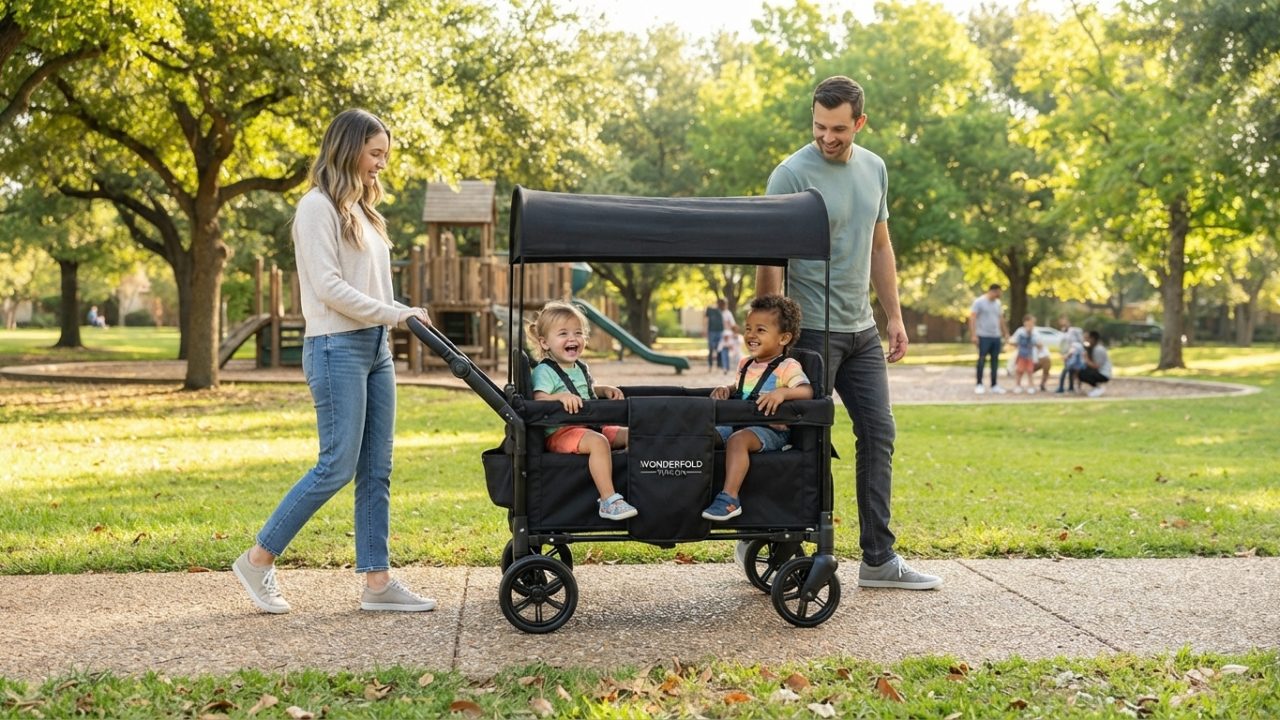
The W1 is WonderFold’s cheapest wagon, priced at $289, and it’s the model most people mean when they say “WonderFold” for the first time without knowing the brand has six or seven other versions above it. It holds two kids, up to 180 pounds combined, which is more than almost any double stroller on the market. It’s also the version WonderFold cut the most corners on to hit that price — flat seats instead of raised ones, a push handle with no matching pull handle, and a folded size that’s bigger than you’d expect from something with “compact” in half its marketing copy.
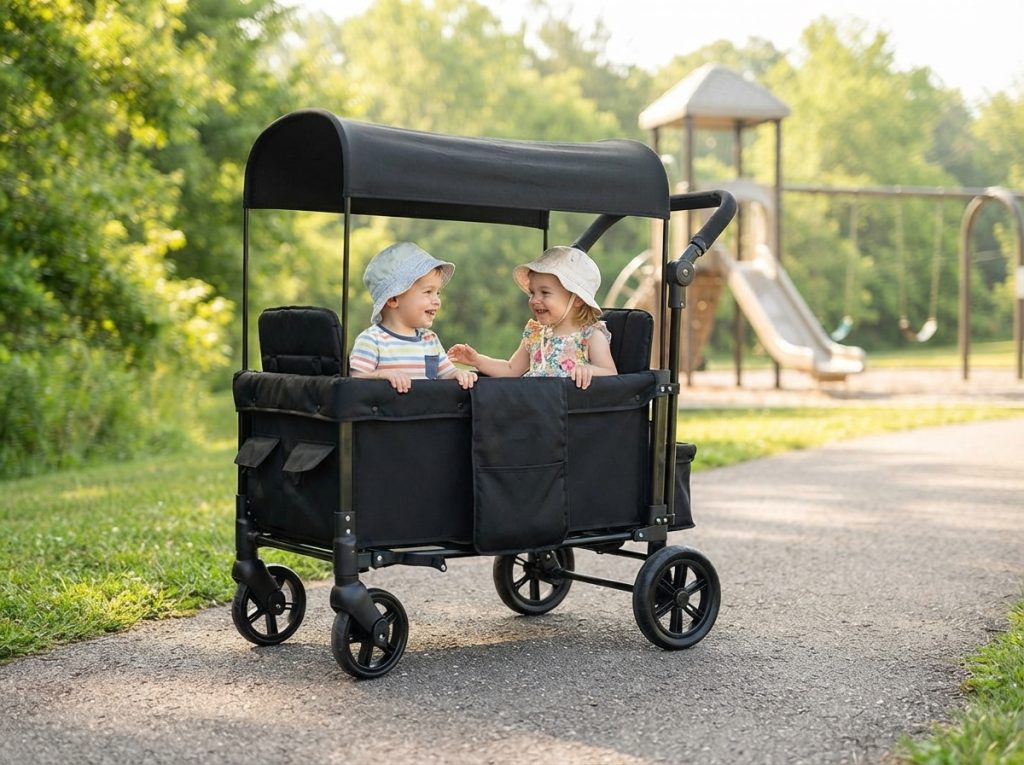
If you want the WonderFold name and the high weight capacity without spending $600 to $1,000, this gets you in the door. If you’ve already read about the raised seats or side-entry doors on WonderFold’s pricier models and assumed the W1 has some version of those too, it doesn’t, and that’s worth knowing before you buy, not after.
| Spec | W1 Original |
| Price | $289 |
| Age range | 6 months and up |
| Weight capacity | 180 lbs combined (2 seats) |
| Wagon weight | 33 lbs with seats |
| Frame | Steel |
| Seats | Flat (floor-level), 5-point harness |
| Handle | Push only, adjustable 25″-38″, pull strap included |
| Front / rear wheels | 7.6″ / 9″, rear wheels 2″ wide |
| Inner wagon size | 31″L x 17″W x 12″H |
| Assembly time | About 15 minutes out of the box |
| Fold time | ~30 sec with canopy, ~11 sec without |
| Folded size | 9.5 cubic feet (33″L x 25″W x 20″H) |
Why it’s cheaper: what actually got left out
WonderFold’s lineup has grown a lot since the W1 first came out, and everything above it — the W2 Elite, the Luxe Pro line, the newer L Series — adds something the W1 doesn’t have. The L Series brought raised, reclining seats and a full side-entry door that lets kids climb in and out on their own instead of being lifted over a wall. The Elite and Luxe Pro tiers swapped the steel frame for aluminum, cutting real weight. The W1 is the version you buy when you want the WonderFold badge and the weight capacity, and you’re fine giving up all of that.
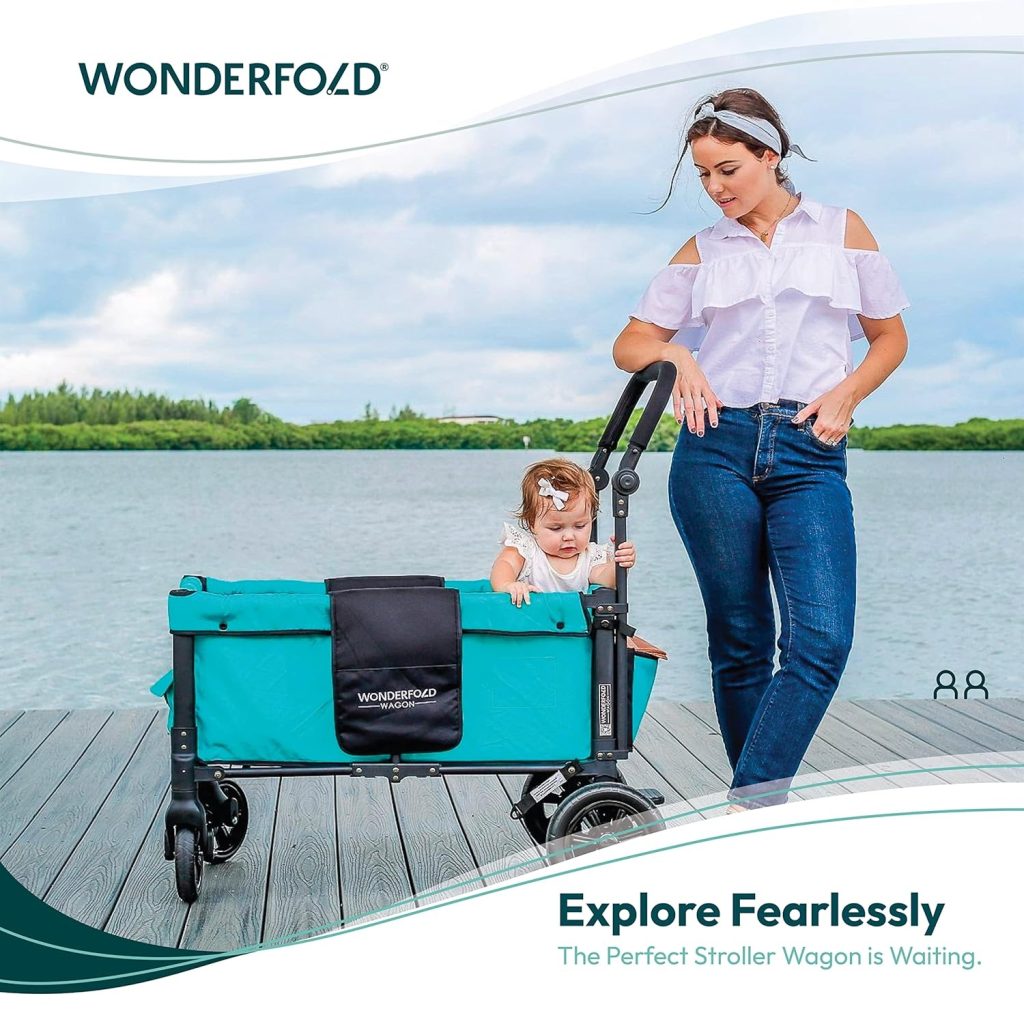
It comes in six colors — Jet Black, Teal Green, Smoky Gray, Cobalt Violet, and Fuchsia Pink among them — so the color range at least isn’t where the savings come from.
| Tier | Frame | Seats | Entry | Roughly |
| W1 Original | Steel | Flat, floor-level | Lift over the wall | $289 |
| W2 / W4 Elite Pro | Aluminum | Flat, floor-level | Lift over the wall | $699+ |
| Luxe Pro line | Aluminum | Flat, floor-level, upgraded fabric | Lift over the wall | $899+ |
| L Series (L2 / L4) | Aluminum | Raised, reclining | Full side-entry door | $950+ |
The seats sit on the floor, not above it
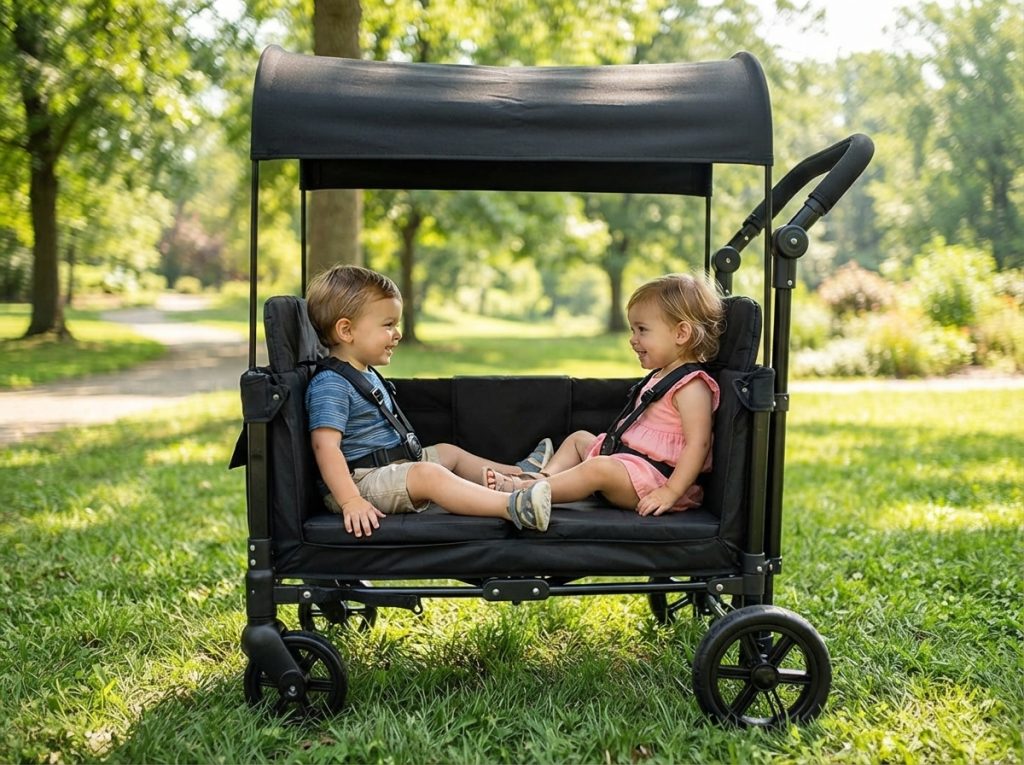
This is the detail most people miss when comparing WonderFold models by price alone. On the W1, kids sit directly on the wagon floor. There’s no raised bench the way there is on the newer L Series or the W4 Elite Pro. It’s not unsafe, and the seat pads are padded and removable, with a real 5-point harness on each side. It’s just a flatter, more basic seating position than what WonderFold now sells on its nicer models, and if you’ve seen photos of a WonderFold with kids sitting up higher, that’s not this one.
One handle, not two
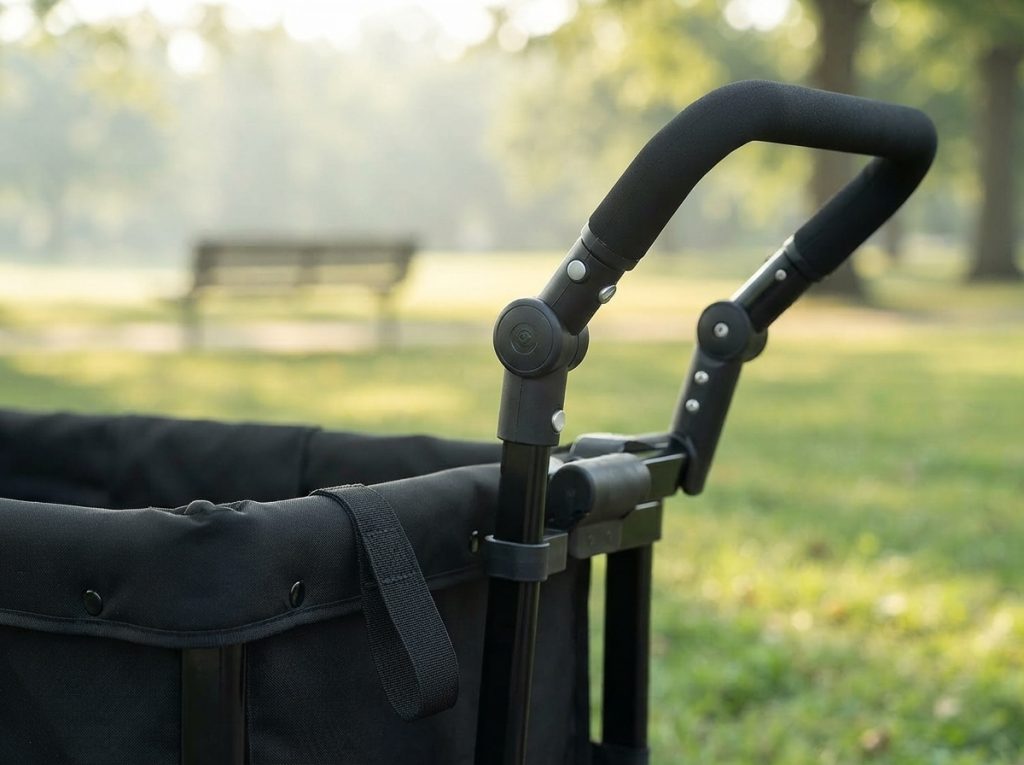
Almost every other stroller wagon in this category gives you a push handle and a separate pull handle, so you can walk in front of the wagon or behind it depending on the situation. The W1 only has the push handle. There’s a strap for pulling, but it’s a strap, not a handle, and testers who’ve actually used it describe it as fine for short distances and not something you’d want to rely on for a real walk. If pulling the wagon behind you — backing out of a tight spot, navigating a crowded aisle — is something you expect to do often, this is a real limitation, not a minor one.
The handle itself adjusts from 25 to 38 inches, which covers a wide range of parent heights, though 38 inches sits on the low side for anyone especially tall. It’s covered in a removable neoprene pad and folds down with two buttons, one on each side — not quite as simple as a single-button release, but not a real problem either.
Storage: the marketing and the actual testing don’t fully agree
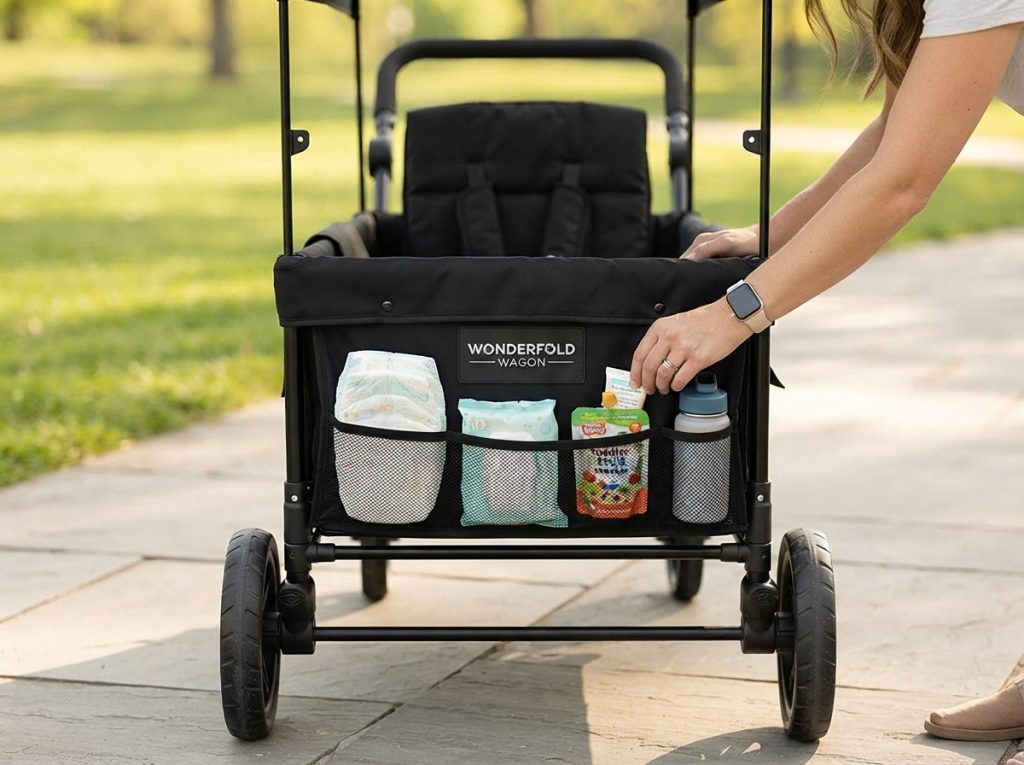
Retailer listings describe front and rear storage pockets plus pockets on both sides. At least one outlet that actually tested the W1 against ten other stroller wagons found the real storage more limited than that — a single wide pocket across the back that doesn’t hold much. That’s a meaningful gap between the sales copy and what shows up in hands-on testing, and it’s worth going in with the more conservative expectation rather than assuming you’re getting storage on par with WonderFold’s pricier models.
If storage ends up feeling tight once it arrives, a universal cargo net or a clip-on parent console — the same kind of accessory that works across Keenz and WonderFold wagons generally — is a cheaper fix than trading up to a pricier WonderFold model just for the extra pocket space.
The canopy works, but it’s fiddly the first time
The canopy is removable and slides along the frame, with UV protection built in. Testers who’ve actually put it on report the canopy posts need to line up with specific holes in the fabric, and getting that alignment right on the first try takes a bit of trial and error. Once it’s on, it stays on fine and slides where you need it. It’s the initial setup that catches people off guard, not the day-to-day use.
Folding: fast in theory, bulky in practice
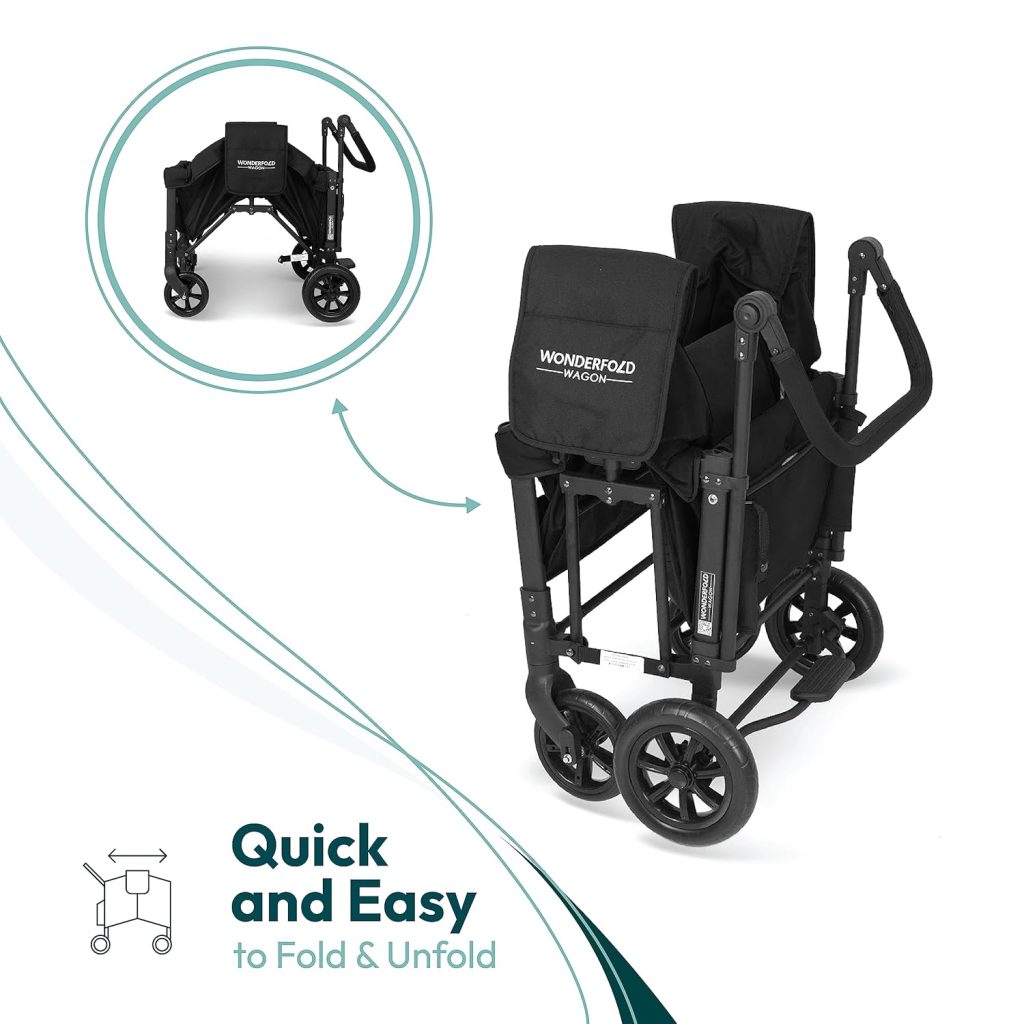
Actual timed testing puts the fold at around 30 seconds with the canopy on, including taking the canopy off and stowing it, or about 11 seconds if you’re not dealing with the canopy at all. Unfolding runs about 25 seconds with the canopy, 10 without. Those are genuinely quick numbers.
Where it falls short is the folded size. Even though the W1 is the smallest and lightest wagon in WonderFold’s own W-series lineup, testers who compared it side by side with other brands found it still folds down bigger than most standalone 2-passenger wagons on the market. It beats bulkier options like the Baby Trend Expedition or the Jeep Wrangler wagon, but it doesn’t beat the field the way “compact” branding might suggest. If trunk space is tight, don’t assume WonderFold’s entry-level model solves that problem just because it’s the smallest one they sell.
| Wagon | Folded size |
| Graco Modes Adventure | 7.0 cu ft |
| Veer Cruiser | 7.9 cu ft |
| Keenz 7S | 8.9 cu ft |
| Evenflo Pivot Xplore | 9.0 cu ft |
| WonderFold W1 Original | 9.5 cu ft |
| Jeep Wrangler | 10.2 cu ft |
| Baby Trend Expedition | 13.1 cu ft |
Folded, it measures 33 inches long, 25 wide, and 20 tall — 9.5 cubic feet. That’s roomier than a Graco, Veer, Keenz 7S, or Evenflo when folded, but smaller than a Jeep Wrangler or Baby Trend. One tester fit it into a Honda Civic trunk without trouble, though with little room left over for anything else.
Age and size range
WonderFold lists the W1 for kids 6 months and up. The 180-pound figure is the combined limit across both seats, not per child — some secondary spec listings put the per-child range at roughly 13 to 45 pounds, though that number doesn’t come directly from WonderFold’s own site, so treat it as a rough guide rather than a guaranteed cutoff. If your exact child’s weight is close to any published limit, it’s worth confirming directly with WonderFold or a retailer rather than relying on a single secondary source.
Weight capacity is the real strength here
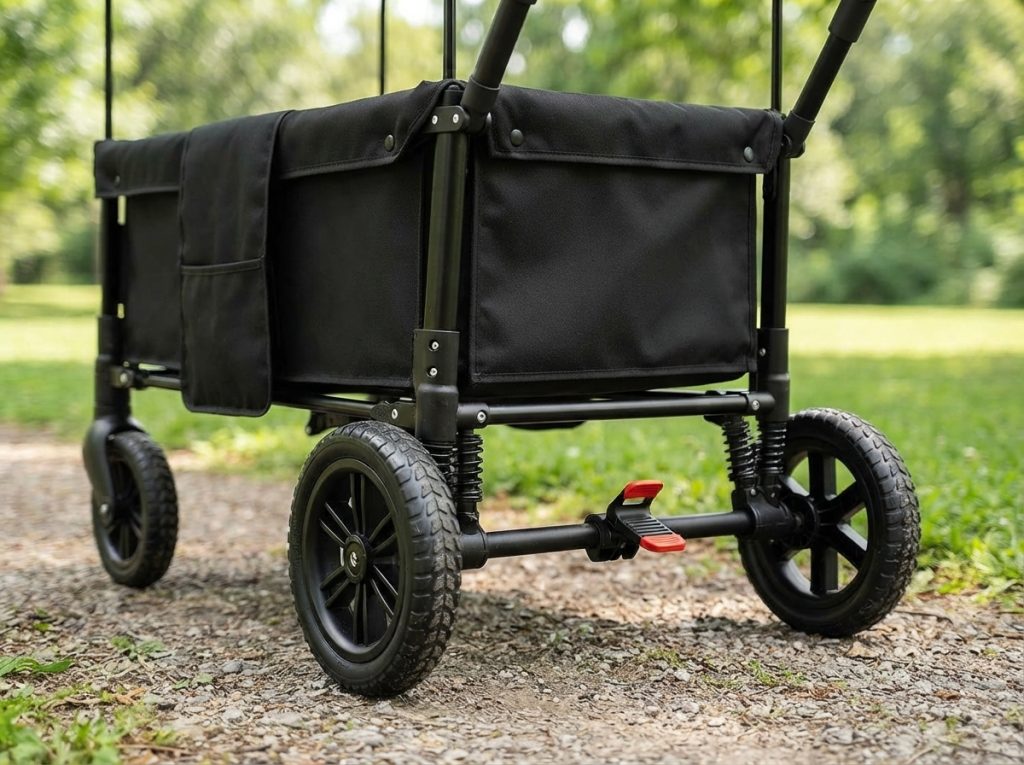
This is the part where the W1 actually stands out, not just holds its own. At 180 pounds combined capacity, it clears almost every double stroller on the market, most of which top out around 90 pounds. The wagon itself weighs 33 pounds with the seats attached — not the lightest wagon out there, but lighter than most of WonderFold’s own W4 and L4 models, since it’s only built for two kids instead of four. All-terrain EVA tires with bearings and a suspension system round out the frame, and the one-step foot brake works the way you’d expect, mostly.
How much muscle it actually takes to push
Independent testing that measured pushing force across eight competing wagons found the W1 needs about 15.4 pounds of force to get rolling and keep moving — right in the middle of the pack, tied with the Graco Modes Adventure and Jeep Wrangler, behind the Veer Cruiser and Evenflo Pivot Xplore (both around 11 pounds) but ahead of the Ever Advanced. Turning a fully loaded wagon 90 degrees from a dead stop took about 28.7 pounds of force in the same testing, again mid-pack — easier than a Jeep Wrangler, harder than a Veer Cruiser or Evenflo. You won’t necessarily feel this difference during a normal walk, but it explains why some wagons feel noticeably lighter to maneuver than others even when the weight specs look similar on paper.
The wheels are smaller than most competitors
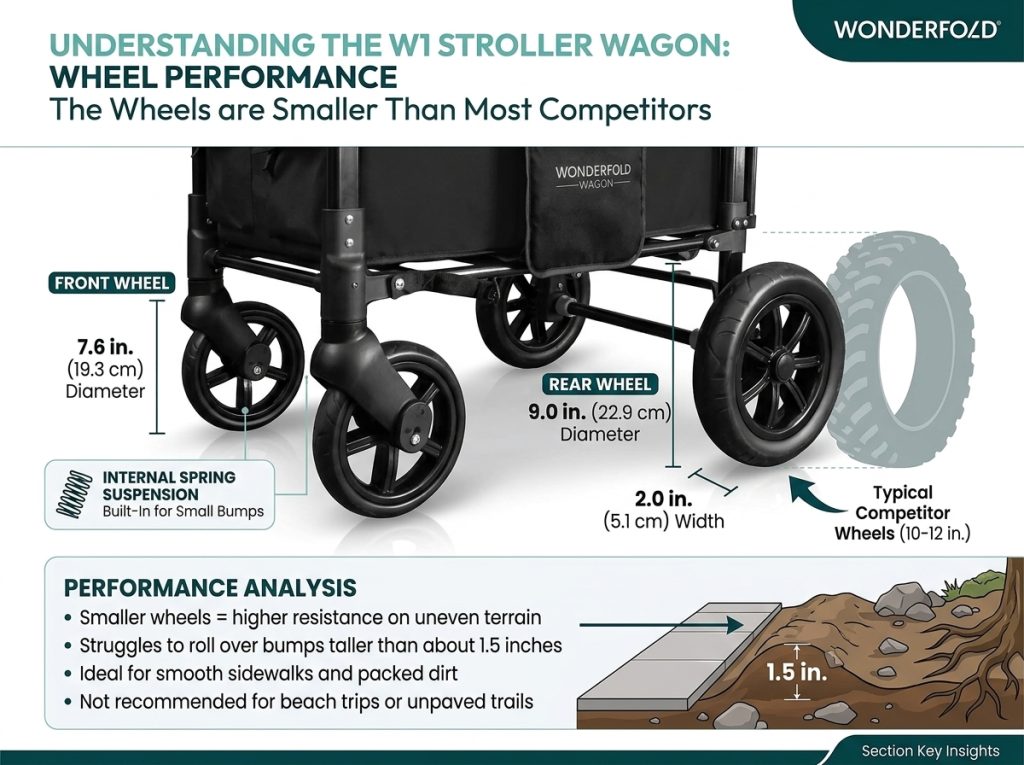
Front wheels measure 7.6 inches across; rear wheels are 9 inches and 2 inches wide. That’s smaller than the 10-to-12-inch rear wheels common on a lot of competing wagons. Smaller wheels generally mean more resistance on grass and bumpy ground, which lines up with testing that found the W1 struggling to roll over bumps taller than about 1.5 inches — fine for sidewalks and packed dirt, not something to count on for a beach trip or an unpaved trail. The front wheels do have internal spring suspension built in, which helps smooth out smaller bumps even if it can’t do much about bigger ones.
The brake works, but not always on the first try
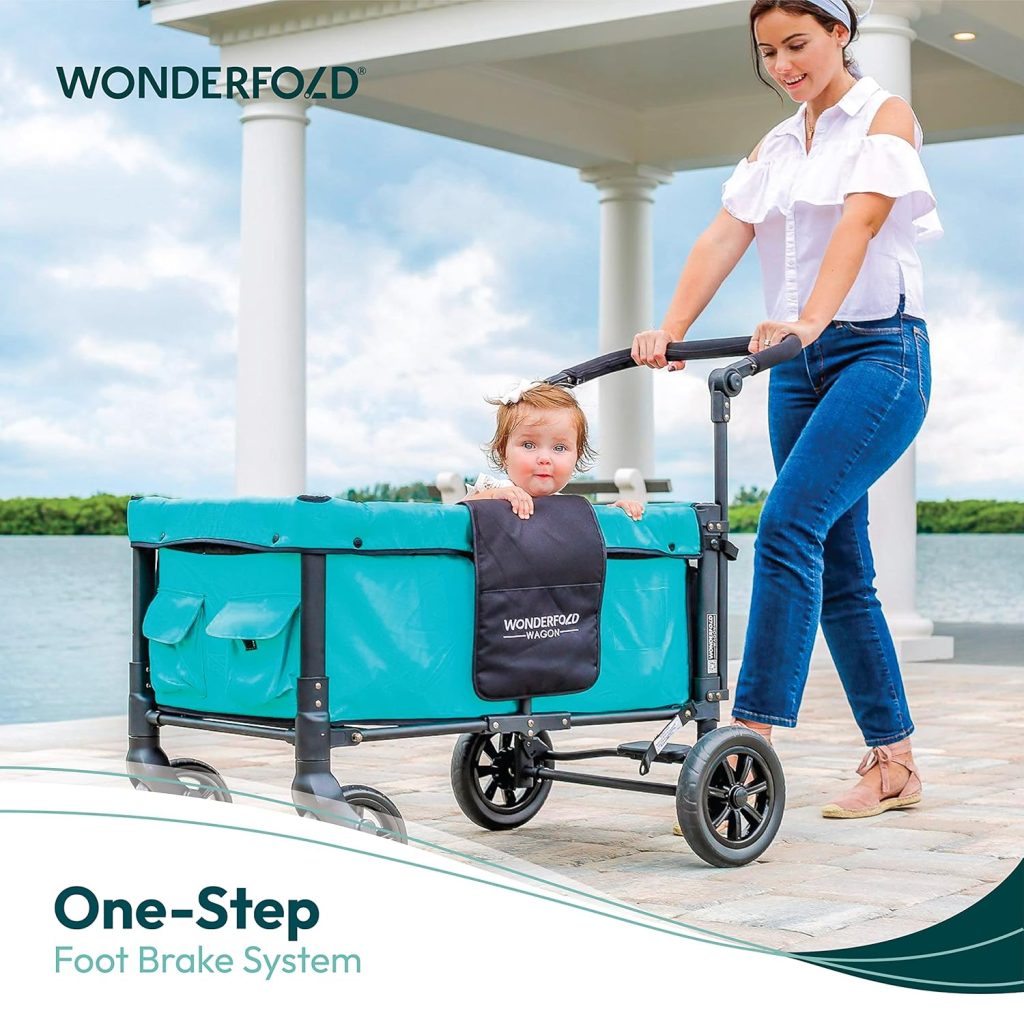
This is a detail that doesn’t show up in most spec sheets but matters more than a lot of the storage or color questions people ask first. In testing that included loading the wagon and releasing it down a hill to see how well the brake could stop it, the pedal didn’t always engage on the first press, and stopping wasn’t always immediate once it did catch. That’s not the same as saying the brake doesn’t work — it does, and a foot brake that needs a second press is still a real brake — but it’s worth testing yours firmly a few times before trusting it on a slope, rather than assuming a single tap will hold every time.
How it handles grass, hills, and bumps
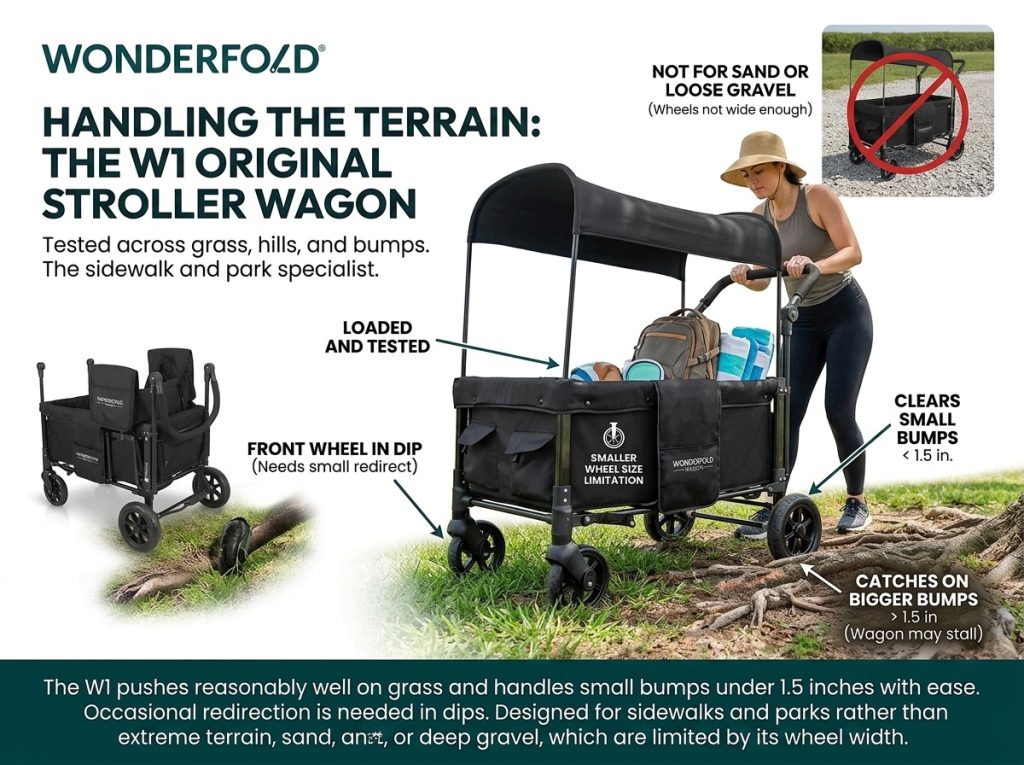
Loaded and tested across different terrain, the W1 pushed through grass reasonably well, occasionally catching a front wheel in a dip and needing a small redirect. On smooth grassy hills it behaved about the same as most other wagons in its price range. Bumps under about 1.5 inches were no problem; bigger bumps caused it to catch or stall. None of that is surprising given the smaller wheel size, and it lines up with WonderFold’s own positioning of the W1 as a sidewalk-and-park wagon rather than an all-terrain one. Sand and gravel are both a stretch for this wagon specifically — not because it’s unusually bad at it, but because the wheels simply aren’t built wide enough for loose ground, a limitation it shares with most wagons that don’t have dedicated all-terrain tires.
Common complaints, checked against real testing
The W1 has been on the market long enough to collect a range of owner complaints online. Here’s how those hold up against independent testing that put the wagon through repeated real-world use.
| Complaint | What testing found |
| Front wheels come loose during use | Testers reported no loose or damaged parts causing wheel issues in their unit |
| Wagon feels small inside | Smaller than the Jeep Wrangler, Keenz 7S, and Radio Flyer Discovery; roomier than Baby Trend, Evenflo, and Ever Advanced |
| Storage is too limited | Confirmed — testers rated it lowest of 8 wagons compared for storage volume |
| Feet bump the brake pedal while walking | Confirmed as a real annoyance; the W4 Elite has the same issue |
| Too big once folded for a 2-seat wagon | Confirmed — 9.5 cubic feet, bigger than most other 2-seat wagons tested |
| Frame tubing comes loose over time | Not reproduced in testing; frame joints held up through repeated use |
| Stitching comes loose | Not reproduced; fabric held up through testing |
| Can’t handle sand or off-road terrain | Confirmed — wheels aren’t wide enough for sand, same limitation as most non-all-terrain wagons |
| Difficult to fold | Not confirmed — tested faster to fold than several other wagons in its price range |
| Straps are uncomfortable | Rated about average; shoulder pads are present, no separate crotch padding |
Steel frame, not aluminum
WonderFold’s higher-end models have shifted to aluminum frames, which cut weight without cutting strength. The W1 is still built on steel. That’s part of why it’s cheaper, and it’s also part of why it’s not the lightest wagon in the lineup despite being the smallest. Steel isn’t a downgrade in terms of durability — if anything, it’s the more battle-tested material — but it is heavier per pound of frame than what you’d get paying more for a Luxe Pro or L Series model.
W1 vs. Keenz 7S
Both are traditional push-and-pull wagons with flat, floor-level seating rather than raised benches. The Keenz costs meaningfully more and packs in a lot more storage, including a large front-mounted bin and an insulated cooler bag. Testing that put both wagons through the same paces found neither one especially strong on steering, though both are adequate — but the W1 folds and stows noticeably easier, while the Keenz has a fussier canopy design that makes folding more awkward.
W1 advantages: cheaper, easier to fold and carry. Keenz 7S advantages: much more storage, a built-in parent cup holder, an insulated cooler bag, and generally higher-rated part quality.
W1 vs. WonderFold’s own W4 Elite
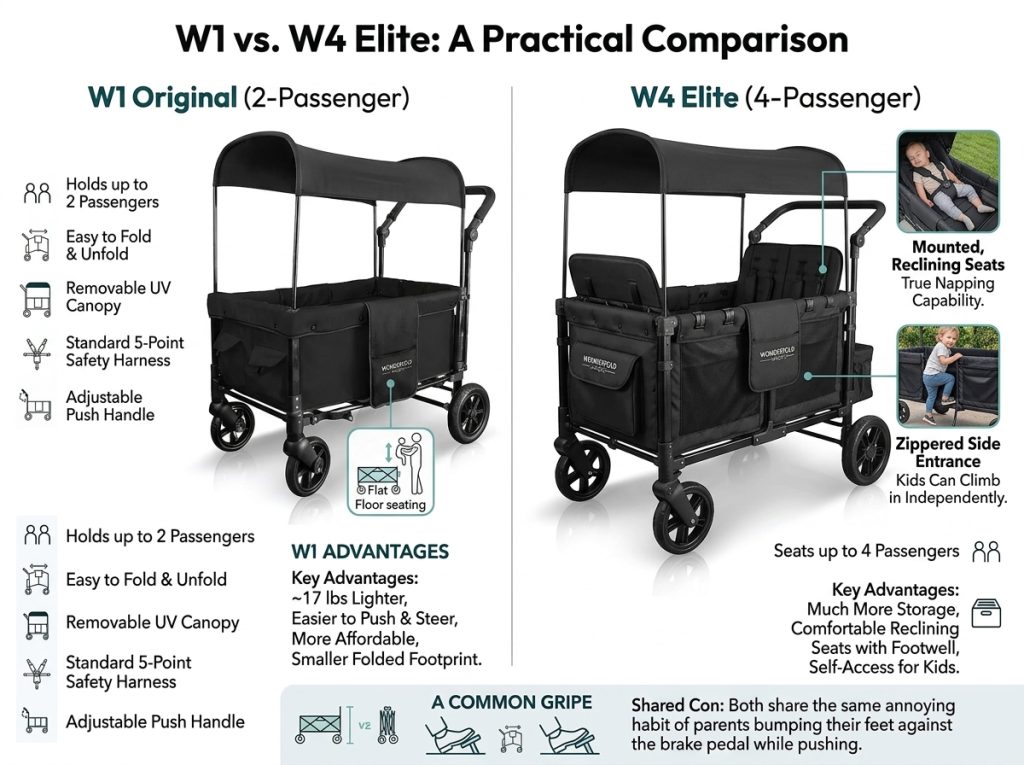
Not an apples-to-apples comparison since the W4 seats four kids instead of two, but it’s the comparison most people actually want once they start browsing WonderFold’s site, so it’s worth being direct about it. The W4’s mounted, reclining seats are more comfortable and make napping realistic in a way flat floor seating doesn’t. It also has a zippered side entrance so kids can climb in themselves — something the W1 simply doesn’t offer. Both wagons share the same annoying habit of parents bumping their feet against the brake pedal while pushing.
W1 advantages: about 17 pounds lighter, easier to push and steer, meaningfully cheaper, easier to fold and fit in a car, and a smaller folded footprint. W4 Elite advantages: much more storage space, more comfortable reclining seats with a real footwell, and the side entrance kids climb in and out of on their own.
Where it sits against the rest of WonderFold’s lineup
If you’ve read our WonderFold W4 Luxe review or our W2 Luxe review, the pattern is the same one that shows up here: WonderFold’s pricier models add raised seating, better folds, aluminum frames, and side-entry doors, and the W1 is what’s left once you strip all of that back out to hit the lowest price point in the family.
Against wagons outside the WonderFold name, the closest price competitor is the Evenflo Pivot Xplore, which tested faster to fold and easier to push in the same round of comparisons, though it comes with its own tradeoffs on storage and fold-mechanism quirks covered in that review.
Not everyone’s sold
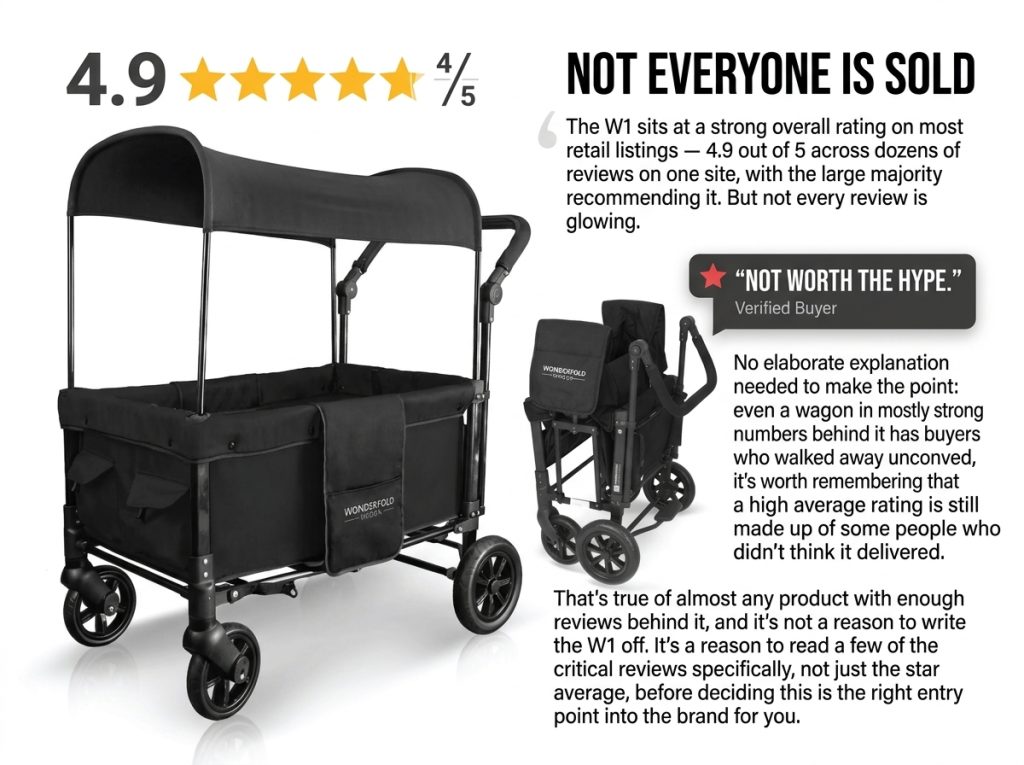
What daily use actually looks like on this one
Picture the ordinary version of using this: loading two toddlers in from the flat seats (no stepping up, no door, just lifting them over the side wall), pushing from behind since there’s no real pull option, and folding it in under a minute for the trunk when you’re done. That’s a fine routine for errands, the park, or a zoo trip. It gets less fine if your daily pattern involves backing out of tight parking spots with the wagon trailing behind you, or if you’re loading and unloading kids who are old enough to want to climb in themselves rather than being lifted.
Who this is actually for
Families who want the WonderFold name, the 180-pound capacity, and a lower price than the rest of the lineup, and who don’t mind flat seating and a single handle to get there. If you’re deciding whether a wagon makes sense for your family in the first place, our guide on whether a stroller wagon is worth it covers that bigger question before you get into comparing specific models. And if you’re weighing a wagon against a traditional double stroller, that comparison is worth reading too, given how directly the W1’s 180-pound capacity plays into that decision.
Skip it if raised seating, a real pull handle, or a genuinely compact fold matter more to you than saving a few hundred dollars — WonderFold’s own pricier models exist specifically to fix these exact gaps, which tells you something about how the company itself sees the W1’s place in its lineup.

Whether that trade is worth it depends on what you’re actually optimizing for, and that’s not a question a review can answer for you.
Related guides & reviews
Radio Flyer Odyssey Stroll ‘N Wagon Review (2026)
The Odyssey is Radio Flyer’s push-pull wagon built for two kids sitting bench-style rather than in individual bucket…
Momcozy ChangeGo Review (2026): Can It Really Replace a Stroller & Wagon?
Quick clarification before anything else, because this trips people up when they land here from a wagon search:…
Evenflo Shyft Rideshare All-Terrain Performance Stroller Wagon Review (2026)
The Shyft Rideshare is a genuinely capable 2-kid, all-terrain wagon with real suspension and urethane wheels that hold…
WonderFold VW4 Volkswagen Special Edition Review (2026)
If you just want the short answer: the VW4 is a genuine WonderFold W4 Luxe underneath a Volkswagen…