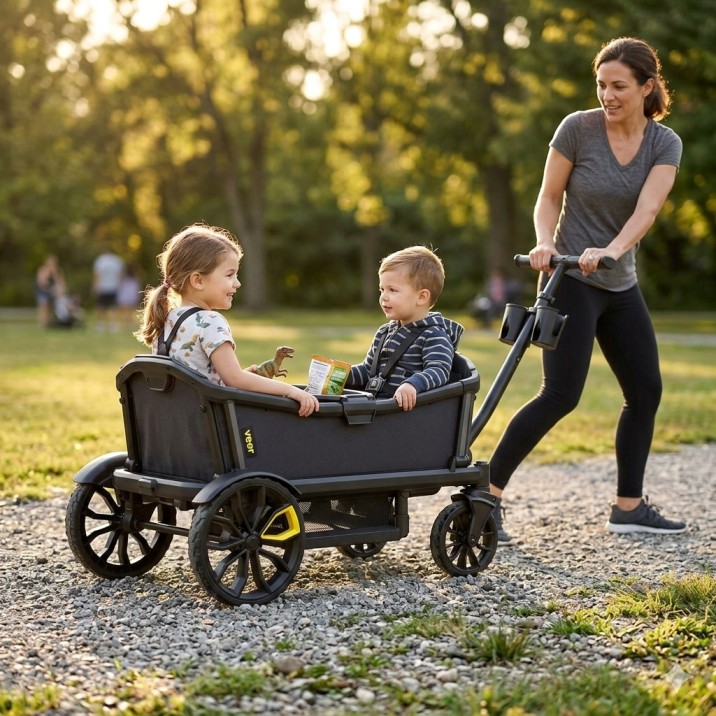
Every Veer Cruiser model reviewed — All-Terrain, City, XL — with independent test data, real parent experience, and a clear verdict on whether it justifies the cost
Last Updated: February 2026 | 12 min read | Covers all 4 Veer Cruiser models
Quick Verdict: Veer Cruiser Stroller Wagon
| Category | Score | Notes |
|---|---|---|
| Terrain Performance | 10/10 | Highest in category — no wagon outperforms it on grass, trail, and uneven surfaces. |
| Build Quality | 10/10 | Aircraft-grade aluminum, robotic welds, hose washable — built to last years. |
| Folding & Transport | 9/10 | Compact fold fits in a MINI Cooper trunk; 32.6 lbs; stands upright folded. |
| Maneuverability (Pulling) | 9/10 | Lowest veer/drift of any wagon tested; smooth swivel wheels when pulling. |
| Child Comfort | 7/10 | Footwell is excellent; 3-point harness (not 5-point); limited back support for naps. |
| Parent Usability | 6/10 | Low storage in base model; canopy and basket sold separately; handle range 38–42″. |
| Maneuverability (Pushing) | 5/10 | Rear-heavy wheel design makes push-mode steering awkward on tighter turns. |
| Value for Money | 6/10 | Best product in class — but true cost with essential accessories reaches $900–$1,100+. |
| Overall | 9/10 | The best-performing stroller wagon tested — for the right family in the right context. |
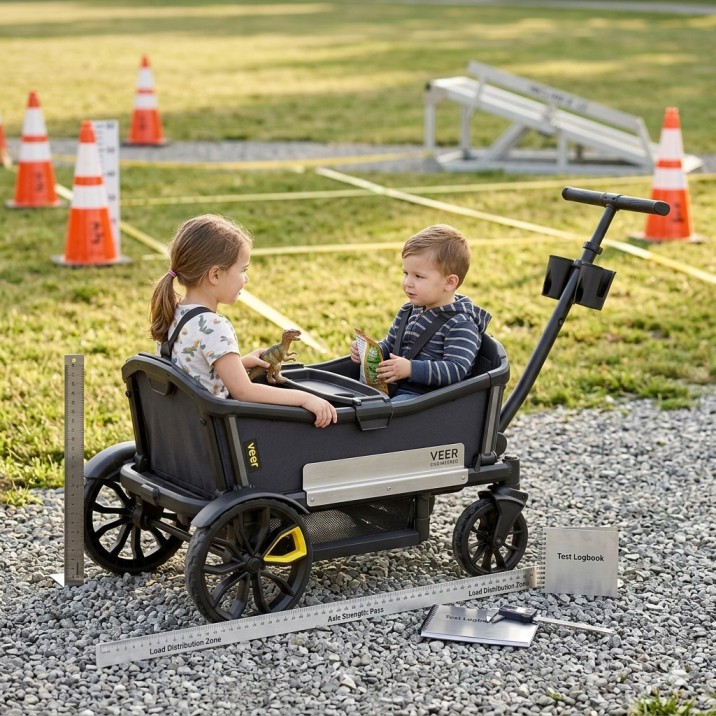
Bottom line: The Veer Cruiser is the highest-performing stroller wagon in every independent test conducted. It earned the top overall score in the KidTravel 65-test study, the top terrain score in BabyGearLab testing, and consistent praise across 2+ year real-family reviews. If terrain performance and build longevity are your priorities — and you can manage the true accessory cost — this is the best stroller wagon available. If you want an all-in-one accessory-loaded wagon at a lower price, look elsewhere.
The Veer Cruiser Lineup in 2026: All 4 Models Explained
Veer now produces four distinct Cruiser models. Most review articles cover only the original Cruiser. This guide covers all four — because the choice between them matters more than most buyers realise before purchasing.
| Model | Seats | Wheel Configuration | Best For | Weight | Price (USD) |
|---|---|---|---|---|---|
| Veer Cruiser (All-Terrain) | 2 Seats | Large Wheels FRONT — Pull Optimised | Trails, beach, outdoor adventures | 32.6 lbs | $599–$699 |
| Veer Cruiser City | 2 Seats | Large Wheels BACK — Push Optimised | Urban streets, smooth surfaces | 32.6 lbs | $599–$699 |
| Veer Cruiser XL | 4 Seats | Large Wheels FRONT — Pull Optimised | Bigger families, outdoor adventures | 36.7 lbs | $749–$849 |
| Veer Cruiser City XL | 4 Seats | Large Wheels BACK — Push Optimised | Urban families with 3–4 children | 36.7 lbs | $749–$849 |
💡 The single most important thing to understand about the Veer lineup: the All-Terrain and City models are nearly identical in specs and dimensions — the ONE difference is wheel configuration. Large wheels at front (All-Terrain) = better for pulling over rough terrain. Large wheels at back (City) = better for pushing on smooth surfaces like a stroller. Choose based on how you’ll primarily use it.
Veer Cruiser (All-Terrain): Full Specifications
| Specification | Detail |
|---|---|
| Seats | 2 — face-to-face or convertible |
| Harness | 3-point safety harness per seat (5-point via Comfort Seat accessory) |
| Per-Seat Weight Limit | 55 lbs (110 lbs total passenger capacity) |
| Cargo-Only Capacity | 250 lbs (up to 300 lbs per some sources) |
| Wagon Weight | 32.6 lbs (34.5 lbs in independent tests — heavier than stated) |
| Frame Material | Aircraft-grade aluminum with robotic welds |
| Wheel Configuration | Larger lead wheels away from handle; smaller swivel wheels at handle |
| Wheel Type | Airless polyurethane foam — never flat |
| Front Wheel Diameter | 12″ (lead wheels mounted away from handle) |
| Rear Wheel Diameter | Smaller swivel wheels at handle side |
| Front Suspension | Yes — independent front suspension |
| Footwell | Drop-down footwell for natural seated position |
| Handle Height Range | 38″–42″ adjustable (shorter range than some competitors) |
| Handle Modes | Push (stroller mode), Pull (wagon mode), Push-Along (beside wagon) |
| Brake | One-touch foot brake — gentle on bare feet & flip-flops |
| Fold | One-hand fold — stands upright; fits MINI Cooper trunk |
| Folded Dimensions | 37″ L × 24″ W × 14″ H (wheels on); 37″ × 24″ × 9″ (wheels removed) |
| Interior | Open rubber-lined carriage — hose washable |
| Fits 32″ Door | Yes — 24″ wheelbase width |
| Car Seat Adapter | Sold separately — compatible with major infant car seat brands |
| Canopy | Sold separately — retractable; fits up to 2 canopies |
| Storage Basket | Sold separately — front-mounted; folds with wagon |
| Snack Tray | Included — kid cupholders |
| Parent Cupholders | Included in base model |
| Bassinet / Nap System | Sold separately — JPMA certified |
| Beach Wheels | Sold separately — required for deep sand |
| Safety Certification | JPMA certified; meets ASTM, SOR, EN 1888.2 standards |
| Chemical Safety | No toxic chemicals per manufacturer |
| Assembly Time | 13.5 minutes — fastest in independent testing |
| Customer Service Response | 7 minutes — fastest tested |
| Amazon Price (Base) | USD $599–$699 |
| True Cost (With Essentials) | USD $900–$1,100+ after adding canopy, basket & car seat adapter |
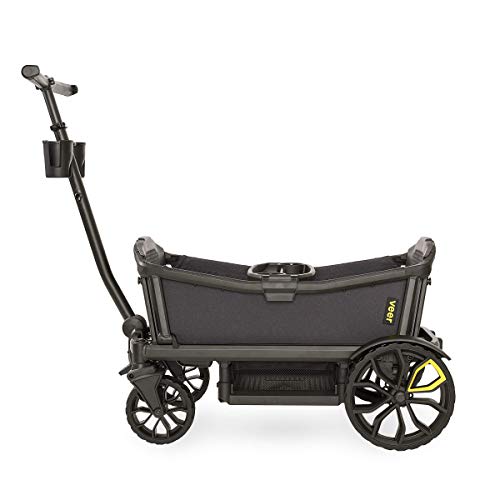
Veer All-Terrain Cruiser | Premium Off-Road Wagon Stroller for Babies, Toddlers, and Kids | Push/Pull/Push-Along Steering for Uneven Terrain | JPMA Certified | Lightweight and Collapsible | 2 Seats
- ALL-TERRAIN DURABILITY: Cruiser’s strength comes from a single-frame, patented wall system, robotic welds, and aircraft grade aluminum, with rugged oversized tires that can handle any terrain with ease whether sand, snow, or the little league field, as well as soft yet durable sidewalls that are water, stain, and fade resistant.
- LIGHTWEIGHT: Easily lift the 2-seat Cruiser into the trunk of your car at only 32.6 lbs., or 24.6 lbs. with the wheels removed—less than many single strollers.
- HOSE WASHABLE: All components are easy to clean and completely hose washable, from the frame to the fabric sidewalls.
New starting from: 699.00 $
Go to AmazonVeer Cruiser: Feature-by-Feature Honest Review
Terrain Performance — Where the Veer Is Genuinely Unmatched
★ BEST IN CLASS Terrain Performance Top score in KidTravel 65-test study, BabyGearLab, and multiple 11-month to 2+ year real family tests
In the KidTravel independent 65-test study — the most comprehensive stroller wagon comparison conducted — the Veer Cruiser scored 95 out of 100 for steering and maneuverability when pulled. It earned a perfect 10 on bumpy terrain.
In grass testing, it outperformed every competitor we evaluated.
During straight-line pushing trials, the wagon showed the least drift of any model in the study.
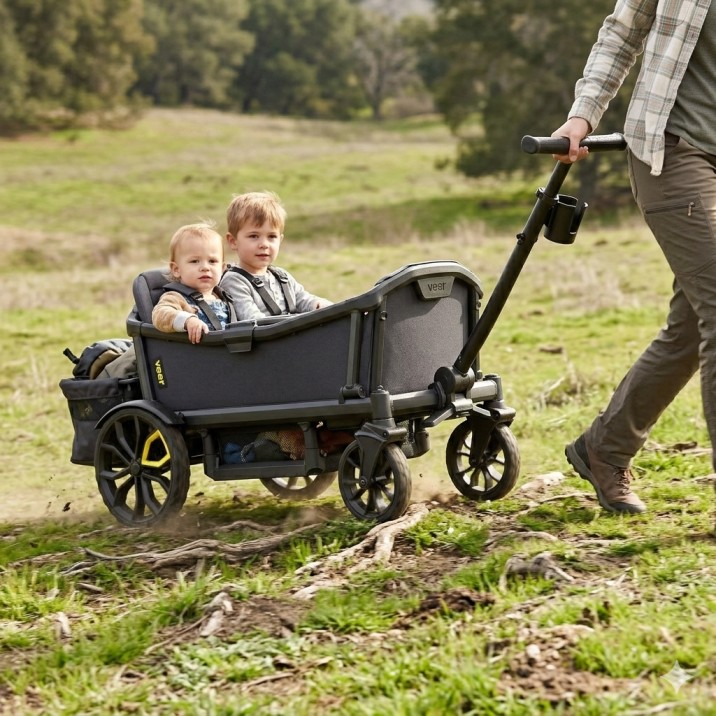
The engineering reason for this performance is the wheel placement philosophy. Most wagons place the smaller, swivel front wheels in front of travel direction and larger rear wheels behind. The Veer All-Terrain inverts this: larger wheels lead the way when the wagon is pushed forward, meaning the big wheels — not the small ones — encounter obstacles first and climb over them rather than catching on them. In practical terrain use, this means the Veer rolls over roots, rocks, kerb transitions, and surface changes that stop or jolt competing wagons.
After 11 months of testing in a real family context including cracked pavement, wonky kerbs, gravel, dirt, grass, and snow, one reviewer from Outside Online summarised it as handling every surface with ease. The independent 2+ year Fathercraft review similarly described the suspension and large wheels as providing a genuinely smooth ride — the kind of ride quality where children feel bumps significantly less than in competing wagons.
The honest beach caveat:
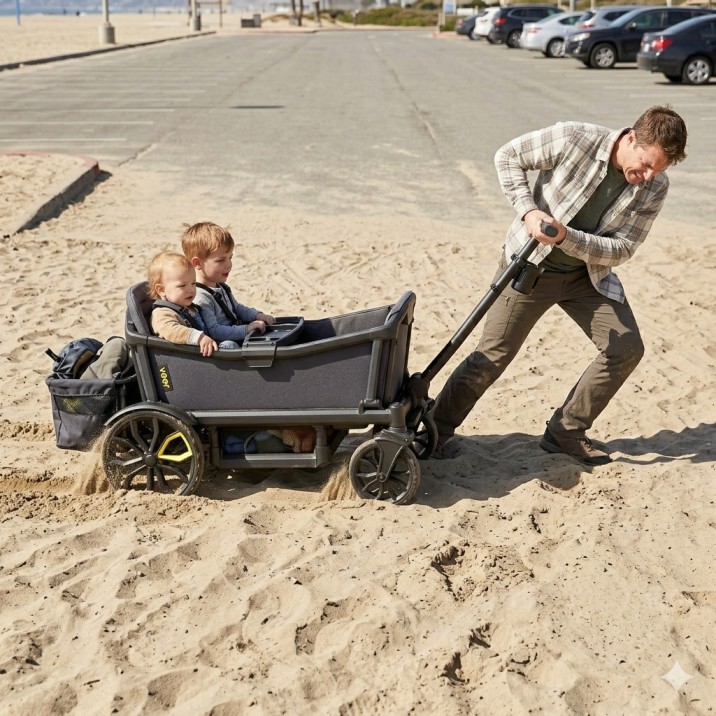
Multiple independent sources flag this clearly and it’s worth stating directly. The stock airless foam tires do not handle deep, loose beach sand without significant effort. On packed, wet sand near the waterline, the Veer manages fine. On dry, loose sand — the typical beach condition from the car park to your spot — you will struggle without the optional Beach Wheel Kit ($250 additional). This is not a minor accessory for regular beach families: it is an essential purchase that significantly changes the beach experience and meaningfully increases the true total cost.
| Terrain Test Category | Veer Cruiser Score | Category Average | What It Means |
|---|---|---|---|
| Overall Maneuverability | 95 / 100 Highest in 65-Test Study | ~70 / 100 | Outperformed every wagon tested |
| Bumpy Terrain | 10 / 10 Perfect Score | 7 / 10 | Leads all wagons — smooth even on rough paths |
| Grass (Flat) | Best in Class #1 Performer | Average | Glides over grass better than competitors |
| Straight-Line Push Drift | 17.2 ft Least Drift | 13.9 ft | Tracks straighter before veering — better control |
| Force to Start Moving | 11.0 lbs Lowest (Tied) | ~14 lbs | Easier to get rolling than most wagons |
| Force for 90° Turn | 15.4 lbs | ~26 lbs | Significantly easier to turn than average wagons |
| Deep Sand (Base Wheels) | Struggles | Struggles | Beach Wheel Kit ($250) required for soft sand performance |
Build Quality — The Best-Constructed Wagon in the Category
★ BEST IN CLASS Build Quality Aircraft-grade aluminum frame, robotic welds — described as ‘built like a tank’ after 2+ years of regular use
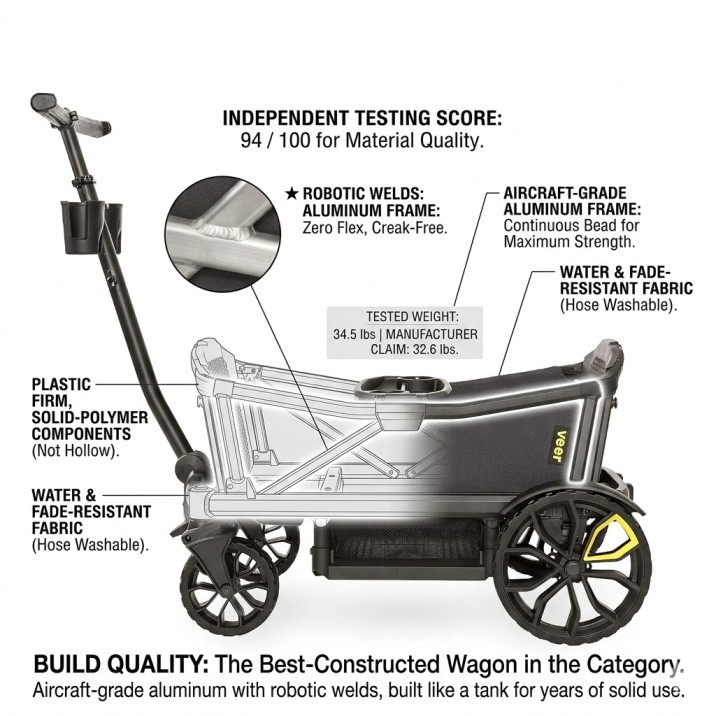
The Veer Cruiser scored 94 out of 100 for parts and material quality in independent testing — second only to the Graco Modes Adventure among all wagons tested. In the real-world, the Fathercraft review after 2+ years of regular use with two children described the aluminium frame as still feeling solid with no perceptible flex or wear.
Aircraft-grade aluminium with robotic welds is not marketing language here — it translates to a frame that doesn’t creak, twist, or show signs of fatigue under repeated loads. The plastic components are firm rather than hollow-feeling. The side fabric walls, while not padded, are water, stain, and fade resistant. The entire wagon — frame to fabric sidewalls — is hose washable, which matters considerably for families who use it in genuinely outdoor conditions regularly.
The one quality note from independent testing: the actual weight of the Cruiser measured 34.5 lbs in BabyGearLab’s testing versus the manufacturer’s stated 32.6 lbs. This isn’t a significant discrepancy but worth noting for families calculating vehicle loading weights precisely.
The Veer is notably hard to find second-hand — a meaningful proxy for real-world satisfaction. When families do sell, prices hold well above typical second-hand baby gear depreciation rates. Parents who buy them tend to keep them for the full duration of their children’s wagon years.
Folding and Transport — Compact, One-Hand, Self-Standing
✓ EXCELLENT Fold & Transport One-hand fold in under 20 seconds; fits MINI Cooper trunk; 32.6 lbs; stands upright — best fold in 2-seat category
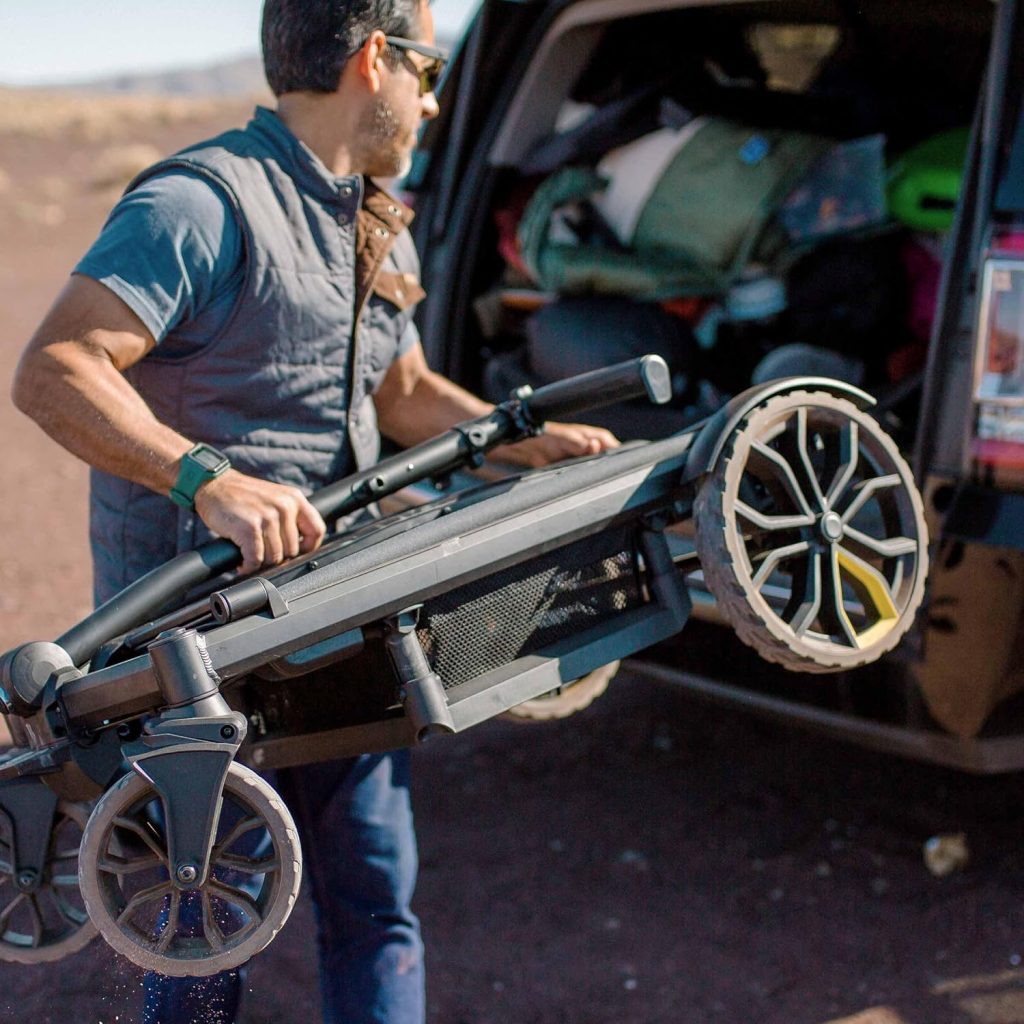
The Veer Cruiser folded in 20 seconds in independent testing — tied with the Evenflo Pivot Xplore for fastest fold among the wagons tested. Critically, the fold does not require canopy or accessory removal first, which saves the extra time that several competitors — including the Jeep Wrangler — require.
The folded dimensions of 37″ L x 24″ W x 14″ H (wheels on) fit in the trunk of a MINI Cooper in Veer’s own testing — a genuine benchmark for compact fold. For most families, this means the Veer fits in virtually any vehicle boot with room to spare. Removing the wheels brings the height down to 9 inches, making it even more compact for tight storage situations.
The wagon stands upright when folded and rolls on its wheels — meaning you can wheel it through a car park or hotel corridor rather than carrying it. For a wagon that weighs 32–34 lbs, this makes a meaningful difference in solo use.
The one genuine transport limitation is the handle height range of 38 to 42 inches — narrower than most competitors and shorter than several. Parents over 6 feet tall may find even the maximum handle height slightly low for comfortable pushing over extended distances. The 38-inch minimum also means shorter parents may find it less ergonomic when pulling in wagon mode. Multiple parent reviews from taller users flag back strain on longer outings.
Child Comfort — Footwell Excellent; Harness and Backrest Limited
Child comfort in the Veer Cruiser is a mixed picture, and being direct about the nuances here matters.
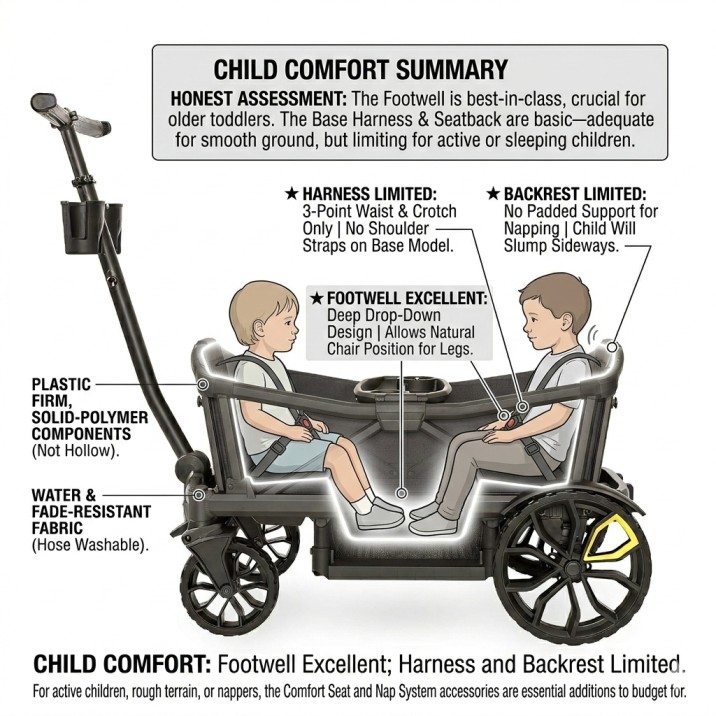
The footwell is a genuine standout. The drop-down footwell allows children to sit with legs bent in a natural chair position — one reviewer noted their 4-year-old’s legs were consistently hunched in a competing Radio Flyer wagon, but sat comfortably in the Veer. For children aged 2+ with longer legs, the footwell makes a significant difference in how long they sit without fidgeting. This is a feature that directly affects outing duration — children who are comfortable sit longer without requesting to get out.
The 3-point harness (waist and crotch, no shoulder straps) is the base model’s primary limitation for child safety. On flat, smooth terrain with well-behaved older toddlers, a 3-point harness is adequate. On rough terrain where the wagon pitches and rolls, or for very young children or active toddlers who lean aggressively, shoulder restraint provides meaningfully better containment. Veer sells a Comfort Seat accessory that adds a 5-point harness — but this is an additional purchase on top of an already expensive base product.
There is no back support for sleeping children in the standard seat configuration. The plastic seat ends and open fabric sides mean a child who falls asleep sitting upright will slump sideways with no cushioning. For napping toddlers, Veer’s Nap System accessory (sold separately) converts one or both seats into a bassinet — but again, this is an additional cost on an already premium-priced product.
Honest summary on child comfort:
The footwell is the best in the 2-seat wagon category. The base harness and seat back are adequate for children who sit cooperatively on smooth terrain. For rough terrain, very young children, or frequent nappers, the Comfort Seat and Nap System accessories are genuinely necessary additions — which means budgeting for them from the start.
Parent Usability — Strong on Fundamentals, Weak on Out-of-Box Accessories
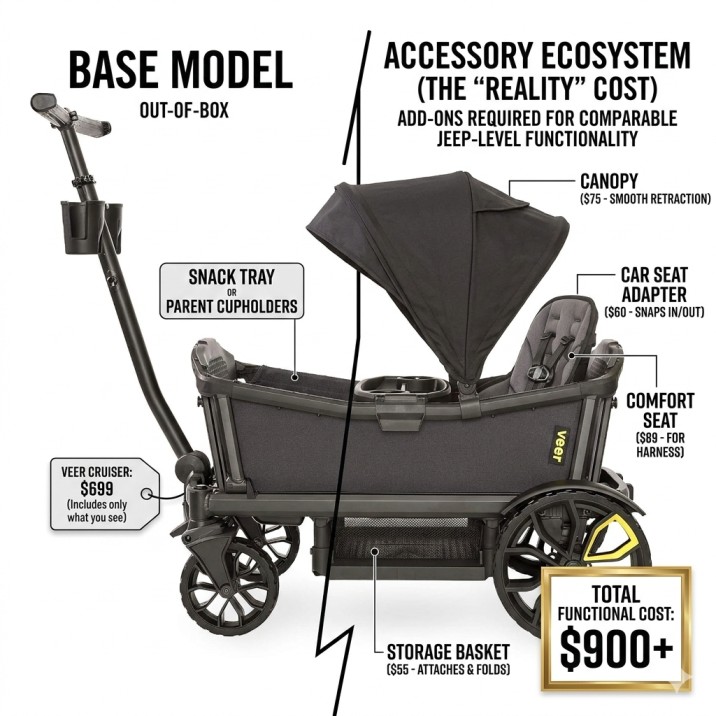
The Veer Cruiser scored 69 out of 100 for parent comfort and usability in the KidTravel independent study — placing it 6th of 9 wagons tested in this category. The reason is straightforward: the base model includes almost no storage or comfort accessories. No canopy, cooler bag, car seat adapter and Neither storage basket. You get the snack tray and parent cupholders — and that is it.
This is where the Veer’s premium price creates a particular tension. A Jeep Deluxe Wrangler at $300–$370 includes a canopy, cooler bag, car seat adapter, and comprehensive storage organisation. The Veer at $599–$699 includes none of these. To build a genuinely comparable feature set you need to add: canopy ($75–$85 each, up to 2), storage basket ($55–$65), car seat adapter ($60–$80), and optionally the Comfort Seat for 5-point harness ($89). That brings the Veer’s true functional cost to $900–$1,100+.
The case for accepting this: the Veer’s accessory ecosystem is exceptionally well-designed. Accessories snap in and out easily, feel solid in use, and are specifically engineered for the platform rather than being universal add-ons. The storage basket attaches to the front and folds with the wagon — unlike separate bags that must be removed for folding. The canopy extends and retracts smoothly. The system works. But you pay for the system, not just the base wagon.
Assembly time is the fastest tested — 13.5 minutes out of box. Customer service responded in 7 minutes in independent testing — also the fastest recorded. These operational details matter for day-to-day ownership quality.
Push vs Pull Mode — An Important Nuance Most Reviews Miss
This is one of the most important practical points about the Veer Cruiser and it deserves more space than most reviews give it.
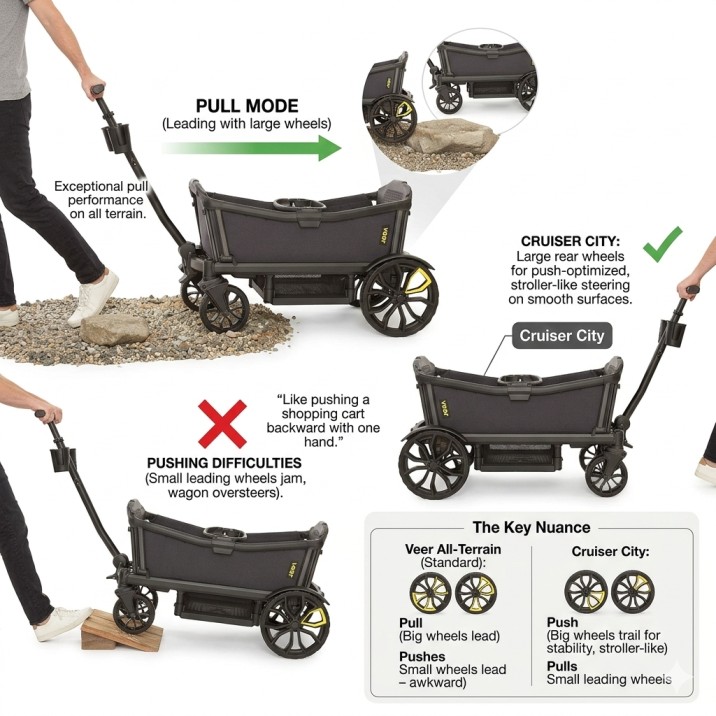
The Veer All-Terrain is designed primarily to be pulled. The larger wheels are on the side away from the handle — meaning when you pull the wagon, the big wheels lead and climb over obstacles first. In pull mode, the Veer is genuinely exceptional: smooth, easy to manoeuvre, and capable on any terrain.
When you push the Veer All-Terrain, the small swivel wheels are at the front of travel — which means they are what encounters obstacles first. The larger wheels, now at the back, create a rear-heavy bias that makes the wagon want to swing out on turns. Multiple independent reviewers flag pushing as genuinely awkward: one described it as similar to pushing a shopping cart backward with one hand. Another noted navigating tight turns was more difficult pushing than pulling.
This is precisely why Veer introduced the Cruiser City variant. The City reverses the wheel configuration — larger wheels at the handle side, smaller swivel wheels at the leading edge — making it steer like a traditional stroller when pushed on smooth surfaces. If you plan to push primarily (as most parents with stroller habits do), and your terrain is mostly smooth paths and city streets, the Cruiser City is the more intuitive choice.
| Mode | All-Terrain Cruiser | Cruiser City |
| Pulling over rough terrain | Excellent — big wheels lead, climb obstacles | Good — handles rough terrain in pull mode |
| Pushing on smooth surfaces | Awkward — small wheels lead, rear-heavy turns | Excellent — big wheels at handle, stroller-like |
| Urban tight spaces | Requires practice — turns take effort when pushed | Natural — pushes like a premium stroller |
| Trail/outdoor use | Best in class | Very good |
| Best use case | Outdoor trails, parks, mixed terrain | City, paths, indoor venues, smooth surfaces |
Veer Cruiser vs Cruiser City vs Cruiser XL vs City XL: Which Should You Buy?
Veer Cruiser (All-Terrain) — 2 Seats
Veer All-Terrain Cruiser | Premium Off-Road Wagon Stroller for Babies, Toddlers, and Kids | Push/Pull/Push-Along Steering for Uneven Terrain | JPMA Certified | Lightweight and Collapsible | 2 Seats
- ALL-TERRAIN DURABILITY: Cruiser’s strength comes from a single-frame, patented wall system, robotic welds, and aircraft grade aluminum, with rugged oversized tires that can handle any terrain with ease whether sand, snow, or the little league field, as well as soft yet durable sidewalls that are water, stain, and fade resistant.
- LIGHTWEIGHT: Easily lift the 2-seat Cruiser into the trunk of your car at only 32.6 lbs., or 24.6 lbs. with the wheels removed—less than many single strollers.
- HOSE WASHABLE: All components are easy to clean and completely hose washable, from the frame to the fabric sidewalls.
New starting from: 699.00 $
Go to AmazonThe original model. Best for families who use their wagon primarily outdoors on mixed terrain — parks, trails, beaches (with beach wheels), outdoor events. The large-wheel-at-front design means pulling over obstacles is genuinely effortless. Pushing on smooth surfaces is manageable with practice but less intuitive than the City model. Weight: 32.6 lbs. Capacity: 110 lbs (55 lbs/seat).
Veer Cruiser City — 2 Seats

Veer Cruiser City | Premium Urban Wagon Stroller for Babies, Toddlers, and Kids | Traditional Stroller Push Steering | JPMA Certified | Lightweight and Collapsible | 2 Seater
- RUGGED DURABILITY: Cruiser City’s strength comes from a single-frame, patented wall system, robotic welds, and aircraft grade aluminum, with rugged oversized tires. Soft yet durable sidewalls are water, stain, and fade resistant.
- LIGHTWEIGHT: Easily lift the 2-seat Cruiser City into the trunk of your car at only 32.6 lbs., or 24.6 lbs. with the wheels removed—less than many single strollers.
- HOSE WASHABLE: All components are easy to clean and completely hose washable, from the frame to the fabric sidewalls.
New starting from: 699.00 $
Go to AmazonThe urban variant. Identical specs and dimensions to the All-Terrain — the sole difference is reversed wheel configuration (larger wheels now nearest the handle) and a slightly lighter graphite frame. Pushes like a premium stroller on smooth surfaces with genuine ease. Still handles rough terrain in pull mode. For families who spend most of their wagon time on city paths, smooth park paths, and indoor venues — this is the more natural choice. Weight: 32.6 lbs. Price: similar to All-Terrain.
One important note: the storage basket accessory for the All-Terrain is NOT compatible with the Cruiser City. All other accessories are cross-compatible.
Veer Cruiser XL — 4 Seats

Veer All-Terrain Cruiser XL | Premium Off-Road Wagon Stroller for Babies, Toddlers, and Kids | Push/Pull/Push-Along Steering for Uneven Terrain | JPMA Certified | Lightweight and Collapsible | 4 Seats
- ALL-TERRAIN DURABILITY: Cruiser XL’s strength comes from a single-frame, patented wall system, robotic welds, and aircraft grade aluminum, with rugged oversized tires that can handle any terrain with ease whether sand, snow, or the little league field, as well as soft yet durable sidewalls that are water, stain, and fade resistant.
- LIGHTWEIGHT: Easily lift the 4-seat Cruiser XL into the trunk of your car at only 36.7 lbs., or 28.7 lbs. with the wheels removed—less than many double strollers.
- HOSE WASHABLE: All components are easy to clean and completely hose washable, from the frame to the fabric sidewalls.
New starting from: 799.00 $
Go to AmazonThe 4-seat version of the All-Terrain. Remarkably, it weighs only 4 lbs more than the 2-seat model (36.7 lbs vs 32.6 lbs) and is only 4 inches wider. It doubles the passenger capacity to 220 lbs (55 lbs per seat x 4) while maintaining the same compact fold. For families with 3–4 children who want outdoor performance, this is the 4-seat benchmark. The All-Terrain XL is approximately 38% lighter than competing 4-seat wagons. Folds to fit any full-size vehicle boot.
Veer Cruiser City XL — 4 Seats

Veer Cruiser City XL | Premium Urban Wagon Stroller for Babies, Toddlers, and Kids | Traditional Stroller Push Steering | JPMA Certified | Lightweight and Collapsible | 4 Seater
- RUGGED DURABILITY: Cruiser City XL’s strength comes from a single-frame, patented wall system, robotic welds, and aircraft grade aluminum, with rugged oversized tires. Soft yet durable sidewalls are water, stain, and fade resistant.
- LIGHTWEIGHT: Easily lift the 4-seat Cruiser City XL into the trunk of your car at only 36.7 lbs., or 28.7 lbs. with the wheels removed—less than many double strollers.
- HOSE WASHABLE: All components are easy to clean and completely hose washable, from the frame to the fabric sidewalls.
New starting from: 799.00 $
Go to AmazonThe urban 4-seater. Same all-around benefits as the Cruiser City but with 4 seats. The push-friendly large-wheel-at-handle configuration makes navigating a 4-seat wagon in urban environments significantly easier than the All-Terrain XL configuration would. For city families with multiple children who want the Veer quality without fighting the push-mode wheel bias, this is the correct choice.
| Your Situation | Best Veer Model |
| Outdoor trails, parks, mixed terrain — 2 children | Veer Cruiser (All-Terrain) |
| City streets, smooth paths — 2 children | Veer Cruiser City |
| Outdoor trails, parks — 3 or 4 children | Veer Cruiser XL |
| City streets, smooth paths — 3 or 4 children | Veer Cruiser City XL |
| Beach use as primary environment | Any Veer + Beach Wheel Kit ($250) essential |
| Budget-conscious — want Veer quality at lower price | Consider Veer Cruiser All-Terrain as base, add accessories gradually |
The Veer Accessory Ecosystem: What You’ll Actually Need and What It Costs
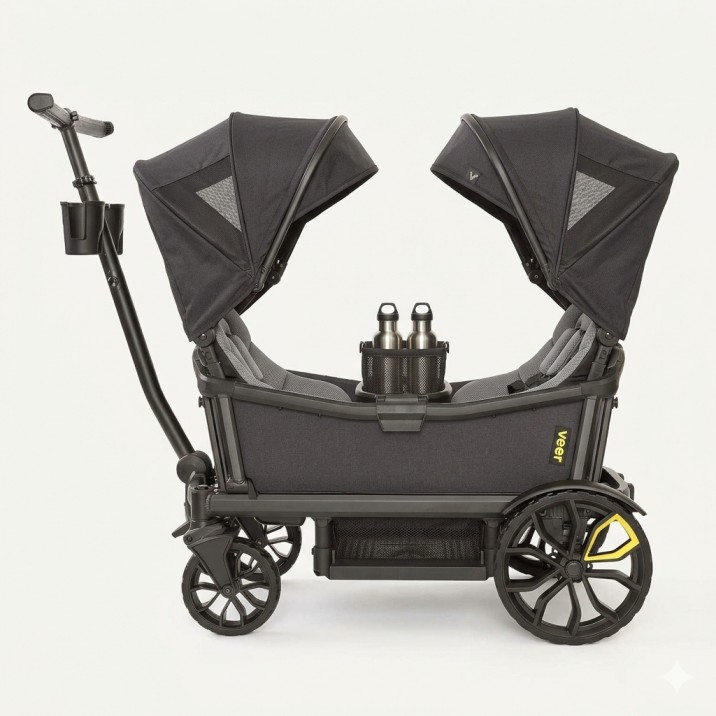
This section is one of the most important in this review and one that most competitors skim. The Veer Cruiser’s true cost depends entirely on which accessories you add — and several of them are not optional if you want a fully functional daily wagon.
| Accessory | Why You Need It | Essential? | Price (USD) |
|---|---|---|---|
| Retractable Canopy | Sun protection — no shade without it; fits up to 2 | YES (Most Families) | ~$75–$85 each |
| Storage Basket | Cargo hauling — base model has almost no storage | YES (Daily Use) | ~$55–$65 |
| Car Seat Adapter | Required for infants under ~6 months; compatible with major brands | YES (With Newborn) | ~$60–$80 |
| Comfort Seat (5-Point Harness) | Adds 5-point harness + padding + back support | YES (Under 2 Years) | ~$89 |
| Nap System (Bassinet) | Converts wagon into JPMA-certified infant bassinet | YES (Infant Use) | ~$89–$99 |
| Bug Shield | Insect protection — pairs with canopy | Situational | ~$35–$45 |
| Beach Wheel Kit | Required for deep sand performance — stock wheels struggle | YES (Beach Families) | ~$250 |
| All Weather Cover | Rain & wind protection for children | Situational | ~$55–$65 |
| Switchback Seat | Premium multi-use seat — fits Veer strollers, joggers & bikes | Optional Upgrade | ~$399 |
True total cost for a fully-featured Veer Cruiser: Base wagon ($650) + 2 canopies ($160) + storage basket ($60) + Comfort Seat ($89) = USD $959 minimum. Add the Beach Wheel Kit for beach families (+$250) and you’re at $1,209. This is not a criticism — the accessories are genuinely well-designed and the system works — but it needs to be stated clearly so buyers don’t experience sticker shock after purchasing the base wagon.
Veer Cruiser: Full Pros and Cons
- #1 terrain performance in independent testing
- Aircraft-grade aluminum — built to last years
- One-hand fold in 20 seconds — fits MINI Cooper trunk
- Lowest straight-line veer/drift in testing
- Best bumpy terrain score — large wheels clear obstacles
- Drop-down footwell — natural chair-seated position
- Front suspension for smoother ride
- Fully hose washable — including frame
- One-touch toe-friendly foot brake
- JPMA certified — meets ASTM, SOR, EN 1888.2
- Fastest assembly (13.5 min) + fastest customer service response
- Stands upright when folded — easy in parking lots
- Compatible with major infant car seat brands
- Canopy, storage basket & car seat adapter sold separately
- True cost with essentials: $900–$1,100+
- 3-point harness standard — 5-point requires $89 accessory
- Handle range 38–42″ — too low for very tall parents
- Push mode awkward on turns (All-Terrain model)
- No back support for naps without Nap System accessory
- Deep sand requires $250 Beach Wheel Kit
- Very limited storage in base model
- 4-seat XL still pricey vs competing 4-seaters
- Weight measured 34.5 lbs vs claimed 32.6 lbs
- Accessory ecosystem gets expensive quickly
- Not permitted at Disney or many theme parks
- Urban maneuverability can frustrate in tight spaces
Veer Cruiser vs the Competition
Veer Cruiser vs Wonderfold W2 Elite
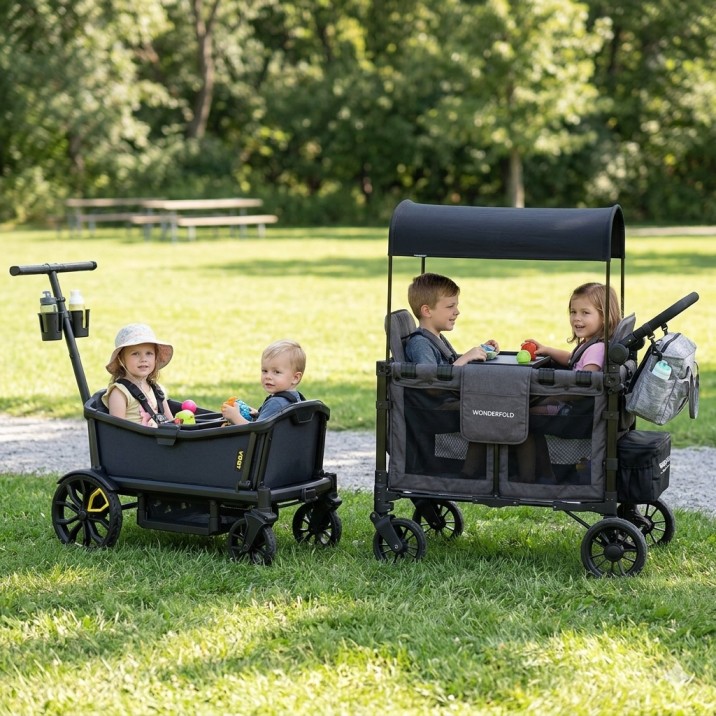
The Wonderfold W2 Elite is the most direct premium competitor. It offers 200 lbs total capacity (100 lbs/seat vs Veer’s 55 lbs/seat), independent reclining seats, a 5-point harness standard, and a comprehensive accessories package all included in the base price ($380–$450). For families whose primary use is flat terrain with children under 5, the W2 Elite delivers a more complete out-of-box experience at a lower price.
The Veer wins on terrain performance (significantly), build quality feel, fold compactness, and push weight on smooth surfaces. The W2 Elite wins on included accessories, per-seat weight capacity, reclining seats, and harness quality in the base model.
Choose the Veer if: Terrain performance is your priority and you’re willing to build the accessory set separately. Choose the Wonderfold W2 Elite if you want the most complete out-of-box wagon with the highest weight capacity at a lower total cost.
Full Wonderfold details in our Best Stroller Wagons for Toddlers guide.
Veer Cruiser vs Jeep Deluxe Wrangler
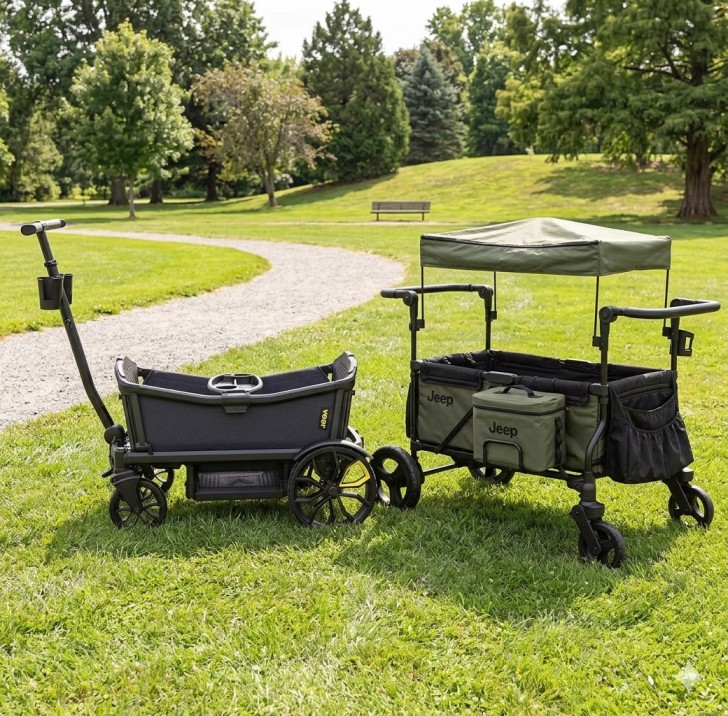
The Jeep Deluxe Wrangler scored lowest on maneuverability in the same independent study where the Veer scored highest. The Veer costs approximately $300 more in base price but includes far less in the box (the Jeep includes cooler bag, car seat adapter, mosquito netting, and canopy). The Veer’s build quality, terrain performance, and fold convenience are in a different league from the Jeep.
Choose the Veer if: Performance and build longevity matter. Choose the Jeep if accessories and value in the box matter more than performance.
Full Jeep Wrangler review: see our Jeep Wrangler Stroller Wagon review.
Veer Cruiser vs Evenflo Pivot Xplore
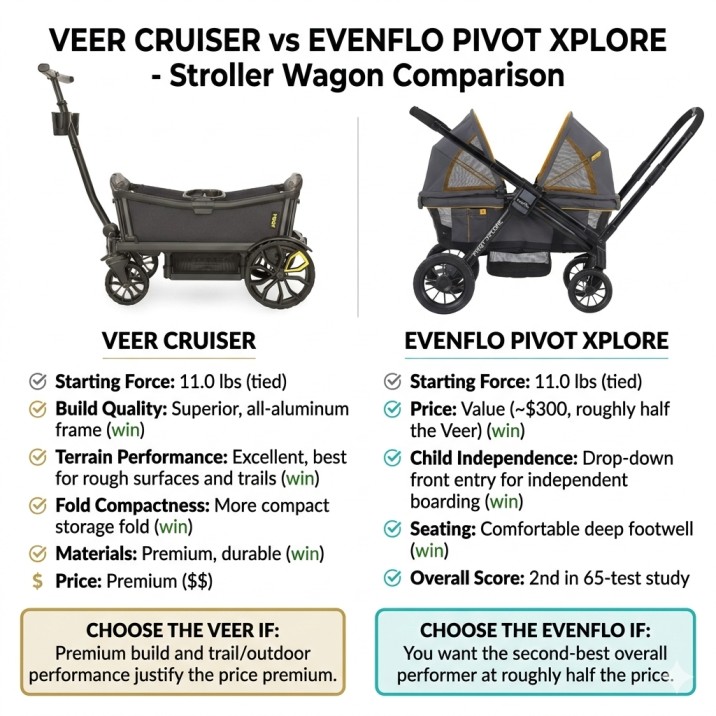
The Evenflo Pivot Xplore scored second in the same 65-test study at approximately half the price ($280–$330). It tied the Veer on starting force (11.0 lbs each), has the drop-down front entry for independent child boarding, and a footwell for comfortable seating. The Veer wins on build quality, terrain performance on rough surfaces, fold compactness, and premium materials.
Choose the Veer if: Premium build and trail/outdoor performance justify the price premium for your family. Choose the Evenflo if you want the second-best overall performer at roughly half the price.
Who Should Buy the Veer Cruiser?
The Veer Cruiser Is the Right Choice If:
- You spend significant time on genuinely varied outdoor terrain — trails, rough park paths, mixed surfaces, transition zones between pavement and grass
- You want one wagon that lasts 5–8 years without frame fatigue, cosmetic wear, or functional degradation
- You have a compact vehicle — the Veer’s fold is the most compact in the premium category
- You push and pull regularly and understand that the All-Terrain model is pull-optimised (or you choose the City model for push priority)
- You are comfortable building the accessory set gradually — starting with the base wagon and adding canopy, basket, and comfort seat over time
- You have two children between 6 months and 7+ years — the 55 lbs/seat limit accommodates bigger children longer than many competitors
Consider a Different Wagon If:
- Budget is a primary constraint — the true functional cost of $900–$1,100+ is significantly higher than alternatives that include accessories in the base price
- Your children are under 6 months and you need an immediate infant solution — the car seat adapter and Nap System are both additional purchases
- Deep sand beach use is a regular priority — the stock wheels struggle and the Beach Wheel Kit adds $250 to the total
- You visit Disney parks or similar venues that prohibit wagons
- You want a 5-point harness standard without additional purchase
- You primarily push (stroller mode) on smooth city streets — the Cruiser City solves this, but note it’s the same price as the All-Terrain
Real-World Scenarios: Where the Veer Excels and Where It Struggles
Scenario 1: Weekend Trail Walk with Two Toddlers
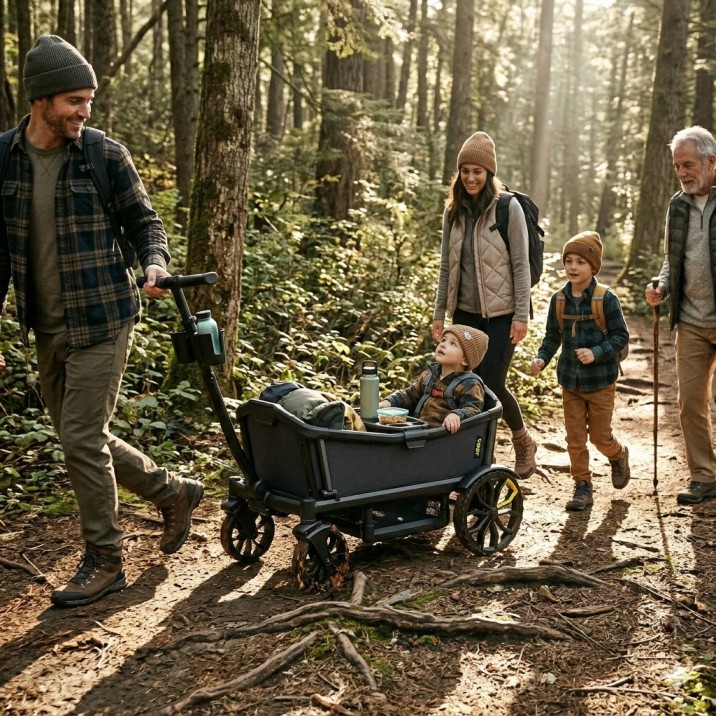
This is the Veer Cruiser’s optimal environment. Packed dirt paths, grass transitions, occasional roots and rocks, gentle inclines — the large lead wheels roll over every obstacle effortlessly in pull mode. Parents who do this regularly consistently report the Veer turns a previously effortful outing into an enjoyable one. No other 2-seat wagon in the market handles this scenario as competently.
Scenario 2: Daily City Use — Dropping Off at Nursery

For the All-Terrain model, daily city use involving pushing, tight turns on footpaths, and navigating narrow shop doors requires adaptation. The push-mode awkwardness is noticeable on sharp turns and in tight spaces. This is precisely why Veer introduced the Cruiser City — the reversed wheel configuration makes daily city pushing feel natural and stroller-like. If city daily use is your primary scenario, order the City variant, not the All-Terrain.
Scenario 3: Beach Holiday
Without the Beach Wheel Kit, the Veer handles firm beach sand (near the waterline) acceptably but struggles in the dry, loose sand you’ll encounter from the car park to the water. With the Beach Wheel Kit installed, it is the best beach wagon available. Budget the $250 for the kit if beach use is regular — it is not an optional add-on for serious beach families, it is a required component.
Scenario 4: Long Zoo Day with a Newborn and a 3-Year-Old
With the car seat adapter and Nap System for the newborn, plus the Comfort Seat for the 3-year-old to provide a 5-point harness, the Veer Cruiser handles this mixed-age scenario very well. Zoo paths are smooth enough that the All-Terrain model’s push-mode behaviour is manageable. The compact fold handles the car park easily. The total cost for this setup is approximately $950–$1,050 before the canopies — plan accordingly.
Frequently Asked Questions
Is the Veer Cruiser stroller wagon worth it?
For the right family — yes, significantly. If outdoor terrain performance, long-term build durability, and compact fold are your priorities, nothing else in the market matches the Veer Cruiser. The caveat is total cost: with the canopy, storage basket, and Comfort Seat, you’re looking at $900–$1,100+. Families who use the wagon 3–5 times per week in outdoor environments consistently report it as one of the best baby gear purchases they made. Occasional users find it harder to justify over alternatives that include accessories at lower prices.
What is the difference between the Veer Cruiser and Veer Cruiser City?
They are virtually identical in specs and dimensions — weight, capacity, fold, and accessory compatibility are the same. The one difference is wheel configuration. The All-Terrain has larger wheels at the front of travel (away from handle), making it pull-optimised for rough terrain. The City has larger wheels at the handle side, making it push-optimised for smooth city surfaces like a traditional stroller. Same price. Choose based on your primary use environment.
What is the difference between the Veer Cruiser and Veer Cruiser XL?
The XL seats 4 children instead of 2, is 4 inches wider, and weighs 4 lbs more (36.7 lbs vs 32.6 lbs). Passenger capacity doubles from 110 lbs to 220 lbs (55 lbs x 4 seats). Both fold to similar compact dimensions and fit in standard vehicle boots. Price difference is approximately $150. For families with 3–4 children, the XL represents exceptional value given how little it adds in weight and size for double the seating.
Does the Veer Cruiser work at the beach?
On firm, packed sand near the waterline — yes. On loose, dry beach sand — no, not adequately. The stock polyurethane foam tires dig into loose sand and require significant pushing effort. The Beach Wheel Kit ($250, sold separately) transforms beach performance dramatically. For families who do regular beach trips, the Beach Wheel Kit is not optional — budget for it from the start.
Is the Veer Cruiser allowed at Disney parks?
No. Disney parks prohibit all wagons in their theme parks. This applies to the Veer Cruiser regardless of model. For Disney and similar theme park visits, a traditional stroller within the park’s size guidelines is required.
Does the Veer Cruiser come with a canopy?
No. The base Veer Cruiser does not include a canopy. The Retractable Canopy is sold separately at approximately $75–$85 each. You can fit up to two canopies on the Cruiser simultaneously, one per seat position. This is one of the most commonly flagged post-purchase surprises — factor the canopy cost into your purchase decision from the start.
What harness does the Veer Cruiser use?
The base Veer Cruiser includes a 3-point harness (waist and crotch) on each seat. For a 5-point harness with shoulder straps, the Veer Comfort Seat accessory (sold separately, approximately $89) provides this along with additional padding and back support. For children under 2 or active toddlers on rough terrain, the Comfort Seat is a recommended addition.
How does the Veer Cruiser fold?
The Veer Cruiser folds with one hand in approximately 20 seconds without removing the canopy or accessories. The fold sequence involves folding down the seatbacks and sidewalls, collapsing the footwell, and optionally removing the wheels for maximum compactness. Folded, it stands upright on its own and rolls on the wheels, making it easy to move through a car park. It fits in the trunk of a MINI Cooper with wheels attached.
Final Verdict: Should You Buy the Veer Cruiser?
The Veer Cruiser earned the top score in the most rigorous independent stroller wagon test conducted — 65 tests across 9 competing products — and has maintained that position across multiple subsequent real-family and independent reviews spanning 11 months to 2+ years of use. The terrain performance, build quality, and fold engineering are genuinely best-in-class.
The case against it is equally clear: the base wagon is expensive, and the accessories needed to make it fully functional push the true cost to $900–$1,100+ before the optional beach wheels. A Jeep Wrangler or Baby Trend Expedition includes a canopy, cooler bag, car seat adapter, and storage in the box for $300–$370 total. The Veer gives you a better product — but demands that you invest in it to get there
If you want an accessible, well-equipped wagon for flat terrain and weekend outings at a fair all-in price, the Wonderfold W2 Elite delivers more value in the box at a lower total spend. That is not a criticism of the Veer — it is an honest acknowledgment that the right product depends entirely on how you actually use it.
Compare all top-rated stroller wagons in our Best Children’s Wagon Stroller guide, or explore terrain-specific recommendations in our Best All-Terrain Outdoor Wagons guide.